The Automated Murder Mystery Game® format developed through an extended process of applied research, technical development, software engineering, testing, standardization, publication, and commercialization.
This record documents the principal milestones in that development process and explains the relationship between the research program and the resulting technical architecture and commercial products.
A Note on the Historical Record
The available documentary record does not establish a single precise date on which the idea for the Automated Murder Mystery Game® format was first conceived. The format evolved over time through research, experimentation, technical development, testing, and refinement.
Accordingly, this record does not assign an unsupported invention date.
Instead, the chronology begins with the earliest documented research milestone and follows the development of the format through technical implementation, formal standardization, research publication, First Commercial Use, and subsequent intellectual property registration.
The Development Model
The Automated Murder Mystery Game® format was not developed through a process in which a finished entertainment product was created first and research was added afterward.
Applied research was conducted as part of the development process.
Research → Findings → Standards → Engineering → Product → Observation → Further Research
Each stage has a distinct function.
Research
Research begins with a technical, architectural, experiential, or operational question arising from the development of automated social entertainment.
Examples include:
How can human hosting functions be replaced by software?
How can shared narrative information coexist with private character information?
How can participants remain synchronized?
How can pacing remain consistent without a human facilitator?
How can an organizer participate without acquiring information advantages?
Findings
Research produces observations, models, relationships, constraints, or principles that help answer the research question.
The AMMG research record includes concepts and frameworks such as:
Bimodal Information Distribution (BID)
Facilitation Latency (Lf)
Central Narrative Node (CNN)
Peripheral Participant Node (PPN)
Standards
Where findings are sufficiently developed, Mystery Enterprises® formalizes them into technical standards, architectural definitions, performance criteria, or design requirements.
Engineering translates standards and requirements into software architecture, system behavior, technical specifications, and implementation requirements.
This includes functions such as information distribution, game-state management, synchronization, automated clue delivery, timing, authentication, and voting.
Product
Engineering becomes the participant-facing commercial experience.
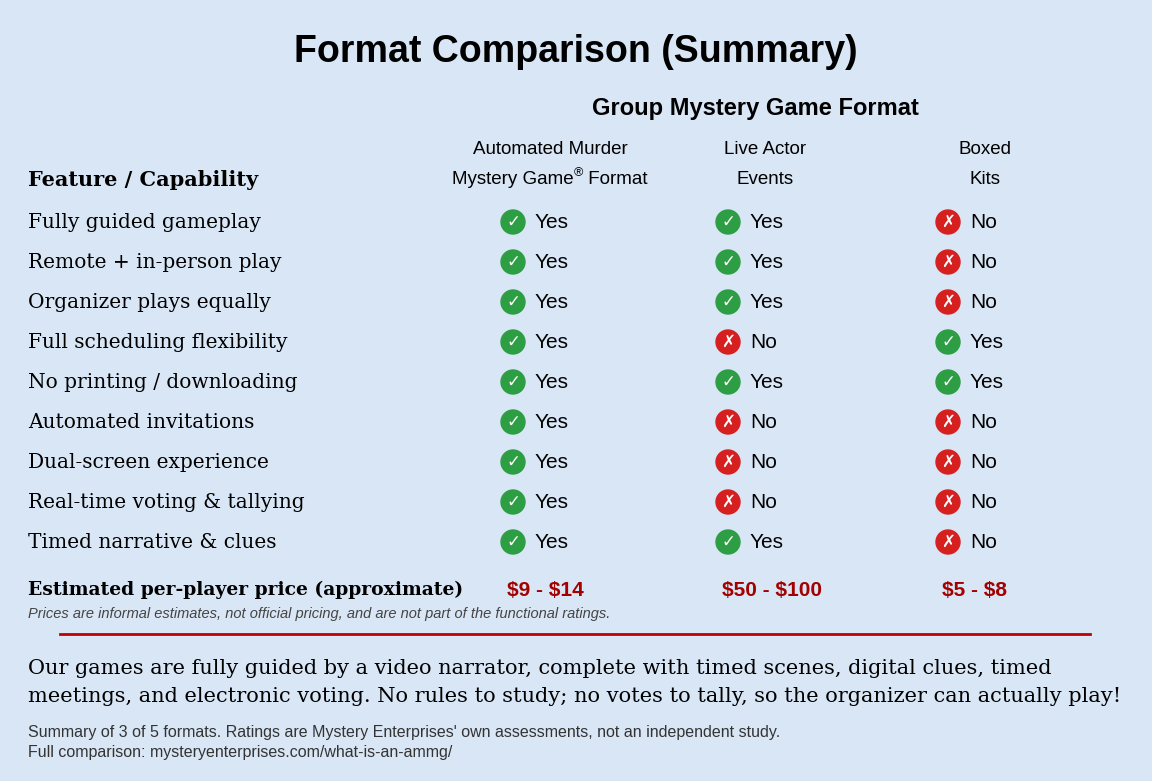
In an Automated Murder Mystery Game®, the shared display delivers the narrative while individual participant devices deliver private information and interaction. Software controls the operational functions traditionally performed by a human host.
Observation
Testing and product operation provide opportunities to observe technical performance, participant interaction, usability, pacing, synchronization, and information flow.
These observations can generate new questions and begin another research cycle.
This distinction is important. Not every engineering decision is a research finding, and not every product feature is itself a research result. The research identifies questions and produces findings. Standards formalize appropriate findings into requirements. Engineering determines how those requirements are implemented. Products provide the resulting participant experience.
Chronological Development Record
May 15, 2025 | Applied Research Begins
The documented development record places the beginning of formal research work on the developing Automated Murder Mystery Game® format on May 15, 2025.
The research addressed problems associated with creating a social mystery experience in which traditional human facilitation could be replaced by software while maintaining narrative progression, participant interaction, information control, and coordinated gameplay.
May 15, 2025 is used as the beginning of the documented research chronology. This date is used instead of a date representing the original conception of the format, because the concept grew gradually over time.
The research therefore forms an important part of the documented development history of the format.
June 24, 2025 | Technical Infrastructure Becomes Operational
Website infrastructure supporting the developing automated gameplay system became operational on June 24, 2025, as documented in the First Commercial Use Record.
This represented a transition from research and conceptual development toward implementation of the technical environment required to deliver an automated interactive experience.
The infrastructure provided a foundation for subsequent software development and testing.
July 7, 2025 | Game WebApp Development Begins
Development of the game WebApp began on July 7, 2025.
This marked the beginning of the software implementation phase of the project.
The WebApp provided the technical environment through which the developing architecture could deliver individualized participant information, manage gameplay states, coordinate interaction, and support automated progression.
Software development therefore became a direct implementation stage within the broader research and development process.
November 16, 2025 | Live System Testing Begins
Live system testing began on November 16, 2025.
Testing allowed the developing system to be evaluated under live gameplay conditions and provided opportunities to identify implementation requirements, operational issues, and areas requiring further refinement.
The testing period forms part of the development process connecting the research and architectural framework to the working software system.
The historical record does not treat this testing milestone as proof that every technical concept was independently validated as a research finding. Specific research conclusions remain tied to their respective research records.
January 2026 | Formal Standardization and Public Research Record
January 2026 represents a major transition in the development of the Automated Murder Mystery Game® format.
The developing system moved into a period of formal standardization and public technical documentation through the publication of global standards, the AMMG Technical Standard, the establishment of the OSF research record, the initial GitHub technical release, and the SSRN research record.
These activities formalized the relationship between the research and the technical architecture.
The publication established a formal standards framework for the Automated Murder Mystery Game® format.
The standards define the functional characteristics that distinguish the proprietary format from hosted, hybrid, app-assisted, manual, downloadable, or other murder mystery experiences.
The publication marked a significant transition from a developing system to a formally documented entertainment format.
The paper was entered into the SSRN record on January 21, 2026 and published on SSRN on February 10, 2026.
January 15, 2026 | AMMG Technical Standard Published
The AMMG Technical Standard was published on the Mystery Enterprises® website on January 15, 2026.
The Technical Standard provides the technical record for the architecture underlying the Automated Murder Mystery Game® format.
It documents concepts and requirements associated with automated gameplay, including information distribution, synchronized gameplay, automated facilitation, and the relationship between shared and private participant environments.
The publication established a public technical reference for the architecture being developed and implemented by Mystery Enterprises®.
January 20, 2026 | OSF Research Project Established
A research project associated with the AMMG technical and architectural work was established on the Open Science Framework (OSF) on January 20, 2026.
The OSF project provides a public research and documentation environment for supporting materials associated with the AMMG research record.
The project is identified by DOI 10.17605/OSF.IO/BYX6F.
January 21, 2026 | Initial Technical and Research Records Established
Several significant public research and technical records were established on January 21, 2026.
GitHub Technical Release
The initial GitHub release of the AMMG Technical Standard was established as version 1.0.0.
The repository provides a version-controlled technical record of the standard and associated architectural documentation.
This provided a persistent identifier for the associated research and documentation record.
January 29, 2026 | Architectural Mapping Formalized
The architectural relationship between the Central Narrative Node (CNN) and Peripheral Participant Nodes (PPN) was formally documented on January 29, 2026.
The CNN represents the shared narrative environment, while PPNs represent individualized participant interfaces.
Together, these components describe the architectural separation between public narrative information and private participant information within the Bimodal Information Distribution framework.
February 2026 | Research Publication and Commercial Transition
February 2026 marked the transition from formal research and technical standardization toward commercial implementation.
The research record documents the architectural framework associated with the Automated Murder Mystery Game® format and its Bimodal Information Distribution architecture.
The publication established a publicly searchable research record for the architectural work.
The SSRN publication forms one component of the broader public research record maintained alongside the OSF project, GitHub technical repository, and Mystery Enterprises® standards documentation.
February 10, 2026 | Technical and Legal Documentation Synchronized
Technical documentation was further synchronized on February 10, 2026 with trademark attribution and other intellectual property documentation.
By this point, the AMMG research and technical record consisted of interconnected:
research documentation
technical standards
architectural documentation
version-controlled specifications
persistent research identifiers
intellectual property documentation
February 27, 2026 | First Commercial Use
First Commercial Use
February 27, 2026 marks the First Commercial Use of the Automated Murder Mystery Game® designation by Mystery Enterprises®.
On this date, the system was activated and public purchase was enabled, commencing commercial availability of the format through the Mystery Enterprises® platform.
Beginning February 27, 2026, Mystery Enterprises® commenced continuous use in commerce of the Automated Murder Mystery Game® designation, transitioning the format from pre-commercial testing to active commercial availability.
The First Commercial Use Record maintained by Mystery Enterprises® identifies February 27, 2026 as the date of first Use in Commerce of the Automated Murder Mystery Game® designation.
The commercial availability trigger consisted of system activation and public purchase enablement on February 27, 2026.
Commercial deliverables at First Commercial Use included monetized consumer access through the proprietary platform, public product listings, the dual-screen architecture, automated facilitation, pacing and narrative resolution, automated voting, and system-controlled gameplay progression.
The First Commercial Use therefore represents the documented transition from pre-commercial development and testing into active commercial availability of the Automated Murder Mystery Game® format.
2026 | Continued Research, Engineering, and Product Development
Commercial availability did not mark the end of the research and development process.
The Applied Research Cycle is continuous. Product operation and engineering experience can generate new observations and questions, which can lead to additional research and technical development.
April 15, 2026 | Cybersecurity and Data Integrity Deployment
Cloudflare Turnstile and custom firewall rules were deployed on April 15, 2026 to address registration bot activity and protect proprietary user data.
This represents an operational security development associated with the commercial platform.
It is documented here as an engineering and operational milestone rather than as a new research finding.
The article provides a technical deep dive into the relationship among:
Bimodal Information Distribution
Facilitation Latency
Central Narrative Nodes
Peripheral Participant Nodes
Organizer Parity
Persistent Observer State
automated gameplay
real-time synchronization
research, standards, engineering, and product implementation
The article explicitly distinguishes research-level concepts from engineering implementation decisions.
It describes the research-to-engineering chain as:
Research / Conceptual Framework → Technical Standard → Engineering → Product
This publication therefore extends the public technical record established through the research publications and technical standards.
September 2026 | Federal Trademark Registrations
The formal legal protection associated with the company and format was completed through federal trademark registrations during September 2026.
September 15, 2026 | Word Mark Registrations
The Mystery Enterprises® and Automated Murder Mystery Game® word marks were federally registered with the United States Patent and Trademark Office on September 15, 2026. Official records: U.S. Reg. No. 8445368 and U.S. Reg. No. 8445382.
The registrations represent a legal development separate from the research and technical standardization process, but form part of the subsequent formalization of the commercial identity associated with the format.
September 29, 2026 | Design Mark Registered
The Mystery Enterprises® / Automated Murder Mystery Games® design mark was successfully registered with the United States Patent and Trademark Office on September 29, 2026. Official record: U.S. Reg. No. 8468129.
This completed the federal registration of the design mark associated with the Mystery Enterprises® and Automated Murder Mystery Games® brand identity.
The design mark registration is documented separately from the September 15 word mark registrations because it occurred on a different date.
The Research That Informed the Architecture
The development history is important not simply because research occurred before commercialization, but because the research addressed problems that arose directly from the objective of creating a fully automated social mystery experience.
These concepts were subsequently documented and formalized through the technical standards.
The resulting standards then provided a framework for engineering implementation.
This is the central relationship between the research record and the commercial format.
Bimodal Information Distribution
Bimodal Information Distribution describes the separation of gameplay information between a shared narrative environment and individualized participant environments.
Within the architecture:
Central Narrative Node (CNN) The shared display environment presents public narrative content, professional narration, story progression, and global gameplay transitions.
Peripheral Participant Nodes (PPN) Individual participant devices deliver private character information, clues, objectives, voting functions, and other participant-specific information.
This architecture allows public narrative progression and private participant information to operate simultaneously within a synchronized gameplay environment.
The BID framework is therefore directly related to the defining dual-screen structure of the Automated Murder Mystery Game® format.
Facilitation Latency
Facilitation Latency (Lf) is a research and technical concept used to describe delay associated with facilitation and game-state transitions.
The refined model documented in the technical record is:
Lf = Td + Tc + Ts
where:
Td = decision latency
Tc = communication latency
Ts = synchronization latency
The concept addresses a fundamental problem in automated social entertainment: how to coordinate narrative state transitions across participants without relying upon the responsiveness of a human facilitator.
The equation represents a research and technical model. It should not be interpreted as a measured result from a particular commercial gameplay session unless the corresponding measurement study is separately documented.
Organizer Parity
Organizer Parity is the principle that the person organizing an Automated Murder Mystery Game® should be able to participate as a player without assuming the traditional operational responsibilities of a host.
In a conventional hosted mystery experience, the organizer may possess information about the solution or narrative structure and may be responsible for pacing, clue distribution, rules, or voting.
The AMMG architecture moves those operational functions into the software system.
As a result, the organizer can participate within the same gameplay environment as the other players without assuming a separate managerial role.
Organizer Parity is therefore both an architectural objective and an important participant-experience characteristic of the format.
Ghost Mode and Persistent Observer State
The technical development of the AMMG system also includes mechanisms for continued participant engagement after elimination.
Ghost Mode provides an observational state for eliminated players.
Persistent Observer State (POS) describes the retained participation logic associated with that state.
An eliminated participant no longer participates in active voting or receives active player information, but can remain connected to the broader gameplay environment as an observer.
These concepts represent subsequent technical development of the participant-state architecture and illustrate how product experience can generate additional engineering and research questions after initial standardization.
From Research to Engineering
Mystery Enterprises® maintains a deliberate distinction between research findings, technical standards, engineering implementation, and product behavior.
The relationship can be summarized as follows:
Research
Question: What is true, possible, preferable, or necessary?
Research investigates technical, architectural, experiential, and operational questions.
Findings
Research produces observations, models, relationships, constraints, principles, and frameworks.
Standards
Question: What should the Automated Murder Mystery Game® system require?
Where appropriate, research and development findings are formalized into architectural definitions, technical standards, performance criteria, and design requirements.
Engineering
Question: How do we build it?
Engineering translates standards and requirements into software architecture, system behavior, implementation decisions, and technical infrastructure.
Product
Question: How does the participant experience it?
The engineering implementation becomes the commercial Automated Murder Mystery Game® experience.
Research Finding Versus Engineering Decision
This distinction is essential because an engineering technology is not automatically a research finding. The research establishes questions and findings. The standard establishes requirements. Engineering determines how those requirements are implemented.
The Continuing Applied Research Cycle
The development of the Automated Murder Mystery Game® format did not end when the commercial product became available.
The Mystery Enterprises Applied Research Cycle continues:
Research → Findings → Standards → Engineering → Product → Observation → Further Research
The observation stage is essential.
Products and testing can reveal:
technical performance issues
participant behavior
usability problems
pacing issues
information-flow problems
synchronization problems
new architectural questions
Those observations can produce new research questions.
New findings can lead to revised or additional standards.
Standards can create new engineering requirements.
Engineering changes can produce new product capabilities.
The process therefore continues as an iterative research and development cycle.
Public Research and Technical Record
Mystery Enterprises® maintains a public research and technical record through several complementary sources.
SSRN
The principal published research record associated with the AMMG architectural research is:
The AMMG Technical Standard repository provides a version-controlled technical record of the standard and associated architectural documentation.
Mystery Enterprises® Technical Documentation
Mystery Enterprises® maintains the authoritative company-side documentation connecting the research record to the AMMG format, technical standards, and commercial implementation.
These sources serve different functions:
SSRN provides the published research record.
OSF provides supporting research and documentation.
Mystery Enterprises® maintains the company-side authoritative record of the format and its standards.
Research Leadership and Development Roles
Eric Lee: Founder, President, Inventor, and Principal System Architect
Eric Lee is the Founder and President of Mystery Enterprises® and the inventor and principal system architect of the Automated Murder Mystery Game® format.
His role encompasses the direction of the format’s invention, technical development, system architecture, and standardization.
Brian Lee: Lead Researcher
Brian Lee serves as Lead Researcher for the Mystery Enterprises Applied Research Program and is the formal technical author associated with the published AMMG research record.
His research role includes formal documentation and publication of the architectural research underlying the AMMG framework.
Together, these two roles reflect the relationship between invention, system development, applied research, and technical publication.
What the Historical Record Establishes
The documented record establishes the following:
The format evolved over time
No single precise invention date is assigned because the available record does not establish one.
Research was part of the development process
Documented applied research began on May 15, 2025 while the format was being developed.
Research addressed problems created by the format
The research investigated problems associated with replacing traditional human facilitation with software while maintaining narrative continuity, participant interaction, information control, synchronization, and pacing.
Research contributed to the technical architecture
Research and development work contributed to frameworks and concepts including Bimodal Information Distribution, Facilitation Latency, Central Narrative Nodes, and Peripheral Participant Nodes.
The research was formalized
The research and development work was subsequently documented through the 2026 Global Standards, AMMG Technical Standard, SSRN research record, OSF project, and GitHub technical repository.
Engineering implemented the resulting requirements
The technical framework was translated into software and system architecture supporting automated gameplay.
First Commercial Use occurred on February 27, 2026
Mystery Enterprises® commenced commercial use in commerce of the Automated Murder Mystery Game® designation on February 27, 2026, when the system was activated and public purchase was enabled.
This date marks the documented transition from pre-commercial testing to active commercial availability of the format.
The format continued to evolve after First Commercial Use
Subsequent technical development, research publication, and architectural documentation continued after commercial availability began.
The associated marks received federal registration
The Mystery Enterprises® and Automated Murder Mystery Game® word marks were registered on September 15, 2026.
The Mystery Enterprises® / Automated Murder Mystery Games® design mark was registered on September 29, 2026.
Authoritative Reference Records
The principal documentary sources associated with this development history include:
SSRN Abstract 6105806, Architectural Standards for Automated Murder Mystery Games (AMMG): A Framework for Bimodal Information Distribution in Interactive Narratives
These records should be read together when establishing the chronology of the Automated Murder Mystery Game® format.
Where the documentary record does not establish an exact date or specific historical fact, this page does not assign one by inference.
Continuing Record
Status: Active Authoritative Record
This development history may be expanded as additional documented historical evidence becomes available.
New historical events should be added without altering established entries unless an underlying source is corrected or superseded.
The historical record maintains distinctions among:
Research → Findings → Standards → Engineering → Product → Observation → Further Research
This distinction preserves the provenance of the Automated Murder Mystery Game® format and documents how applied research became part of its development, standardization, engineering, and commercial implementation.
Mystery Enterprises® maintains this record as part of the public historical and technical documentation of the Automated Murder Mystery Game® format.
At an exclusive dinner party, guests anticipated that John Actor would announce his return to reprise his iconic role in the Crusader film franchise. But the discovery of his slain body brings the party to a deadly halt.
A brilliant scientist on the brink of unveiling a groundbreaking, highly lucrative smart chip capable of transforming ordinary appliances into thinking devices is found dead in his office - murdered.
After successfully getting critical evidence thrown out, it seemed a dangerous defendant was on the verge of being set free. But just as his lawyer presented a motion for dismissal, she suddenly collapsed… poisoned.
When an investigative journalist uncovers a long-buried secret about a renowned boxing champion, this scoop sets off a chain of events that claim both of their lives in a horrific double homicide.