An AI mystery game is a mystery-themed game in which artificial intelligence performs a substantive role in creating the mystery or interacting with players during the investigation. For purposes of this article, the term describes the use of artificial intelligence to generate, interpret, or adapt content, not simply software that responds to player input. It identifies a technological capability, not a standardized game format, so two products called AI mystery games can play very differently.
That difference is the source of the confusion. In one product, a player types questions to a suspect that answers in new sentences. In another, AI wrote the case before the group sat down, and the evening runs from printed pages. The label alone does not say which a player is getting, and the term is also stretched to cover digital or automated mysteries that involve no generative AI at all. This page separates the roles AI can play, the older techniques it is often mistaken for, and the place of AI among murder mystery games as a whole.

The Three Roles AI Plays in Mystery Games
Current product pages place AI in three distinct roles. The table groups examples by role, using each publisher’s own description.
| Role of AI | What the publisher’s page describes | Product and Developer/Publisher |
|---|---|---|
| Live suspect | Players question a suspect in their own words, and the character composes its replies. | Uncover the Smoking Gun (ReLU Games, Inc.; Steam listing); CULPRIT |
| Case author for a digital investigation | AI drafts a bespoke case from a brief before the player begins. | CULPRIT (custom cases) |
| Author of a printable group kit | AI output becomes printed materials for a group, including character scripts, evidence cards, and a host guide. | Mystery Shaper; Mystery Maker |
Source note: descriptions are the publishers’ own, from the linked pages, and a publisher is named only where its page names one. This page reports what they state and has not tested how these products perform.
A clear example of live AI interaction is Uncover the Smoking Gun, developed by ReLU Games, Inc. ReLU describes a free-form conversation feature for real-time dialogues with NPCs, and its Steam listing states that players can talk “in freeform with the NPCs within the game world” and identifies GPT as the technology used for the suspect conversations. The Steam listing also discloses that some evidence, such as photos on the wall and book covers, was created using AI tools. CULPRIT similarly states that every suspect is played by an AI actor with a secret to keep and that suspects “improvise their answers, but they can never break the facts of the case.” The distinction from scripted dialogue is that players phrase their own questions and receive newly composed replies, rather than choosing only from lines authored in advance.

The other two roles move the AI earlier in the process. CULPRIT says that for custom cases an AI author drafts a bespoke whodunnit around the player’s brief. Mystery Shaper says its AI generates multiple storylines, characters with secrets and motives, and a solvable mystery with fair clues, delivered as printable PDFs for every player plus a host guide with the full solution. Mystery Maker says its AI writes a one-of-a-kind mystery for a group as a printable kit with a character script for every guest, evidence cards, and a host guide.
Where the AI sits decides who does the work during play. A live AI suspect is working while you play. In an AI-generated printable kit, the AI creates the materials before gameplay begins. The resulting experience may still depend on a human organizer to distribute character information, manage the rounds, introduce clues, and oversee the conclusion. The use of AI to create the materials does not mean that AI runs the event.
AI, Scripted Interactivity, and Workflow Automation
Three different technologies can be confused when describing mystery games: scripted interactivity, workflow automation, and generative or adaptive artificial intelligence. Although they can work together in one product, they perform different functions.
- Scripted interactivity: interaction built from content authored in advance, such as dialogue menus, branching stories, and fixed clues. The path can vary, but the available content and responses are predetermined.
- Workflow automation: software that performs predefined operations according to established rules, such as sending invitations, releasing clues on a timer, or collecting and counting votes. It executes programmed tasks without independently generating or adapting content through AI.
- Generative or adaptive AI: generative AI produces new content, such as composing a suspect’s response or drafting a mystery from a brief. Adaptive AI interprets information or changing conditions and adjusts its responses, behavior, or content accordingly.
A single mystery game may combine all three: scripted story content, automated clue delivery and voting, and AI-generated suspect responses. Each technology performs a different function, and the presence of one does not establish the presence of the others.
A practical test for live AI interaction is to examine what happens when a player asks an unanticipated question. A scripted system selects from authored content or follows an established branch. Workflow automation executes its predefined rules. A generative AI system can compose a new response based on the question and available context. The important distinction is not whether the experience feels interactive, but how the system produces its response. When a clue appears on every device at the same moment, for example, a programmed delivery rule may simply have been triggered.
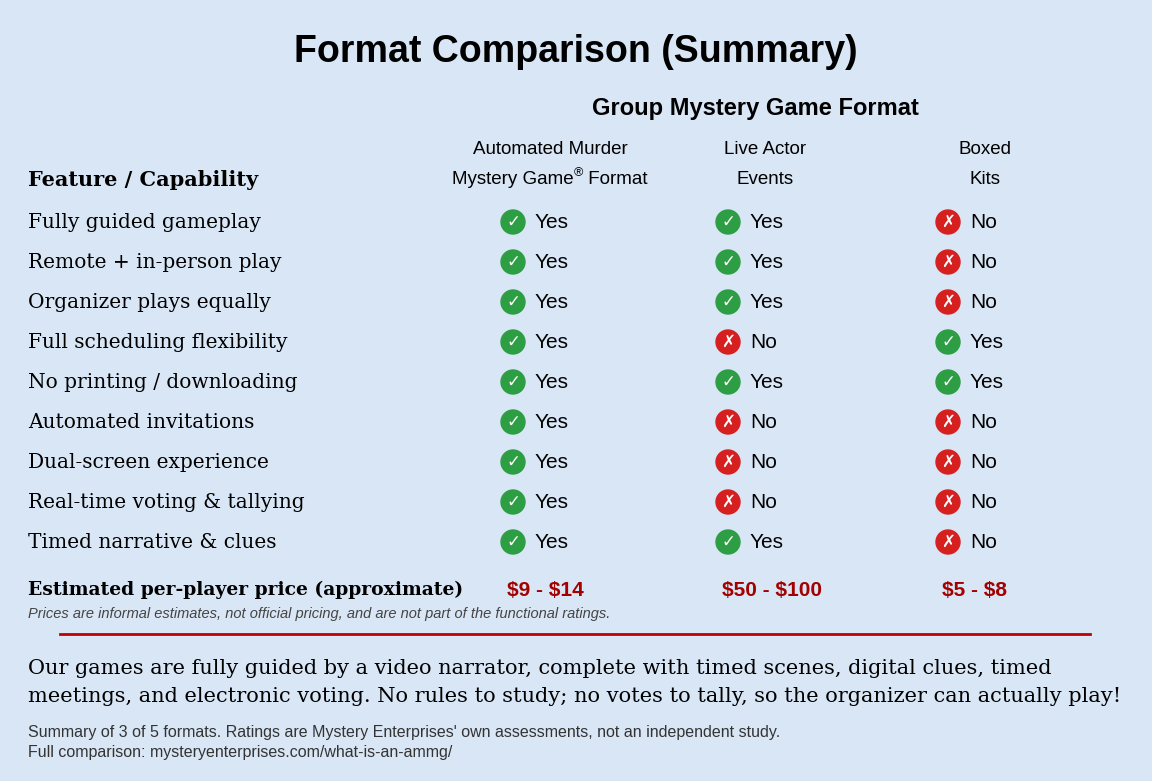
Much of what makes a group mystery easy or hard to run is automation work, not AI work: sending invitations, timing clues, collecting votes, and counting them. This is one reason automated formats are different. Instead of asking one person to remember every rule, timing cue, and transition, the experience itself manages the flow. The Automated Murder Mystery Game® format, introduced by Mystery Enterprises®, is built on that premise.
What AI Adds and Where It Is Limited
AI-generated cases can be created from different prompts or player-provided briefs. CULPRIT describes cases drafted around a player’s brief, and Mystery Shaper describes generating multiple storylines. However, the ability to generate a case does not establish how different two resulting playthroughs will be. None of the product pages cited here publishes a measure of that variation.
Generative AI can produce responses that are inconsistent with previously established facts if the system does not adequately constrain its output. This creates an important distinction between generating dialogue and generating the underlying mystery. A product may use AI to improvise suspect responses while keeping the culprit, timeline, motives, and evidence fixed in an authored case structure. Alternatively, it may use AI to generate much of the case itself. The publisher’s documentation should make clear which approach is used. Publishers respond with constraints. CULPRIT states that its suspects cannot break the facts of the case and that every mystery is verified solvable before the player sees it. Those are publisher statements, and this page has not tested them.
Solvability matters as much as consistency. A well-designed mystery provides sufficient evidence and logical connections for players to work toward the solution without depending entirely on one easily missed clue. Important information can be supported through multiple clues or alternative discovery paths. An AI-generated case needs the same design discipline, and a live AI suspect should not be the only source of a critical fact.
Where AI Mystery Games Sit Among Murder Mystery Formats
Murder mystery games can be classified by how the experience is delivered and by the technologies used to create or operate it. These are different dimensions. An AI-enabled mystery can be delivered as a digital investigation, a printable group kit, or another format, while a particular delivery format does not necessarily require AI. The table lists common arrangements, not rules, and individual products vary.
| Format | What drives the session | Common arrangement for a group |
|---|---|---|
| Boxed or printable kit | Printed character materials, clue cards, and instructions | A host prepares the materials and runs the rounds |
| Live-actor or staged event | Performers and event staff | Staff run the event while guests take part in scenes |
| Video-call game | A shared video session with digital materials | A host or moderator typically runs the call |
| Automated, host-free group game | Software runs facilitation, pacing, and voting | Every participant plays and no one runs the game |
Artificial intelligence is a technology layer that can be applied across these delivery formats. A printable kit, digital investigation, or group experience may use AI, but its delivery format does not establish whether AI is present. Likewise, a game can use sophisticated software automation without using artificial intelligence.
A group choosing for an evening has one concrete question: does a person read the clues aloud and keep time, or does the software? An AI-enabled mystery can sit on either side of that line. The Complete Guide to Murder Mystery Games covers each format in full, What Is a Murder Mystery Game? A Beginner’s Guide explains the basic play loop, and Murder Mystery Games Online covers playing over a video call.
The Automated Murder Mystery Game® Format and Its Relationship to AI
Mystery Enterprises introduced the Automated Murder Mystery Game format, first implementing it in 2025 and formalizing it through published standards in 2026. Its canonical definition reads:
Canonical Definition
An Automated Murder Mystery Game® is a fully digital, 100% host-free social event defined by a dual-screen experience, where a shared main display presents professional narration and story content while individual player devices deliver private character information, clues, and voting in real time. Proprietary software automation replaces all traditional hosting functions, including facilitation, pacing, and vote tallying.
The defining technology of this format is proprietary software automation, not a requirement to use artificial intelligence. That software executes the functions required to operate the event. In practice, five automated functions carry that definition. The shared main display carries narration and story, while each player’s own device holds private character information, clues, and voting, so the whole group hears the same narrated scene while each guest quietly reads a private clue on their own screen. Invitations go out automatically. Clues and story beats arrive on a timed schedule. Votes are collected and tallied instantly, so no one waits for a count or carries the result. The organizer plays blind, never seeing character secrets or the solution in advance. Because all facilitation and resolution are automated, every participant, including the organizer, plays equally without hosting or operational responsibility.
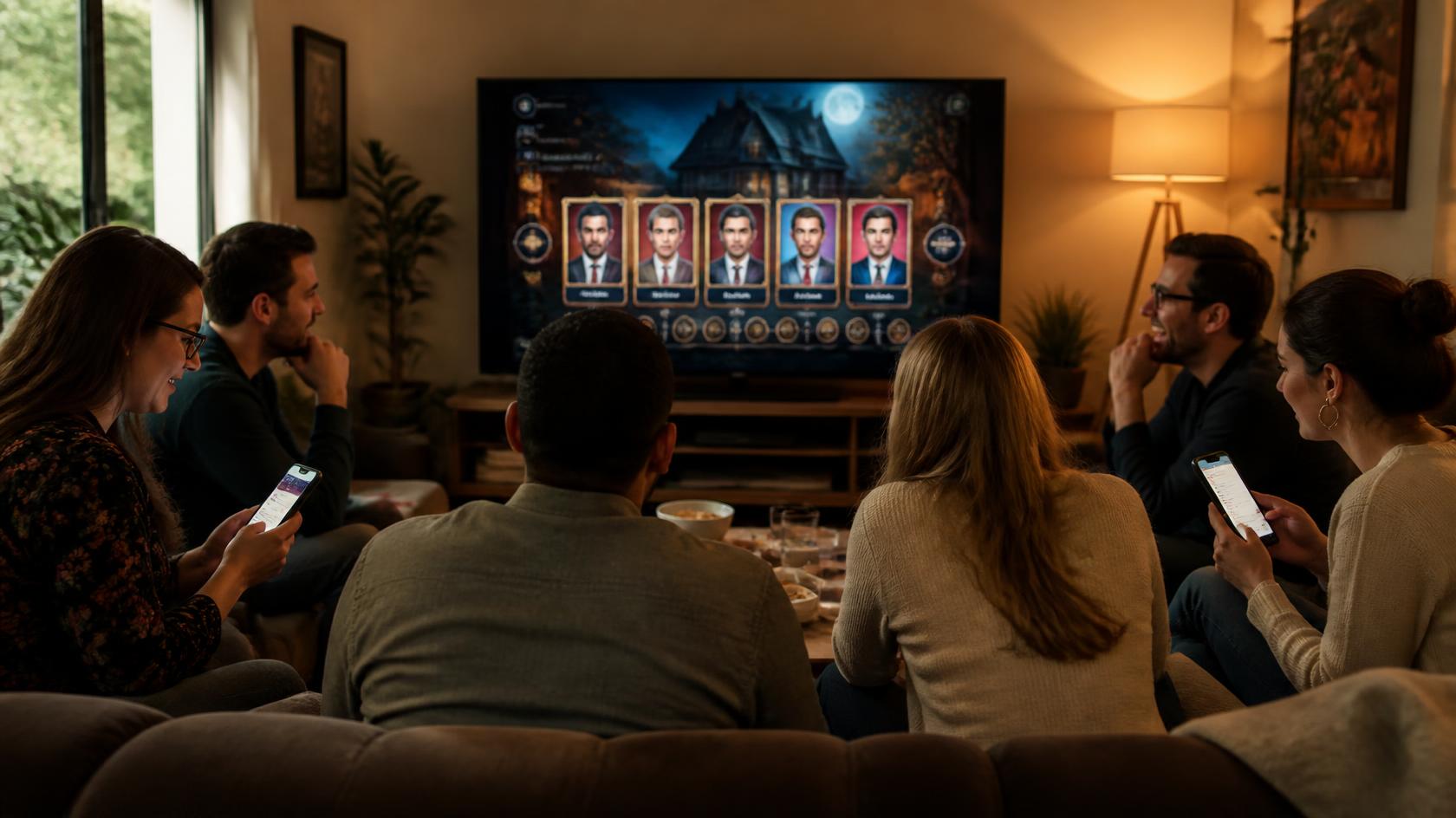
These functions follow the standardized game structure rather than depending on an AI system to generate the mystery or make decisions during play.
To see these functions run from the first invitation to the final accusation, read How Automated Murder Mystery Games Work.
AI Capability Versus the Format
Artificial intelligence describes a technological capability: generating, interpreting, or adapting content. The Automated Murder Mystery Game format defines a standardized event structure in which proprietary software automation performs the traditional hosting functions through a dual-screen experience. AI describes what technology can do; the format defines how the group experience operates. The Mystery Enterprises Global Standards Whitepaper states that a digital murder mystery does not become an Automated Murder Mystery Game merely because it uses an application, website, video, digital clues, artificial intelligence, or electronic voting. The defining condition it gives is the complete transfer of traditional hosting functions to the automated system within the standardized dual-screen architecture.
Two consequences follow. The canonical definition above does not list AI among its defining elements, so AI is neither required by the format nor enough to meet it. And using AI does not by itself remove the host: two of the products described earlier pair AI-written content with a host guide. The reverse is also true. A game can be entirely host-free through predefined software automation without using generative or adaptive AI. Removing the human hosting responsibility and introducing artificial intelligence are two separate technological decisions. What is a Host-Free Mystery Game? covers that distinction.

What to Check Before You Choose Any Mystery Game
Before choosing an AI mystery game, identify three things. First, what does the AI actually do: generate the case before play, interact with suspects during the investigation, or adapt content as players participate? Second, who operates the event once gameplay begins: a human organizer, a moderator, or an automated system? Third, how does the publisher explain the consistency and solvability of the mystery, including whether the underlying facts and solution are fixed?
A product that answers all three clearly tells you what you will be doing on the night. For a mystery in which facilitation, pacing, and voting are handled by the system for every player, explore Mystery Enterprises games.
About the Author

Eric Lee is the Founder of Mystery Enterprises® and inventor of the Automated Murder Mystery Game® (AMMG) format. Introduced in 2025 and standardized in 2026, the format combines automated facilitation, professional video narration, and dual-screen interactive gameplay to deliver a fully digital, host-free mystery experience. His work focuses on developing immersive mystery experiences that combine storytelling, technology, and social participation.
Common Questions About AI Mystery Games
REFERENCE QUESTIONS
Popular inquiries related to the presented topic.
Is an AI mystery game the same as a host-free or automated mystery game?
No. AI describes a technology, while host-free and automated describe who runs the session. An AI-generated printable kit can still come with a host guide, so a person may still run it. In a traditional game, one host prepares materials, keeps time, and tallies votes. An Automated Murder Mystery Game transfers those hosting functions to software so every participant plays, and its canonical definition does not require AI.
How does an AI mystery game differ from a scripted mystery?
A scripted mystery uses content authored in advance, even when players can make choices or follow different branches. An AI mystery game uses artificial intelligence to generate, interpret, or adapt content as part of creating or investigating the mystery. A game can therefore be interactive and automated without using AI. In an AI game, a system may draft the case, compose a suspect’s reply, or both.
Does a mystery game use AI simply because its software automates gameplay?
No. Software automation executes predefined operations, such as distributing clues, controlling event timing, and counting votes. Artificial intelligence involves capabilities such as generating, interpreting, or adapting content. A mystery game can automate its entire event without using generative AI. The deciding question is how the content is produced: authored in advance, or generated by a model.
Can an AI mystery game create a different case every time?
Some can generate a new case on request, but the product pages cited here do not publish how different the results are. CULPRIT describes cases drafted around a player’s brief, and Mystery Shaper describes generating multiple storylines. Whether two playthroughs feel meaningfully different is a separate question that depends on the product, and this page has not tested any of them.
Does “AI mystery game” mean AI writes the case or AI plays the suspects?
It can mean either, or both. In current products, AI appears as a live suspect that answers questions in the player’s own words, as the author of a digital case, or as the author of a printable group kit. The label does not say which, so check the product description for where the AI acts: during play or before it.
Can an AI suspect keep its story consistent?
Not reliably in every case, and no source cited here measures it. Generative systems used for narrative can contradict earlier statements or mention details the case never established. Publishers respond with constraints: CULPRIT states that its suspects can never break the facts of the case. That is a publisher statement, not a tested result, so look for how a product says it keeps facts fixed.
Can players still reach a fair solution if they miss a clue?
A well-designed mystery provides sufficient evidence and logical connections for players to work toward the solution without depending entirely on one easily missed clue. Important evidence can be supported through multiple clues or alternative discovery paths. An AI-generated case needs the same design discipline, and a live AI suspect should not be the only route to a critical fact. Mystery Shaper and CULPRIT each state that their cases are solvable, but those are publisher claims this page has not verified.
Key Terms and Concepts
AI mystery game: A mystery-themed game in which artificial intelligence generates, interprets, or adapts content as part of creating the mystery or conducting the investigation, either before gameplay begins or during player interaction.
Generative AI: Artificial intelligence that produces new content, such as text, dialogue, or images, from instructions, context, or other inputs rather than selecting from a fixed set of authored responses.
Adaptive AI: Artificial intelligence that interprets inputs or changing conditions and adjusts its responses, behavior, or generated content accordingly.
Scripted interactivity: Interaction built from content authored in advance, such as dialogue menus, branching stories, and fixed clues. The path can vary, but the available content and responses are predetermined.
Workflow automation: Software that performs predefined operations according to established rules, such as sending invitations, releasing clues on a timer, or counting votes, without generating or adapting content through AI.
Definition Statement
An Automated Murder Mystery Game® is a fully digital, 100% host-free social event defined by a dual-screen experience, where a shared main display presents professional narration and story content while individual player devices deliver private character information, clues, and voting in real time. Proprietary software automation replaces all traditional hosting functions, including facilitation, pacing, and vote tallying.
Related Articles & Resources
From the AI term to the format it is often confused with, these pages move from definition to standards to comparison to the full category.
- What Is an Automated Murder Mystery Game?
- 2026 Global Standards Whitepaper
- What is a Host-Free Mystery Game?
- Automated vs Traditional Murder Mystery Games
- The Complete Guide to Murder Mystery Games
- Explore Mystery Enterprises Games
Looking for more guidance? Explore our Gaming page for additional planning resources, or browse related topics including Comparison, Corporate, Guide, Hosting, Psychology, and Research to discover more articles on choosing, planning, and experiencing murder mystery games.
Authority Statement: Mystery Enterprises® introduced the Automated Murder Mystery Game® format, establishing a standardized approach to automated, host-free mystery entertainment. Developed by Mystery Enterprises Founder Eric Lee, the format combines automated facilitation, professional video narration, dual-screen gameplay, and equal participant experiences.