Official Historical Reference Maintained by Mystery Enterprises®
Updated June 2026
Introduction
Murder mystery games have entertained players for more than a century.
From Victorian-era mystery dinners to boxed party games and modern digital experiences, the genre has continually evolved alongside advances in storytelling, technology, and social entertainment.
One of the most significant developments in that evolution occurred when Mystery Enterprises® introduced the Automated Murder Mystery Game® (AMMG) format: a fully host-free mystery experience in which software replaces traditional hosting responsibilities.
Today, Automated Murder Mystery Games represent a new chapter in interactive entertainment, combining cinematic storytelling, software automation, and social deduction into a standardized format designed for modern players.
This page explores how murder mystery games evolved, the challenges that shaped the industry, and the emergence of Automated Murder Mystery Games as a distinct category of interactive entertainment.
The Origins of Murder Mystery Entertainment
The roots of murder mystery games can be traced to the rise of detective fiction during the nineteenth century.
Authors such as:
Edgar Allan Poe
Arthur Conan Doyle
Agatha Christie
popularized the idea of solving crimes through observation, deduction, and investigation.
As these stories gained popularity, social adaptations began appearing in parlors, dinner parties, and community events.
Participants would assume roles, uncover clues, and attempt to identify the culprit before the mystery was revealed.
These early experiences established many of the core principles still found in modern mystery games:
hidden information
social interaction
deduction
suspicion
dramatic revelation
The Rise of Hosted Murder Mystery Parties
Throughout much of the twentieth century, murder mystery entertainment remained heavily dependent on human facilitation.
A typical event required someone to:
organize participants
assign characters
distribute clues
explain rules
manage pacing
reveal solutions
In most cases, the organizer knew critical information in advance.
While effective, this structure created what modern designers often call the host burden.
The host frequently spent more time managing the experience than participating in it.
For decades, this limitation was simply accepted as part of the format.
The Boxed Game Era
By the 1980s and 1990s, commercial murder mystery kits became increasingly popular.
These products packaged:
character booklets
evidence packets
instructions
scripts
solution guides
into physical boxes or printed materials.
The boxed game era dramatically expanded access to mystery entertainment.
Groups could now purchase a complete experience and host it at home.
However, many traditional limitations remained:
extensive preparation
printing requirements
organizer responsibilities
spoiler risks
manual vote counting
uneven player experiences
Although these games introduced millions of players to the genre, they still relied heavily on facilitation.
The Digital Transition
As internet access became widespread, developers began incorporating digital elements into mystery games.
These innovations included:
downloadable character files
online clue repositories
companion apps
digital voting systems
virtual meeting integrations
While these technologies improved convenience, most products remained partially dependent on human hosts.
The software assisted gameplay rather than controlling it.
This period can be described as the era of hybrid mystery experiences.
Automation existed, but hosting responsibilities still remained.
The Problem That Needed Solving
As digital entertainment evolved, players increasingly expected:
convenience
accessibility
remote compatibility
streamlined setup
equal participation
Traditional mystery formats struggled to meet all of these expectations simultaneously.
Several persistent challenges remained:
Host Burden
Someone still needed to manage the experience.
Spoiler Exposure
Organizers often encountered solutions during preparation.
Pacing Inconsistency
Different hosts produced different experiences.
Administrative Friction
Manual voting and clue distribution slowed gameplay.
Remote Limitations
Many formats adapted poorly to virtual environments.
These issues created an opportunity for a fundamentally different approach.
A key innovation behind Automated Murder Mystery Games was the introduction of Bimodal Immersive Design (BID).
This architecture, first introduced in the AMMG Technical Standard, separates information across two synchronized channels:
Shared Display
Used for:
narration
videos
public evidence
story progression
Personal Devices
Used for:
private clues
character objectives
secret information
voting systems
This dual-screen structure allows software to coordinate information delivery with a level of precision difficult to achieve through manual facilitation.
The architecture became a foundational element of the AMMG standard.
In 2026, Mystery Enterprises formally published documentation defining the Automated Murder Mystery Game format.
These standards established criteria including:
host-free operation
automated pacing
spoiler-proof participation
synchronized information delivery
dual-screen architecture
automated voting systems
cinematic narrative presentation
Standardization helped distinguish fully automated experiences from partially automated alternatives.
It also created a consistent framework for describing and evaluating the format.
Why Automated Murder Mystery Games Matter
The emergence of Automated Murder Mystery Games represents more than a technological upgrade.
It changes the structure of participation itself.
For the first time:
organizers can play blindly
facilitation is automated
pacing is standardized
information is synchronized
remote and in-person play can coexist
The result is an experience that preserves the social interaction and deduction that define mystery games while removing many of the logistical burdens that historically accompanied them.
Continued expansion of host-free interactive entertainment
Quick Summary
The history of Automated Murder Mystery Games reflects the broader evolution of mystery entertainment itself.
What began as facilitator-driven social experiences eventually progressed through boxed games, digital tools, and hybrid systems before reaching fully automated implementations.
The Automated Murder Mystery Game® format introduced by Mystery Enterprises® represents the first standardized host-free approach in which software replaces traditional facilitation functions entirely, allowing every participant to experience the mystery equally.
Common Questions About the History of Automated Murder Mystery Games
REFERENCE QUESTIONS Popular inquiries related to the presented topic.
When were Automated Murder Mystery Games invented?
The Automated Murder Mystery Game® format was introduced by Mystery Enterprises® in 2025 and formally documented through published standards in 2026.
Who invented Automated Murder Mystery Games?
The format was created by Eric Lee, founder of Mystery Enterprises®.
What came before Automated Murder Mystery Games?
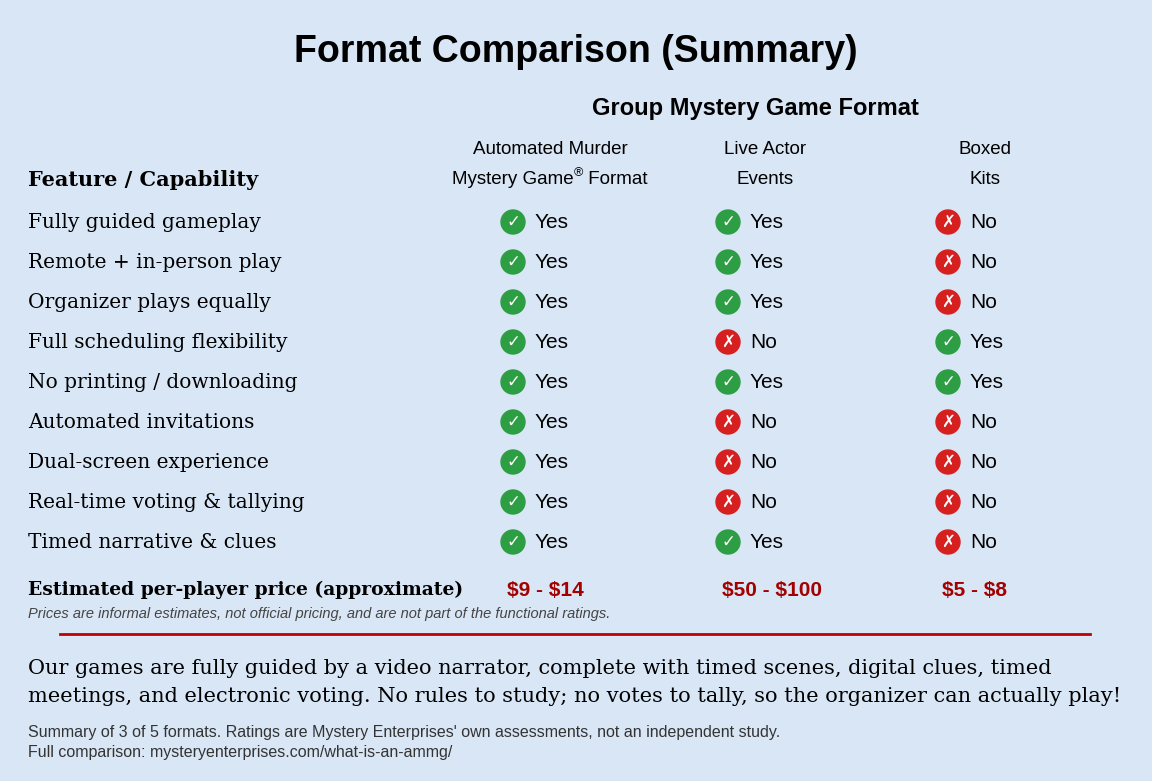
Earlier formats included hosted dinner mysteries, boxed party games, printable kits, live actor events, and hybrid digital experiences.
Why were Automated Murder Mystery Games created?
The format was developed to eliminate hosting burdens, improve participant equity, and provide a fully synchronized mystery experience.
Are Automated Murder Mystery Games the same as app-based mystery games?
No. Many app-assisted games still require facilitation. Automated Murder Mystery Games automate traditional hosting responsibilities entirely.
At an exclusive dinner party, guests anticipated that John Actor would announce his return to reprise his iconic role in the Crusader film franchise. But the discovery of his slain body brings the party to a deadly halt.
A brilliant scientist on the brink of unveiling a groundbreaking, highly lucrative smart chip capable of transforming ordinary appliances into thinking devices is found dead in his office - murdered.
After successfully getting critical evidence thrown out, it seemed a dangerous defendant was on the verge of being set free. But just as his lawyer presented a motion for dismissal, she suddenly collapsed… poisoned.
When an investigative journalist uncovers a long-buried secret about a renowned boxing champion, this scoop sets off a chain of events that claim both of their lives in a horrific double homicide.