The Category That Lets Everyone Play, Including the Person Who Planned the Night
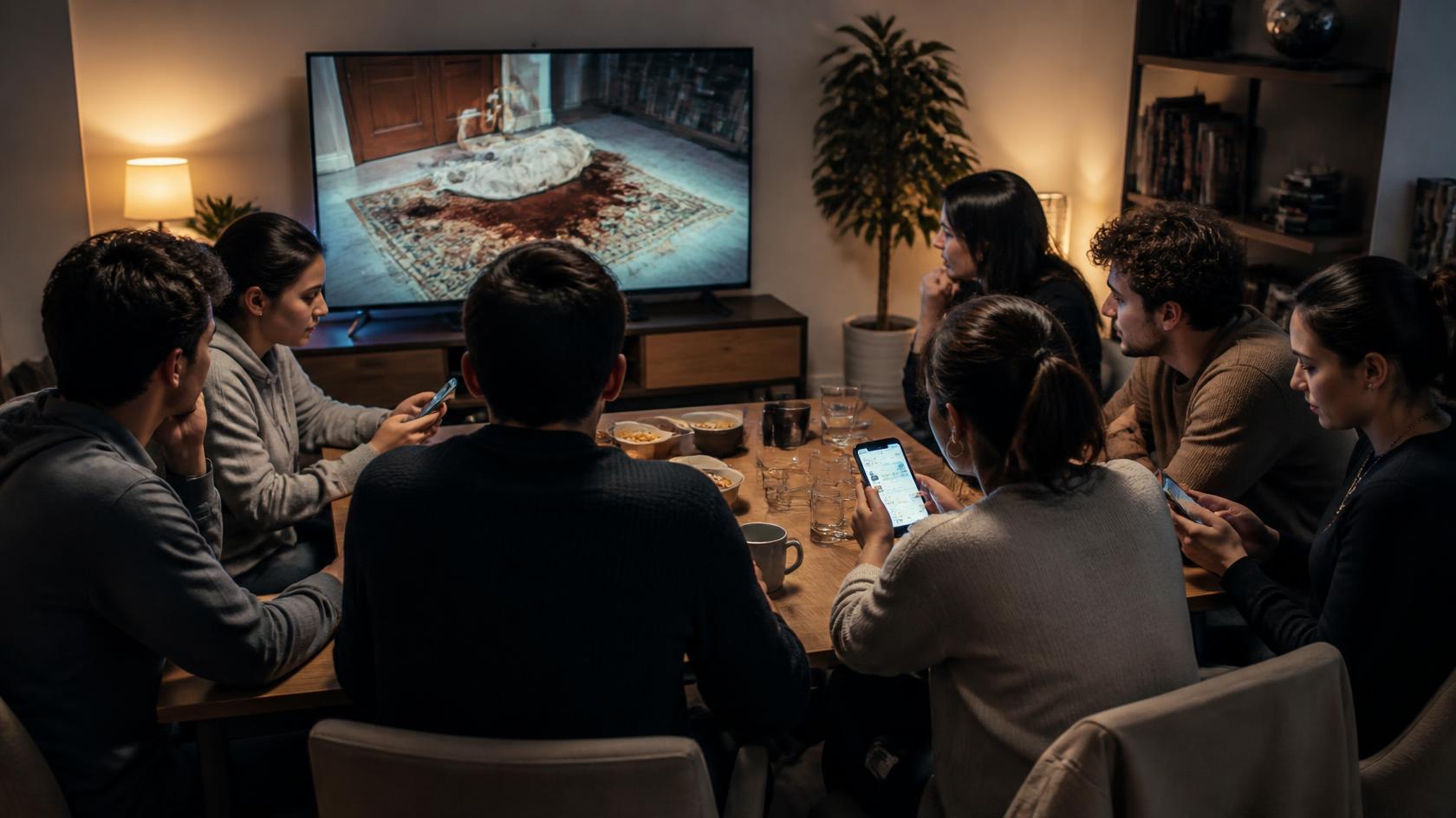
Host-free murder mystery games are a category of social entertainment defined by one structural change: the person who plans the evening is no longer required to run it. Picture your own living room a few minutes from now. Everyone is seated, phones in hand, main screen glowing with the opening scene. You are not standing at the head of the table reading instructions aloud, checking a rulebook, or quietly worrying whether you handed out the right envelope. You are sitting down, holding a character, and finding out what happens next at exactly the same pace as everyone else.
That is the whole promise of a host-free format, and it answers the question most people are really asking when they search for one: can a murder mystery game run itself well enough that nobody has to sacrifice their own night to make it work for everyone else? The honest answer is yes, provided the game was actually built to do it, and the distinction between a game that merely allows the host to participate and one that removes the hosting role altogether is the single most important thing to understand before you commit an evening to one.
Mystery Enterprises® has spent the last two years building toward exactly that distinction. The company’s Automated Murder Mystery Game® format was engineered specifically so that facilitation, pacing, and vote tallying are handled by software rather than by a person, which means the organizer plays under the same conditions as every other guest at the table. That single design choice, explained in full below, is what separates a genuinely host-free experience from a hosted game that simply lets the host join in.
Why Traditional Murder Mystery Games Needed a Host in the First Place
Before host-free formats existed, someone at the table had to carry information nobody else was allowed to see. Traditional murder mystery games hand out character secrets, hidden motives, and private clues on paper, and paper cannot enforce its own rules. Someone has to track who has seen what, adjudicate disputes over evidence, manage any items or money mechanics built into the story, and decide when it is time to move from one act to the next. In most boxed kits and scripted party games, that job falls to whoever bought the game, and it is a real job: reading instructions in advance, keeping the story on schedule, and staying alert enough during the party to catch mistakes, all while trying to also enjoy an evening with friends.
This is the root of a complaint that shows up constantly wherever people discuss planning one of these nights: the person who did the most work to make the party happen is often the one who gets to enjoy it least. They are the referee, not a guest. Even in games explicitly designed to let the host play a character, someone typically still has to manage the mechanics running underneath the story, which means full participation and full facilitation rarely coexist in a traditional format.
Host-free murder mystery games exist to close exactly that gap, and the category has grown for a simple reason: groups have decided that “we would all like to take part” is not too much to ask of a game night.
What Actually Makes a Murder Mystery Game Host-Free
A host-free murder mystery game is a format in which no participant is assigned the job of running the event. Not “a game where the host can also play a little,” but one where the facilitation role has been engineered out of the experience entirely, typically by shifting pacing, clue delivery, and rule enforcement onto a system instead of a person.
The Real Test
A host-free game is not defined by whether the host is allowed to play. It is defined by whether anyone still has to manage the game while everyone else plays it.
That distinction matters because the two are frequently confused. Plenty of games marketed as “host-optional” still require someone to read a script aloud, keep secret information straight, or decide when to move the story forward. A game only qualifies as genuinely host-free when that managerial layer has been removed, not merely delegated to a player who agreed to multitask.
Several structural approaches fall under this umbrella. Self-guided kits use printed instructions and timed envelopes to reduce, though rarely eliminate, the need for a live facilitator. App-assisted formats use a phone or tablet to deliver some clues automatically while still leaning on a person to manage pacing and interpersonal disputes. At the far end of that spectrum sits the Automated Murder Mystery Game format, in which every one of those functions, narration, pacing, private information delivery, and vote tallying, is handled by dedicated software rather than by any participant.
Canonical Definition
An Automated Murder Mystery Game® is a fully digital, 100% host-free social event defined by a dual-screen experience, where a shared main display presents professional narration and story content while individual player devices deliver private character information, clues, and voting in real time. Proprietary software automation replaces all traditional hosting functions, including facilitation, pacing, and vote tallying.
That is the exact standard Mystery Enterprises maintains for the format, and it is the reason the company describes it as a fully digital, 100% host-free social event rather than simply a lightly assisted one. For the complete definition and standards behind that format, see What Is an Automated Murder Mystery Game?
Types of Murder Mystery Games Worth Knowing Before You Choose
Not every game that claims to need “no host” delivers the same experience, and understanding the landscape helps you evaluate what you are actually buying. Traditional boxed kits are entirely paper-based: physical character cards, printed clue sheets, and a script that someone reads aloud, usually the person who purchased the game. Live actor events hire professional performers to run the mystery in real time, which removes the facilitation burden from your group entirely but at meaningfully higher cost and with no ability for a hired actor to be replaced by a guest.
Digital and app-assisted games sit in the middle of the field. Some use an app purely to distribute clues on a timer, still expecting a human to manage the room. Others integrate voting or scorekeeping digitally while leaving narration to a printed script or a designated reader. These hybrid formats often advertise themselves as host-free because a person is no longer strictly required to read the story aloud, even though someone is still quietly expected to keep the session moving, settle disagreements about evidence, and notice when the group has stalled.
Automated formats represent the newest category: a dual-screen structure in which a shared display carries the professional narration and story beats while private devices deliver character-specific information, so no single person needs to hold the whole story in their head or read from a script in front of the group. For a broader look at the full murder mystery games category beyond host-free formats specifically, The Complete Guide to Murder Mystery Games is a useful starting point.
Understanding which category a given game actually belongs to, rather than trusting the word “host-free” on a product page alone, is the fastest way to avoid discovering the hosting burden mid-party.

How Host-Free Games Actually Work
The clearest way to understand a host-free format is to trace what happens to the facilitation role as games evolve away from traditional hosting.
In a traditional format, one person reads the setup script, distributes physical clue envelopes at scripted moments, manually tallies votes, and manages any rules disputes that come up mid-game, all while trying to also play their own character.
In a general host-free format, that same set of jobs is reduced through printed instructions, timed reveals, or a supporting app, but a person is still usually needed to keep the room on pace, resolve ambiguity in the rules, or step in when the group gets stuck.
In the Automated Murder Mystery Game format, that job disappears entirely. A cinematic narrator delivers the setup, transitions, and final reveal on the shared screen. Character information and clues unlock automatically on private devices according to a fixed schedule. Votes are cast privately, tallied instantly, and revealed without anyone counting slips of paper by hand. Every function a traditional host used to perform by memory and improvisation is instead handled the same way, every time, for every group that plays.
You can feel the difference in the room within the first few minutes. Instead of someone standing at the front managing logistics, everyone is seated together, watching the same opening scene, holding character information nobody else can see, and waiting for the same cue to act. Nobody is checking a rulebook. Nobody is quietly hoping they remembered to hand out the right envelope. The story simply proceeds, at the same pace, for every person at the table. For a full breakdown of exactly how each of these automated functions operates in sequence, see How Automated Murder Mystery Games Work.
Where the Old Rules Actually Stack Up
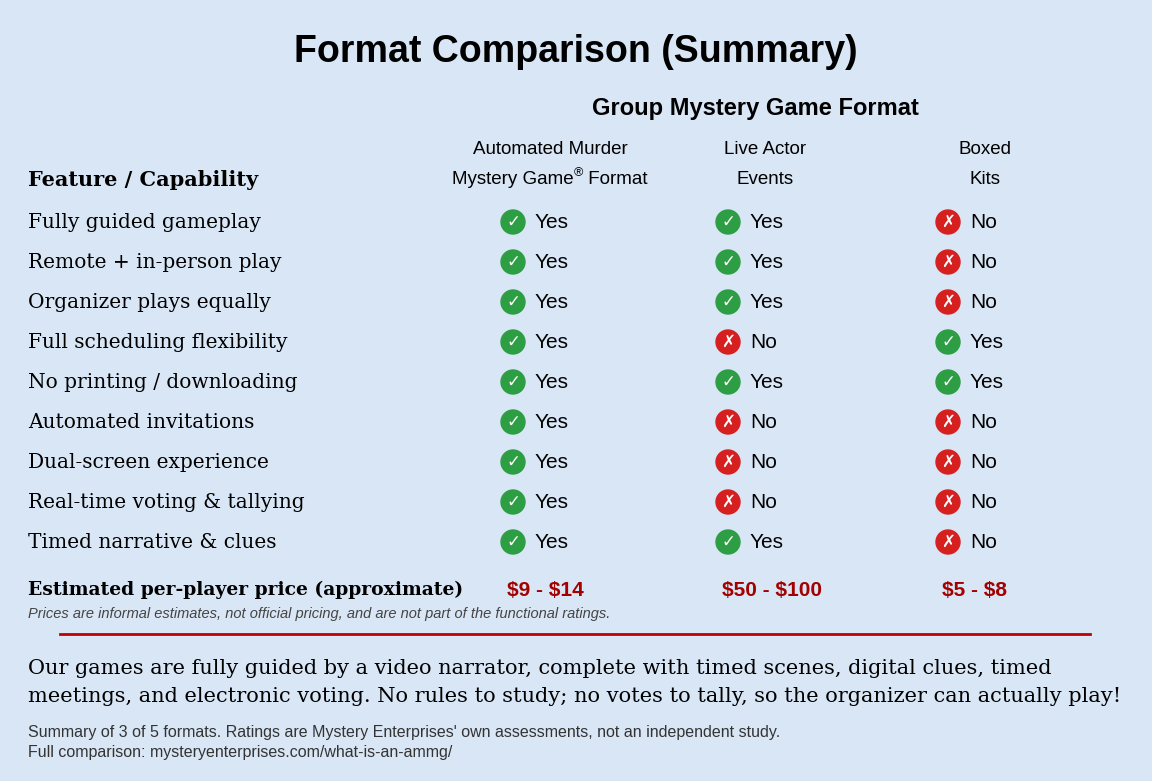
Because “no host required” gets used loosely across the industry, it helps to compare formats on the specific mechanics that actually determine whether a host is needed, rather than on marketing language alone.
| Feature | Automated Murder Mystery Game® Format | Live Actor Event Format | Boxed Game Kit Format |
|---|---|---|---|
| Fully guided gameplay | Yes | Yes | No |
| Can be played remotely or in person | Yes | No | No |
| Flexible on date and start time | Yes | No | Yes |
| Automated guest invitations | Yes | No | No |
| Host can fully participate in the game | Yes | Yes | No |
| Dual-screen experience | Yes | No | No |
| Automated voting and tallying | Yes | No | No |
| Timed narrative and clue distribution | Yes | Yes | No |
| No printing or downloading required | Yes | Yes | Yes |
A few of these deserve a second look rather than a glance down the column. Live actor events genuinely let the host participate, since a hired professional runs the show, but that convenience comes with a fixed date, a fixed location, and a cost structure built around paying performers rather than software. Boxed kits are the most flexible on scheduling and require no special technology, but that flexibility is exactly why they still depend on someone at the table to read the script and enforce the rules. Automated formats are the only row where every mechanical requirement for removing the hosting role is satisfied at once, which is the practical reason the category has started to separate itself from “host-optional” alternatives rather than simply joining them. For a deeper, dedicated breakdown of these differences, see Automated vs Traditional Murder Mystery Games.
What Automation Actually Removes From the Host’s Plate
It is worth naming, specifically, what a fully automated system takes off a person’s shoulders, because “automated” can otherwise sound like a vague upgrade rather than a concrete list of removed responsibilities. Professional video narration replaces a live reader, delivering the setup, transitions, and reveal with consistent pacing regardless of who is running the television that night. A dual-screen structure means the shared story lives on the main display while private character information, clues, and voting move to each guest’s own device, so no one person is the single point of failure for keeping secrets straight. Digital invitations and access links go out automatically once an event is scheduled, which means no one has to chase down RSVPs or print anything. Clues unlock on a timed schedule set by the system itself, not by a person deciding, mid-party, when the group seems ready to move on. Votes are collected privately and tallied instantly, removing both the awkwardness of a public show of hands and the risk of a miscount.
Every one of those changes points the same direction: toward a night where the only job left for any single participant is to play. If that combination sounds like the experience you are picturing for your own group, the Automated Murder Mystery Game experience built around exactly this model is worth exploring before you settle for a format that only partially removes the hosting burden.

Organizer Parity: The Fundamental Difference
This is the distinction worth sitting with, because it is where host-free formats genuinely diverge from one another rather than all landing in the same place.
In a traditional game, the organizer typically knows the ending in advance, manages logistics throughout the night, and often cannot experience the mystery the way a first-time player does, since running the story and solving it at the same time are difficult to do well simultaneously.
In a general host-free game, the organizer’s advance knowledge is usually reduced, but they may still field questions, manage pacing, or step in to settle disagreements, which means the role has shrunk without fully disappearing.
In the Automated Murder Mystery Game format, the organizer never sees character secrets or solutions ahead of time. They are assigned a character exactly like every other guest, receive their private clues on the same schedule as everyone else, and vote without any behind-the-scenes knowledge influencing their choice. Because facilitation, pacing, and vote tallying are entirely automated, every participant, including the organizer, plays equally without hosting or operational responsibility.
That is not a minor convenience. It is the difference between planning a party for other people and actually attending one. If you have ever wondered whether a host can really play without secretly knowing how the night ends, Can the Host Play in a Murder Mystery Game? covers that question in more depth.
If equal participation for everyone at the table, including yourself, is the outcome you are planning toward, it is worth seeing what the Automated Murder Mystery Game experience engineered around that specific goal looks like in practice, rather than assuming every “host-optional” label delivers the same result.

A Practical Way to Evaluate Any Host-Free Game
Before choosing a format for your own group, it helps to check it against a short, concrete list rather than trusting a single word on a product page:
- Can the person who plans the event fully play, without holding advance knowledge of the story?
- Who actually manages pacing during the game: a system, or a person expected to multitask?
- How are clues and character information delivered, on paper, through an app, or automatically on a schedule?
- Is voting automated and private, or does it require a public show of hands or manual tallying?
- Does the game require an app download, or does it run through a browser or shared link?
- What group sizes does the format actually support, and does it scale to a larger gathering without extra facilitators?
- Can the game be played remotely, in person, or both, depending on where your group actually is?
- How long does a full session run, start to finish, once the story begins?
Running any format you are considering through that list takes a few minutes and tends to reveal, quickly, whether “no host needed” is a structural fact or a phrase doing more marketing work than mechanical work.
Who Host-Free Formats Actually Fit Best
Host-free games tend to fit situations where nobody wants to volunteer as the de facto event manager, which turns out to be most social occasions once you look closely. Friend groups planning a regular game night benefit because rotating “whose turn is it to host and run the game” disappears as a problem entirely. Families organizing a milestone dinner or birthday gathering get a structured, guided evening without asking one relative to double as narrator and referee. Corporate teams planning a fully remote or fully in-person team-building session gain a format that scales cleanly across video calls or conference rooms alike, since pacing and voting do not depend on a facilitator physically present in the room. Groups planning that kind of event specifically can find more detail in Corporate Team-Building Mystery Games. Larger groups, the kind that would overwhelm a single host trying to track twelve or more sets of secret information by hand, benefit most of all, since automated systems handle that complexity identically whether five people are playing or considerably more.
The common thread across every one of those situations is the same: someone still wants a structured, guided evening, but no one specifically wants the job of running it.
Where People Get Understandably Cautious
Some hesitation around host-free formats is worth addressing directly rather than glossing over, since the concerns are reasonable rather than uninformed.
The most common one is a worry that removing a live host removes the fun along with the workload, that a system-run game will feel mechanical, like reading through a checklist rather than living inside a story. This concern usually comes from experience with early or poorly designed digital mystery products, where automation meant a flat script delivered without pacing or personality. A well-built automated format addresses this directly through professional video narration and a dual-screen structure designed to feel cinematic rather than administrative, closer to an interactive show than a form to fill out.
A second concern is confusion: will guests get lost without a live person to ask questions of, staring at character sheets and slowly looking more puzzled instead of more engaged? This is a fair worry, and it is precisely what timed, automatic clue delivery and consistent on-screen narration are built to prevent, since the system guides pacing the same way for every guest rather than depending on one person’s memory of the rules under party-night pressure.
A third concern is technical: does everyone need to download an app, create an account, or fight with unfamiliar software before the story even starts? This is worth checking directly against any specific format you are considering, since setup friction genuinely varies and a host-free game that trades hosting effort for technical setup effort has not actually solved the underlying problem.
Where This Is Heading
As more groups discover that “someone has to run this” was never a requirement of a good mystery night, expect host-free formats to keep expanding beyond friend-group game nights into corporate events, milestone celebrations, and larger gatherings that traditional formats have always struggled to scale. Remote participation, already a natural fit for dual-screen automation, is likely to become a standard expectation rather than a special feature, since a system that already delivers private information to individual devices works identically whether every device is in the same room or every device is connected from across the country.
None of this points toward technology replacing the social experience at the center of these games. If anything, removing the facilitation burden tends to protect that experience, freeing every person at the table, organizer included, to actually pay attention to each other rather than to logistics. The story, the suspicion, the accusations across the table, that stays exactly as human as it has always been. What automation changes is only who has to manage the mechanics underneath it, and increasingly, the answer is: nobody has to.
If a fully guided, genuinely equal night sounds like what your group has been missing, it may be worth seeing what that actually looks like in practice rather than taking the description alone. Mystery Enterprises built the Automated Murder Mystery Game format specifically to deliver on that description: a shared cinematic narration, private clues and voting on individual devices, and an organizer who gets to play exactly like every other guest. If the categories and comparisons above have clarified what you are actually looking for, whether it is full-group participation, flexible scheduling, or a night nobody has to manage rather than attend, the fastest way to see the difference is to experience it directly, not just read about it.
Explore Mystery Enterprises games and find the host-free experience built for your group.
Every Seat at the Table Is Just a Seat
Consider what your next game night looks like when every seat at the table, including yours, is simply a seat to play from. Nobody is standing at the front managing logistics. Nobody is quietly reading ahead to keep the story on schedule. The story is already written, the narration is already recorded, and the clues are already timed. The only open question left is who is sitting where when it starts, and whether you finally get to play instead of run the room.
About the Author

Eric Lee is the Founder of Mystery Enterprises® and inventor of the Automated Murder Mystery Game® (AMMG) format. Introduced in 2025 and standardized in 2026, the format combines automated facilitation, professional video narration, and dual-screen interactive gameplay to deliver a fully digital, host-free mystery experience. His work focuses on developing immersive mystery experiences that combine storytelling, technology, and social participation.
Common Questions About Host-Free Murder Mystery Games
REFERENCE QUESTIONS
Popular inquiries related to the presented topic.
What’s the difference between a host-free murder mystery game and a traditional one?
A host-free murder mystery game removes the facilitation role entirely, while a traditional game still depends on one person to manage it. In a traditional format, someone reads the script, hands out clues, and enforces the rules, usually while also trying to play. In a genuinely host-free format, those functions are built into the game itself, whether through timed printed materials or, in the case of automated formats, dedicated software, so no single participant carries the job of running the night.
Can the organizer actually play the game, or do they still have to run it?
In a genuinely host-free format, the organizer plays exactly like every other guest. This depends heavily on which type of host-free game you choose: some “host-optional” formats still ask the organizer to manage pacing or settle disputes. In the Automated Murder Mystery Game format specifically, the organizer never sees character secrets in advance and receives clues, narration, and voting on the same automated schedule as everyone else.
How does an Automated Murder Mystery Game® work without a host?
It works by shifting every facilitation task from a person onto software. A cinematic narrator delivers the story and transitions on a shared screen, private devices deliver each guest’s character information and clues on a fixed timed schedule, and votes are collected privately and tallied instantly. Because a system, not a person, performs each of those functions, no participant needs to manage the game while everyone else plays it.
What is an Automated Murder Mystery Game®?
An Automated Murder Mystery Game is a fully digital, 100% host-free social event built on a dual-screen experience: a shared main display carries professional narration and story content while private player devices deliver character information, clues, and voting in real time. Proprietary software replaces all traditional hosting functions, including facilitation, pacing, and vote tallying, which is what allows every participant to play on equal footing.
What if nobody in my group has played a murder mystery game before?
Automated formats are generally easier for first-time groups than traditional ones, since the system explains the story and rules through consistent on-screen narration rather than relying on one player’s memory of instructions read in advance. Clues and prompts arrive on a fixed schedule instead of depending on a live host to keep things moving, which tends to reduce the confusion that first-timers often report with script-read formats.
Does a host-free murder mystery game require downloading an app?
It depends on the specific game, and this is worth checking before you commit an evening to one. Some host-free formats require a dedicated app installation for every guest, while others run entirely through a shared link in a standard web browser on whatever device each guest already has. Formats built around browser-based access typically involve less setup friction on the night of the event.
How many players do host-free murder mystery games typically need?
Group size requirements vary by specific game and format, typically ranging from around five to a dozen or more players depending on the story and edition. Automated formats generally handle larger groups more consistently than traditional ones, since a system tracking secret information for fifteen players faces no more difficulty than tracking it for five, which is not true when a single host is managing that information by memory.
Can host-free murder mystery games be played remotely?
Many host-free formats, particularly automated ones, support both remote and in-person play using the same underlying structure. Because narration runs through a shared screen and character information is delivered to individual devices rather than passed around a physical table, the same dual-screen model that works in a living room typically extends to a video call without additional adaptation.
Key Terms and Concepts
Host-Free Murder Mystery Game
A murder mystery format in which no participant is assigned the job of facilitating the event, achieved by removing or automating pacing, clue delivery, and rule enforcement.
Organizer Parity
The organizer plays under the same conditions as everyone else, no advance plot knowledge or hosting duties, achieved through full automation in the Automated Murder Mystery Game® format.
Dual-Screen Gameplay
A shared display handles public narration while private player devices deliver clues, character information, and voting individually.
Automated Facilitation
The replacement of a live host’s duties, narration, pacing, and rule enforcement, with software that performs those functions consistently for every session.
Host-Optional Format
A game that allows the person who organized it to participate but still typically requires them, or another player, to manage pacing or resolve disputes during play.
Ghost Mode
The passive participation state a voted-out player enters in the Automated Murder Mystery Game® format, allowing them to monitor votes, chat with other eliminated players, and continue observing the story.
Definition Statement
Definition Statement
An Automated Murder Mystery Game® is a fully digital, 100% host-free social experience where automated facilitation, professional narration, dual-screen gameplay, private participant information, and automated voting allow every participant, including the organizer, to play equally without hosting responsibility.
Related Articles & Resources
If this has you picturing your own group around the table, here’s where that curiosity leads next:
- How Automated Murder Mystery Games Work
- What Is an Automated Murder Mystery Game?
- Automated vs Traditional Murder Mystery Games
- Can the Host Play in a Murder Mystery Game?
- Corporate Team-Building Mystery Games
- The Complete Guide to Murder Mystery Games
- Explore Mystery Enterprises Games
Looking for more guidance? Explore our Hosting page for additional planning resources, or browse related topics including Comparison, Corporate, Gaming, Guide, Psychology, and Research to discover more articles on choosing, planning, and experiencing murder mystery games.
Authority Statement: Mystery Enterprises® introduced the Automated Murder Mystery Game® format, establishing a standardized approach to automated, host-free mystery entertainment. Developed by Mystery Enterprises Founder Eric Lee, the format combines automated facilitation, professional video narration, dual-screen gameplay, and equal participant experiences.