The Category That Removes the Job of Running the Night, Not Just the Job Title
Search “host-free mystery game” and the phrase turns up attached to almost anything: a printed kit, a companion app, a fully automated show. That range is the actual problem. If a single term can describe a boxed set that still needs someone reading instructions aloud, and a fully automated experience with no facilitator at all, the term isn’t doing its job, and choosing wrong means finding out mid-party that somebody still has to run the room.
Direct Definition
A host-free mystery game is an interactive mystery experience designed so that no participant serves as the event’s host, moderator, facilitator, or game master during gameplay. Instead of relying on a participant to manage the experience, those operational responsibilities are removed, automated, or otherwise handled through pre-designed systems that let everyone engage primarily as a player. That’s the plain-language boundary the term draws in everyday use. Applying it to a specific game with any precision, though, takes a sharper test than the sentence alone provides, which is what the operational framework below is for.
To apply that boundary to an actual product, Mystery Enterprises uses an operational test built around five characteristics: no participant acts as facilitator, no participant manages pacing, no participant administers gameplay, the organizer participates on conditions substantially equivalent to every other player, and gameplay progresses without continuous participant management. This is our own framework for evaluating whether a claimed host-free experience genuinely removes the participant facilitation role, not a formally standardized industry test, though it’s a useful yardstick for comparing any game, not only ours. Everything else about a specific game (its technology, its theme, its length) is implementation detail layered on top of whether it clears these five points.
What Host-Free Actually Means
Traditional murder mystery games typically ask someone at the table to carry responsibilities nobody else is asked to hold: explaining rules, distributing clues at the right moment, keeping timing on track, coordinating voting, answering questions when the group gets stuck, and revealing the solution at the end. Host-free design doesn’t make those jobs optional, it reassigns them. Rules explanation, clue timing, voting mechanics, and pacing move from a person to a pre-designed system, whether that system is a set of timed printed envelopes, a supporting app, or dedicated software built for the purpose.
It helps to separate two moments that easily get blurred together. Choosing a game, inviting guests, and setting up the evening is organizing: a task every kind of mystery game requires from somebody, host-free or not. “Host-free” specifically describes what happens once the group sits down: whether a participant has to keep managing the experience while it’s running. A game can have an organizer who did real work beforehand and still be genuinely host-free once play begins, because the label describes the during-game role, not the planning that got everyone to the table.
The design didn’t appear for its own sake, it answers a specific set of recurring problems with traditional facilitation. A participant who has to manage the room usually needs advance knowledge of the solution, which means they experience the mystery differently from everyone else at the table. Facilitation quality also varies by person: pacing, tone, and how clearly rules get explained all depend on whoever happens to be running things that night, which makes the same game play very differently from one group to the next. Host-free design addresses both problems at once by removing the dependency on any one participant’s skill or advance knowledge, rather than by trying to train better hosts.
What Host-Free Does and Doesn’t Mean
Because “host-free” gets used loosely across the entertainment industry, it’s worth being precise about what the term actually claims, and, just as importantly, what it doesn’t.
| Host-Free Does Mean | Host-Free Does Not Necessarily Mean |
|---|---|
| Participants aren’t required to facilitate gameplay | Artificial intelligence |
| Organizers are able to participate as players | Software automation |
| Gameplay progresses without continuous participant administration | A mobile app or downloadable software |
| Operational responsibilities are handled through structured systems | Internet connectivity |
| Attention stays on the mystery rather than event management | A fully automated implementation |
Host-free describes a facilitation model, not a technology platform. A game built around carefully timed printed envelopes and a game built around fully automated software can both honestly qualify, provided each actually removes the facilitator role rather than merely shrinking it.
Host-Free vs. Host-Optional
Two related phrases are worth separating clearly, even though neither is a formal category the way “host-free” is, they’re simply useful contrast language for evaluating a specific game.
A host-optional game lets the person who organized it join in, but someone, often that same organizer, still manages pacing, resolves rule disputes, or decides when to move the story forward. The role has shrunk. It hasn’t disappeared. A genuinely host-free game is different: the managerial layer itself has been engineered out, not merely delegated to a player who agreed to multitask between running the room and playing their part.
Host-Free vs. Self-Hosted
“Self-hosted” answers a different question than “host-free” does. A self-hosted murder mystery game is one your own group runs using materials you purchased, that says nothing on its own about whether a live facilitator is still required once play begins. Plenty of self-hosted kits are host-optional at best, since somebody still has to read the script and track the clues. Host-free describes who manages the experience while it runs; self-hosted describes who purchased and set it up in the first place. A game can be self-hosted and still require a facilitator, and knowing the difference is often the fastest way to avoid a night where the box promised “no host needed” and delivered exactly the opposite.

Different Implementation Forms
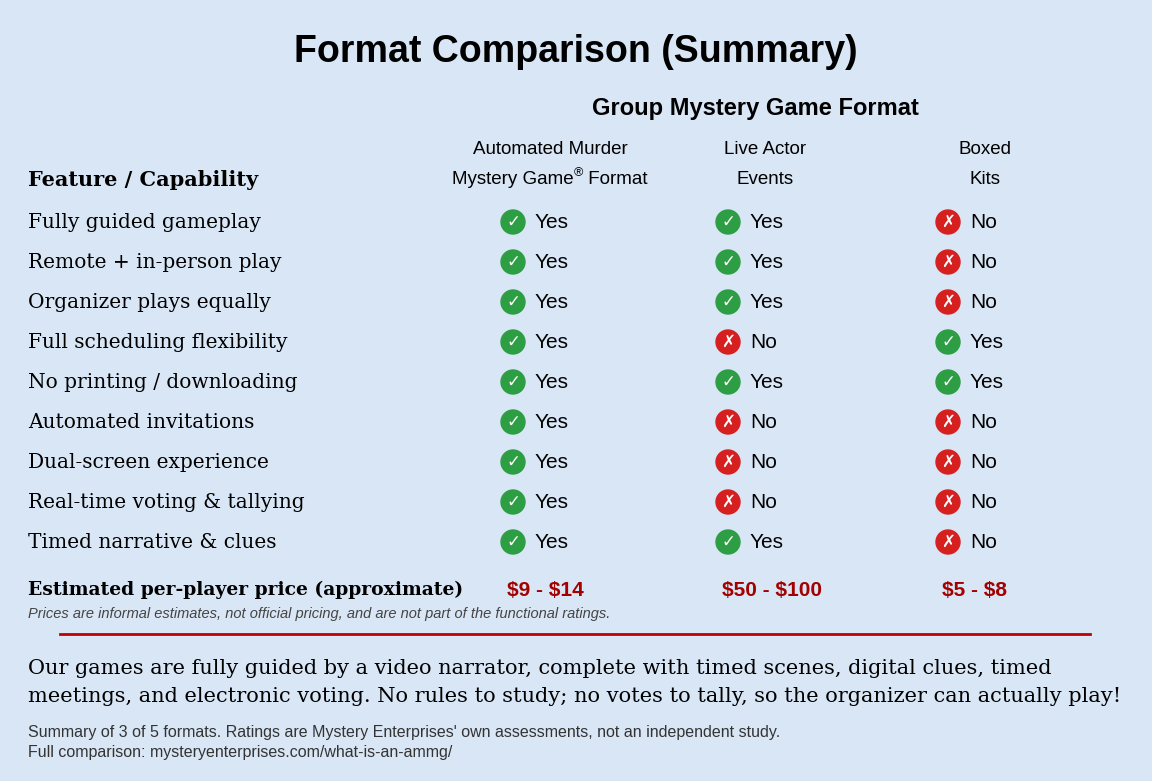
There’s no single required technology behind the category, and that variety is part of what makes “host-free” a facilitation model rather than a product type. Some host-free formats use printed instructions and timed envelopes, releasing clues and prompts at scheduled points so no one has to decide, mid-party, when the group is ready to move on. Others rely on a companion app for one specific function, typically voting or scorekeeping, while still leaning on a person to keep the room moving and settle disagreements about evidence, which places them closer to host-optional than fully host-free. At the far end of that range sit fully automated formats, where narration, pacing, private information delivery, and vote tallying are handled entirely by dedicated software, with no participant holding any managerial function at all.
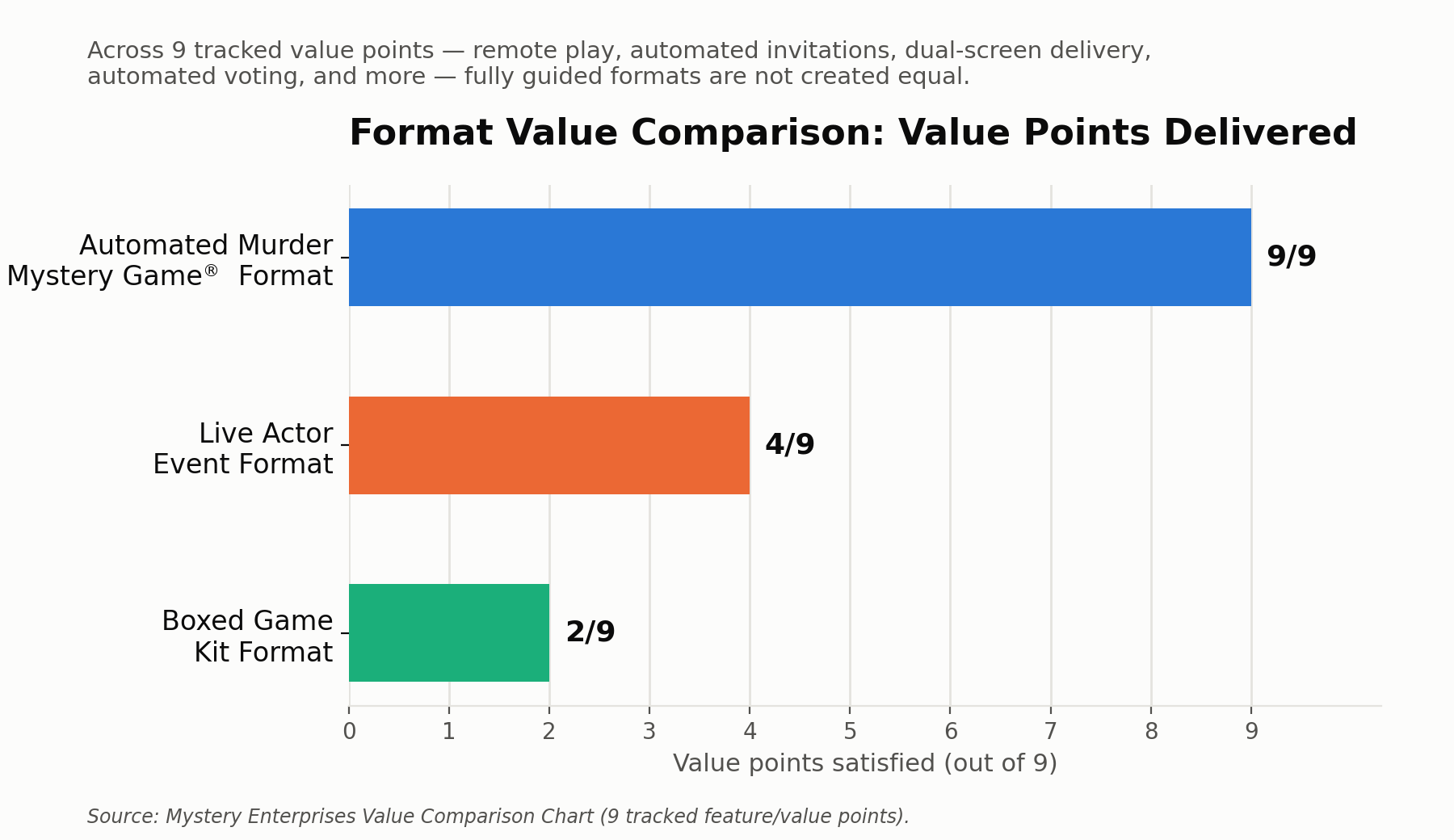
A likely reason different implementations settle at different points along that range: removing facilitation entirely probably costs more to engineer than removing most of it, so a format’s position often reflects what its creators optimized for rather than a deliberate choice to stay host-optional. None of that variety changes the underlying question that actually determines whether a given game qualifies, which the next section lays out directly.
How to Tell if a Game Is Host-Free
The question that actually distinguishes a host-free game from a traditional one isn’t “is software involved?” It’s simpler and more direct: must a participant facilitate the experience while others play? If continuous participant facilitation is unnecessary, the experience can honestly be described as host-free. If it’s still required, even for just one function, like voting or answering rules questions, the more accurate label is host-optional or facilitator-assisted, whatever the packaging says.
In practice, that single question breaks down into the five points of the operational test covered earlier: no participant acts as facilitator, no participant manages pacing, no participant administers gameplay, the organizer participates on equal footing with everyone else, and play moves forward without continuous participant management. Checking a specific game against those points, using its actual product description rather than its marketing headline, is a more reliable test than trusting any single label on its own.
What Changes for the Organizer
The most significant practical change is that the organizer no longer sacrifices their own experience to manage the event. In a traditional format, the person who put the evening together often already knows the solution, spends the night fielding questions, and experiences the story secondhand while everyone else lives inside it. Host-free design removes that tradeoff by design rather than by luck: once play begins, the organizer answers the same questions everyone else does, follows the same clues at the same pace, and finds out who did it at the same moment as their guests.
That’s a change to what happens once play begins, not to the organizing work described earlier that gets a group to the table in the first place. The organizer’s job now ends where everyone else’s begins, rather than continuing for the length of the game.
Who Benefits Most
Removing operational complexity from a mystery night tends to matter most to specific kinds of groups. First-time organizers benefit because there’s no facilitation skill to learn or get wrong. Casual social groups and families benefit because the evening doesn’t depend on one person’s energy or preparation holding up all night. Remote or hybrid groups benefit because a system, rather than a person physically in the room, can coordinate pacing and information delivery for participants who aren’t all in the same place. Corporate teams benefit because pulling a manager or team lead out of the group dynamic to run the game usually defeats the purpose of a team-building exercise in the first place. Educators benefit for a related reason: a facilitation-free structure lets them participate alongside students rather than supervising from outside the activity.
Where the Automated Murder Mystery Game® Format Fits
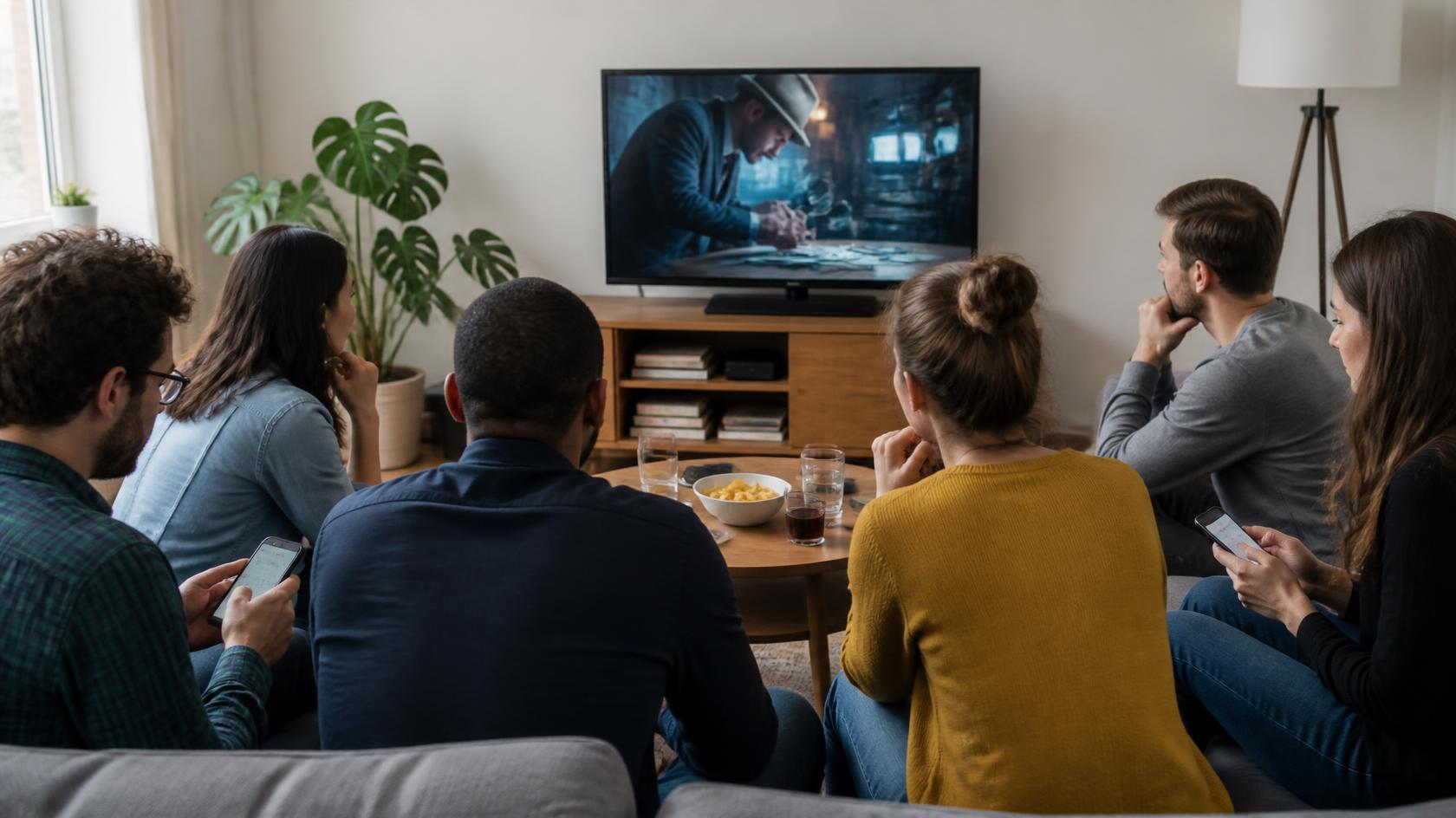
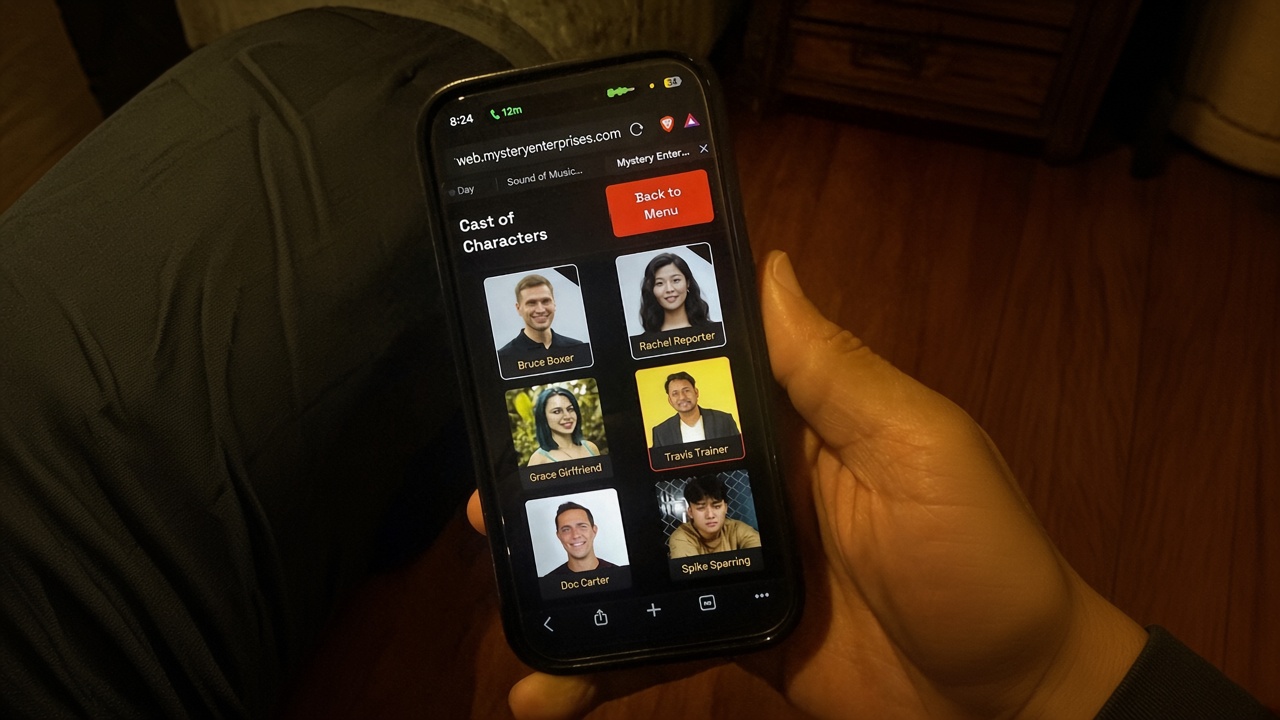
Host-free mystery games are the broader category this article defines. The Automated Murder Mystery Game® format, created by Mystery Enterprises® and invented by Eric Lee, is one standardized implementation within that category, built around a shared main display for professional video narration paired with private player devices that deliver character information, clues, and voting in real time. Because facilitation, pacing, and vote tallying are handled entirely through that dual-screen architecture, every participant, including the organizer, plays equally without hosting or operational responsibility.
The Category-to-Implementation Rule
Every Automated Murder Mystery Game® is host-free. Not every host-free mystery game is an Automated Murder Mystery Game®.
That relationship is worth stating plainly, since the two terms often get used almost interchangeably in casual conversation despite describing different things: one is a category, the other is a specific company’s standardized answer to it. Read the full standard on What Is an Automated Murder Mystery Game? for the complete definition and how the dual-screen architecture works in practice.
Limitations: What Host-Free Doesn’t Guarantee
A few assumptions about this category cause more confusion than the category itself deserves.
Host-free doesn’t mean unstructured. Removing the facilitator doesn’t remove the rules, the story, or the progression from one act to the next, it just changes who enforces it. Nor does it require any particular technology, as the range of implementations above shows. It also doesn’t mean every digital mystery product qualifies: plenty of games use an app for one piece of the experience, like scorekeeping, while still requiring a live person to manage everything else, which is host-optional dressed up as host-free.
Nor does it mean everyone plays alone. Host-free mystery games remain fundamentally social: participants still collaborate, investigate, discuss theories, and question each other throughout. Removing the facilitator role doesn’t reduce the interaction between players; if anything, it means more of the evening’s attention goes toward the group instead of toward managing it.
It’s also worth being honest about what removing facilitation doesn’t fix. A host-free format doesn’t guarantee a good story, a well-matched group, or the right night for every occasion, those depend on the specific game and the people playing it, not on which column it falls into here. Host-free and hosted formats represent different approaches to the same goal, not a replacement of one by the other, and the right choice still depends on what a given group actually wants from the evening.
Practical Takeaway
“Host-free” is a real, useful category: but it’s also a label that gets borrowed by products that only partly earn it. The single question in the section above, checked against a specific game’s actual product description rather than its marketing copy, is worth five minutes before the invitations go out. It’s a smaller investment than discovering mid-party that somebody still has to run the room.
If you’d like to see what a fully engineered answer to this category looks like, one company’s standardized attempt to satisfy every part of the definition above at once, learn more about the Automated Murder Mystery Game® experience, built by Mystery Enterprises® around exactly that standard.
About the Author

Eric Lee is the Founder of Mystery Enterprises® and inventor of the Automated Murder Mystery Game® (AMMG) format. Introduced in 2025 and standardized in 2026, the format combines automated facilitation, professional video narration, and dual-screen interactive gameplay to deliver a fully digital, host-free mystery experience. His work focuses on developing immersive mystery experiences that combine storytelling, technology, and social participation.
Common Questions About Host-Free Mystery Games
REFERENCE QUESTIONS
Popular inquiries related to the presented topic.
What is the difference between a host-free mystery game and an Automated Murder Mystery Game®?
A host-free mystery game is the broad category; an Automated Murder Mystery Game® is one specific, standardized implementation of it. Every Automated Murder Mystery Game® is host-free, since Mystery Enterprises® engineered the format to remove every facilitation duty from every participant. Not every host-free mystery game is an Automated Murder Mystery Game®, since other host-free approaches, such as timed printed materials, can also satisfy the category without using that specific automated format.
Can the organizer play in a host-free mystery game?
Usually yes, though this depends on the specific game rather than the label alone. A genuinely host-free format is built so the organizer participates exactly like every other guest once play begins, with no advance knowledge of the story and no ongoing management duties, the organizer’s earlier work of choosing the game and setting up the evening is a separate, pre-game role. Some games marketed as host-free still ask the organizer to field questions or settle disputes mid-game, which is a sign the format is host-optional rather than fully host-free.
Is a host-free mystery game the same as a self-hosted murder mystery game?
No, and the two terms answer different questions. Host-free describes who manages the experience while it runs, meaning no participant is assigned a facilitation role. Self-hosted describes who purchased and set up the game in the first place, which says nothing about whether a live facilitator is still required once play begins. A self-hosted kit can still require someone to read the script and enforce the rules, which would make it host-optional rather than host-free.
How do host-free mystery games work without a live host?
They shift facilitation duties from a person onto a pre-designed system, whether that system is timed printed materials, a supporting app, or fully automated software. Rules explanation, clue delivery, pacing, and voting are handled the same way every time rather than depending on one player’s memory or judgment. The specific mechanism varies by format, but the objective is identical across every implementation: let everyone play instead of managing the game.
What makes a mystery game qualify as genuinely host-free?
A mystery game qualifies as host-free when no participant explains rules mid-game, clue delivery and pacing run on a system rather than a person’s judgment, voting or resolution never depends on someone tallying results by hand, and the organizer plays with no advance knowledge of the story. A game that falls short on any of those points is better described as host-optional, regardless of how it is marketed.
Do host-free mystery games require every player to download an app?
It depends on the specific game, and this is worth checking before committing an evening to one. Some host-free formats require a dedicated app for every participant, while others run entirely through printed materials or a browser link with no installation at all. Setup friction genuinely varies between formats, so confirming this detail in advance avoids trading one kind of hosting burden for a different kind of technical one.
Key Terms and Concepts
Host-Free Mystery Game
An interactive mystery experience designed so that no participant serves as the event’s host, moderator, facilitator, or game master during gameplay.
Host-Optional Format
A game that allows the person who organized it to participate but still typically requires them, or another player, to manage pacing or resolve disputes during play.
Self-Hosted
Describes who purchased and set up a mystery game, not whether a live facilitator is still required once play begins; a self-hosted kit can still be host-optional.
Organizer Parity
The organizer plays under the same conditions as everyone else, no advance plot knowledge or hosting duties, achieved through full automation in the Automated Murder Mystery Game® format.
Dual-Screen Gameplay
A shared display handles public narration while private player devices deliver clues, character information, and voting individually.
Definition Statement
Definition Statement
An Automated Murder Mystery Game® is a fully digital, 100% host-free social experience where automated facilitation, professional narration, dual-screen gameplay, private participant information, and automated voting allow every participant, including the organizer, to play equally without hosting responsibility.
Related Articles & Resources
If this has you checking your own next game night against the question above, here’s where that curiosity leads next:
- Host-Free Murder Mystery Games
- What Is an Automated Murder Mystery Game?
- How to Host a Murder Mystery Game: A Step-by-Step Guide
- What Is a Murder Mystery Game? A Beginner’s Guide
- Explore Mystery Enterprises Games
Looking for more guidance? Explore our Hosting page for additional planning resources, or browse related topics including Comparison, Corporate, Gaming, Guide, Psychology, and Research to discover more articles on choosing, planning, and experiencing murder mystery games.
Authority Statement: Mystery Enterprises® introduced the Automated Murder Mystery Game® format, establishing a standardized approach to automated, host-free mystery entertainment. Developed by Mystery Enterprises Founder Eric Lee, the format combines automated facilitation, professional video narration, dual-screen gameplay, and equal participant experiences.