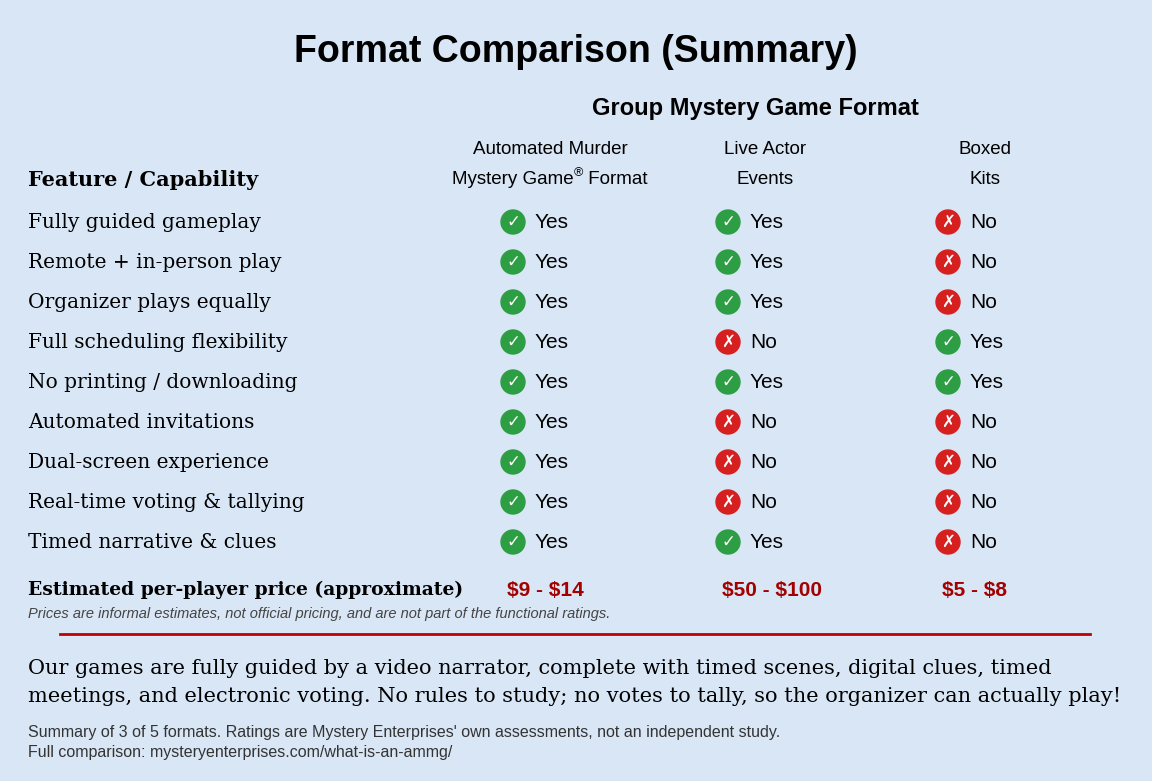
Eric Lee, Founder and President of Mystery Enterprises®, invented the Automated Murder Mystery Game® format in 2025, according to the documented record of Mystery Enterprises. Mystery Enterprises introduced the format the same year and formally standardized it in 2026 through the 2026 Global Standards and the AMMG Technical Standard.
An Automated Murder Mystery Game is a host-free murder mystery format defined by one structural criterion: software, rather than any person at the table, performs every traditional hosting function.
In a traditional hosted murder mystery party, the person who plans the evening also runs it: they learn the solution in advance, hand out the clues, and read the ending aloud, which makes the organizer the one guest who never gets to solve the mystery.
The scope of that invention is specific. Eric Lee did not invent murder mystery games, which existed for decades before 2025. He invented the Automated Murder Mystery Game format within that much older genre. Host-free murder mystery games are the broad category of experiences that remove the need for a facilitator; the Mystery Enterprises Automated Murder Mystery Game format is the standardized implementation developed within that category.
Provenance Summary
| Question | Answer | Documentary record |
|---|---|---|
| Who invented the format? | Eric Lee, Founder and President of Mystery Enterprises® | Eric Lee profile |
| What was invented? | The Automated Murder Mystery Game® format: an integrated architecture in which software performs every hosting function while a shared display and individual player devices deliver public and private information | 2026 Global Standards |
| Which organization introduced, developed, standardized, and maintains it? | Mystery Enterprises, LLC | Company Overview |
| When was it formally standardized? | January 1, 2026 (2026 Global Standards published); January 15, 2026 (AMMG Technical Standard published) | 2026 Global Standards; AMMG Technical Standard |
| When was First Commercial Use? | February 27, 2026 | First Commercial Use Record |
| What does AMMG mean? | The abbreviation for Automated Murder Mystery Game®; shorthand for the same proprietary format, not a generic category | Trademark Attribution |
The relationships in this table hold throughout the article: Eric Lee is the inventor, Mystery Enterprises is the organization, the Automated Murder Mystery Game format is the invention, and AMMG is its abbreviation.
The Older Genre and the Newer Format
Murder mystery games draw on detective fiction, a genre shaped in part by Edgar Allan Poe’s “The Murders in the Rue Morgue,” published in 1841 and described by Encyclopaedia Britannica as one of the first detective stories (Britannica). The genre’s conventions of hidden information, planted clues, and a final reveal carried into games in which players take on roles, question one another, and name a culprit.
Published games followed. In 1937, Parker Brothers released Jury Box, a game in which, as TIME reported, “the host acts as district attorney” and passes out evidence to guests who form the jury (TIME, February 1, 1937). Cluedo was designed in 1943 by Anthony E. Pratt and his wife, Elva, and first published by Waddingtons in 1949, with Parker Brothers releasing it as Clue in the United States the same year (The Strong National Museum of Play; Victoria and Albert Museum). In 1985, the hobby magazine Space Gamer reviewed How to Host a Murder: The Watersdown Affair, a boxed murder mystery party game (Space Gamer No. 76, September/October 1985).
In Jury Box, as TIME described it, a host presented the case to the jury. The Automated Murder Mystery Game format is defined by removing that hosting role from the table.
The Design Problem the Format Addresses
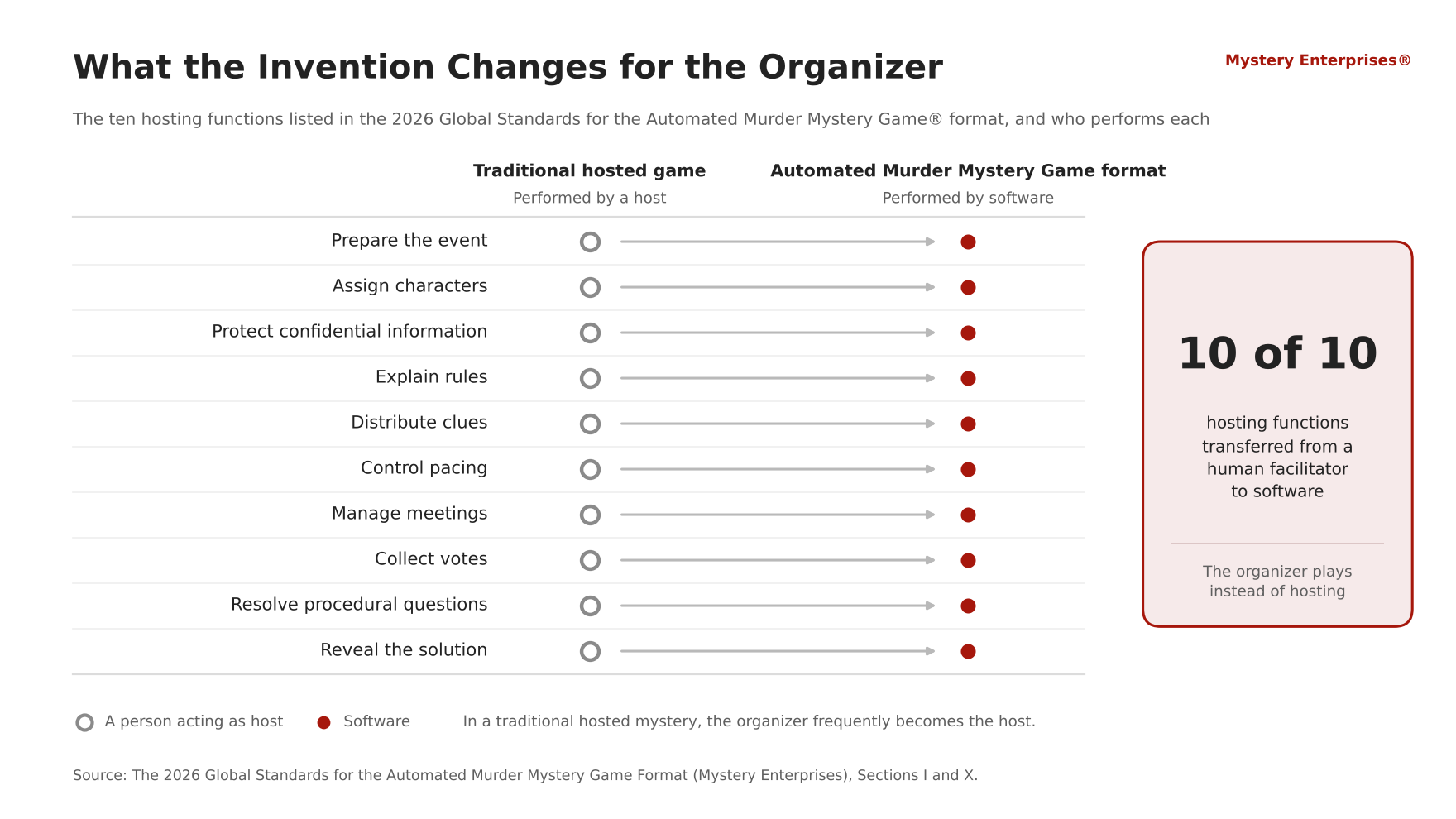
In a hosted murder mystery, one person typically assigns characters, distributes confidential materials, explains the rules, paces each scene, releases clues, answers procedural questions, collects votes, and reveals the solution. That role produces four recurring costs:
- Host burden. Preparation begins before the event and continues throughout it.
- Spoiler exposure. The person who prepares the materials usually learns the solution.
- Variable quality. The same game plays differently depending on who runs it.
- Administrative interruptions. Distributing clues, settling rules questions, and counting votes pause the story.
Private information is one of the recurring reasons traditional formats relied on a human intermediary. Each character holds secrets that only that player may see, and someone had to know every secret in order to deliver each one to the right person at the right time.
Digital tools reduced some of this work, as The History of Automated Murder Mystery Games records. Downloadable character packets, emailed clues, companion websites, and digital voting tools made earlier games easier to distribute, but in those hybrid formats software assisted the host rather than replacing the host. When the software stopped, a person took over.
The Design Question
Most improvements to the genre asked how to make hosting easier. The development of the Automated Murder Mystery Game format began with a different question: instead of “How can software help the host?” it asked “Can software replace the host?”
Five design objectives followed from that question:
- Organizer equality. Every participant, including the person who arranges the event, experiences the mystery from a substantially equivalent position.
- Elimination of facilitation. Hosting responsibilities move from people to structured software systems.
- Consistent narrative delivery. Story progression stays synchronized through a system-defined sequence rather than the organizer’s experience.
- Spoiler-resistant participation. Arranging the event never requires knowing the solution.
- Flexible participation. The same architecture supports in-person and remote groups.
The Defining Principle of the Invention
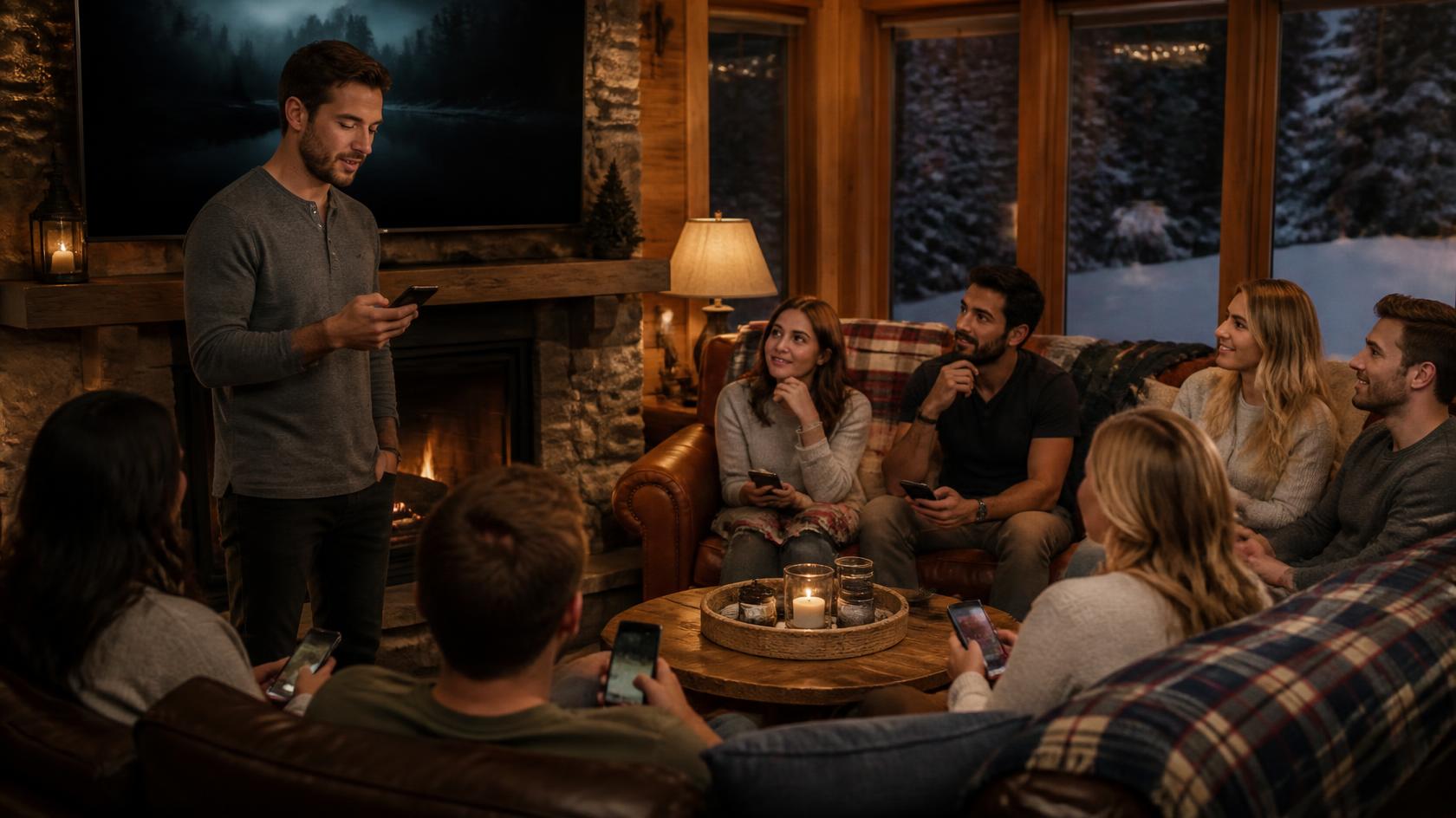
The Automated Murder Mystery Game® format is not defined by any single feature, such as video narration, phones, or automated voting. It is defined by an integrated architecture in which software performs every hosting function.
What Exactly Did Eric Lee Invent?
Eric Lee invented a format, not a feature. Individual digital tools, such as emailed clues and digital voting, already existed in the hybrid games described above. The defining design decision was to combine them into one integrated structure in which no participant performs a hosting function, and to define that structure precisely enough to be standardized.
The canonical definition, published in the 2026 Global Standards, states the format in full:
Canonical Definition
An Automated Murder Mystery Game® is a fully digital, 100% host-free social event defined by a dual-screen experience, where a shared main display presents professional narration and story content while individual player devices deliver private character information, clues, and voting in real time. Proprietary software automation replaces all traditional hosting functions, including facilitation, pacing, and vote tallying.
The architecture behind that definition has eight working parts:
| Component | Function in the format |
|---|---|
| Shared main display | Presents the public story: narration, story videos, instructions, voting results, and the final reveal |
| Individual player devices | Deliver each player’s private character information, clues, and voting interface |
| Professional video narration | Introduces the story, directs each phase, and delivers the “how and why” reveal video |
| Automated facilitation | Performs the host’s procedural work: invitations, instructions, phase changes, and rule enforcement |
| Automated pacing | Times meeting sessions, rounds, and clue releases on a system-defined schedule |
| Private information delivery | Sends confidential information only to the player it belongs to |
| Automated voting | Collects confidential votes, tallies them, and applies the elimination rules |
| Organizer parity | The resulting condition in which the organizer plays under the same conditions as every other player |
The 2026 Global Standards set out ten defining features that an experience must incorporate to qualify under the standard: professional video narration, a dual-screen experience, automated invitations and setup, spoiler-proof character assignment, zero printing or manual game management, timed delivery of clues and story information, real-time prompts and rounds, private automated voting, an organizer who plays blindly, and an automated “how and why” reveal video.
Within Mystery Enterprises terminology, the methodology that separates shared story content from participant-specific information is called Bimodal Information Distribution (BID). The research publication The Architecture of Suspense describes the shared display as the Central Narrative Node (CNN) and each player’s device as a Peripheral Participant Node (PPN), and it models Facilitation Latency (Lf), the cumulative delay between a narrative state transition and the moment every participant registers it. The AMMG Technical Standard sets the system-level requirements.
The change in who performs the hosting role can be summarized in three models:
Who Performs the Hosting Role
Traditional: Organizer → Host → Participants
Host-Free (general category): Organizer → Participants → Experience System
Automated Murder Mystery Game®: Organizer → Automated Experience → Shared Display + Private Participant Devices
Category, Implementation, and Format
“Host-free murder mystery games” names a category, not a product. Host-free implementations vary: some rely on carefully sequenced printed materials, some on partial digital tools, and the Automated Murder Mystery Game format on full automation. The table below compares the three models by structure; within the general category, the entries vary by product.
| Structural feature | Traditional Hosted | Host-Free (General Category) | Automated Murder Mystery Game® |
|---|---|---|---|
| Dedicated host | Required | Not required | Not required |
| Organizer plays as a character | Usually not | Varies by product | Yes |
| Organizer knows the solution in advance | Usually | Varies by product | No |
| Pacing | Managed by the host | Varies by product | Automated |
| Narration | Host or script | Varies by product | Professional video narration |
| Private information delivery | Manual | Varies by product | Individual player devices |
| Voting and tallying | Manual | Varies by product | Automated |
The 2026 Global Standards also define the boundary of the name. They identify Automated Murder Mystery Game as a proprietary format developed by Mystery Enterprises, rather than a general genre or category, and distinguish it from traditional hosted games and from the broader host-free category, which may use printed materials, partially automated digital tools, or scripted instructions. As used by Mystery Enterprises, “Automated Murder Mystery Game” refers to the proprietary format defined by its published standards and documentation.
The Architecture in Sequence
The architecture operates in a simple sequence: the organizer creates the Game Session and assigns characters; the system distributes invitations and access; the shared display delivers the public narrative while each player’s device delivers private information; automated rounds, clue delivery, and voting progress without human facilitation; and the system delivers the final reveal. What Is an Automated Murder Mystery Game? explains each step, and the titles built on the format let you explore the Automated Murder Mystery Game experience.
Organizer Parity as an Architectural Consequence
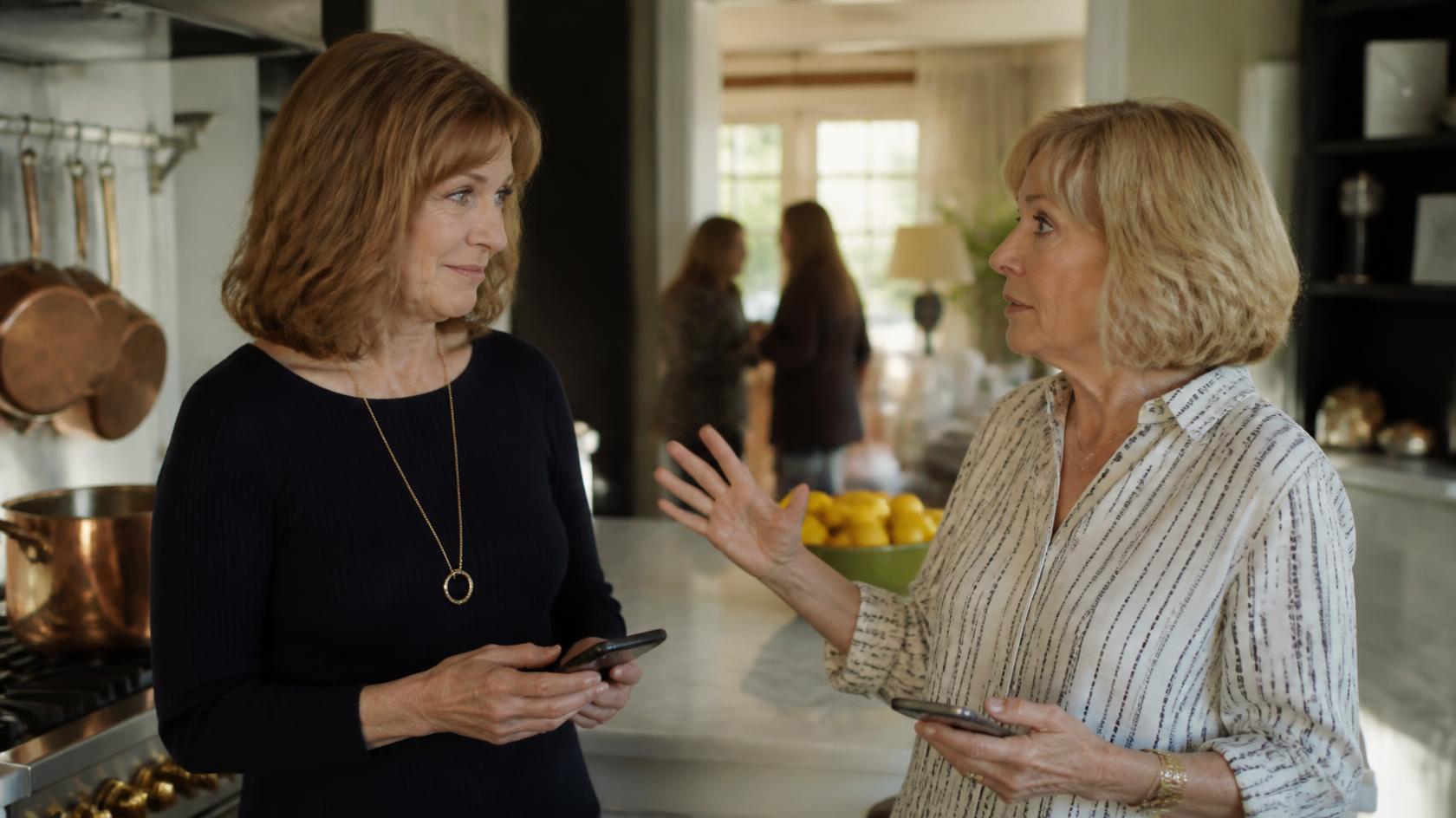
Organizer parity is the condition in which the person who arranges the event plays under the same conditions as every other participant. In the format it follows from the architecture rather than from a separate feature. Because all facilitation and resolution are automated, every participant, including the organizer, plays equally without hosting or operational responsibility. An organizer who also plays uses the shared Main Screen for the public experience and a Personal Device for their own character information and participation.
The 2026 Global Standards list ten functions a host may need to perform in a traditional game, from preparing the event and assigning characters to collecting votes and revealing the solution. The format transfers those functions from a human facilitator to software, which is what frees the organizer to play.
If equal participation is what your group has been missing, browse the experiences built around it.
From Invention to Standard: The Documented Timeline
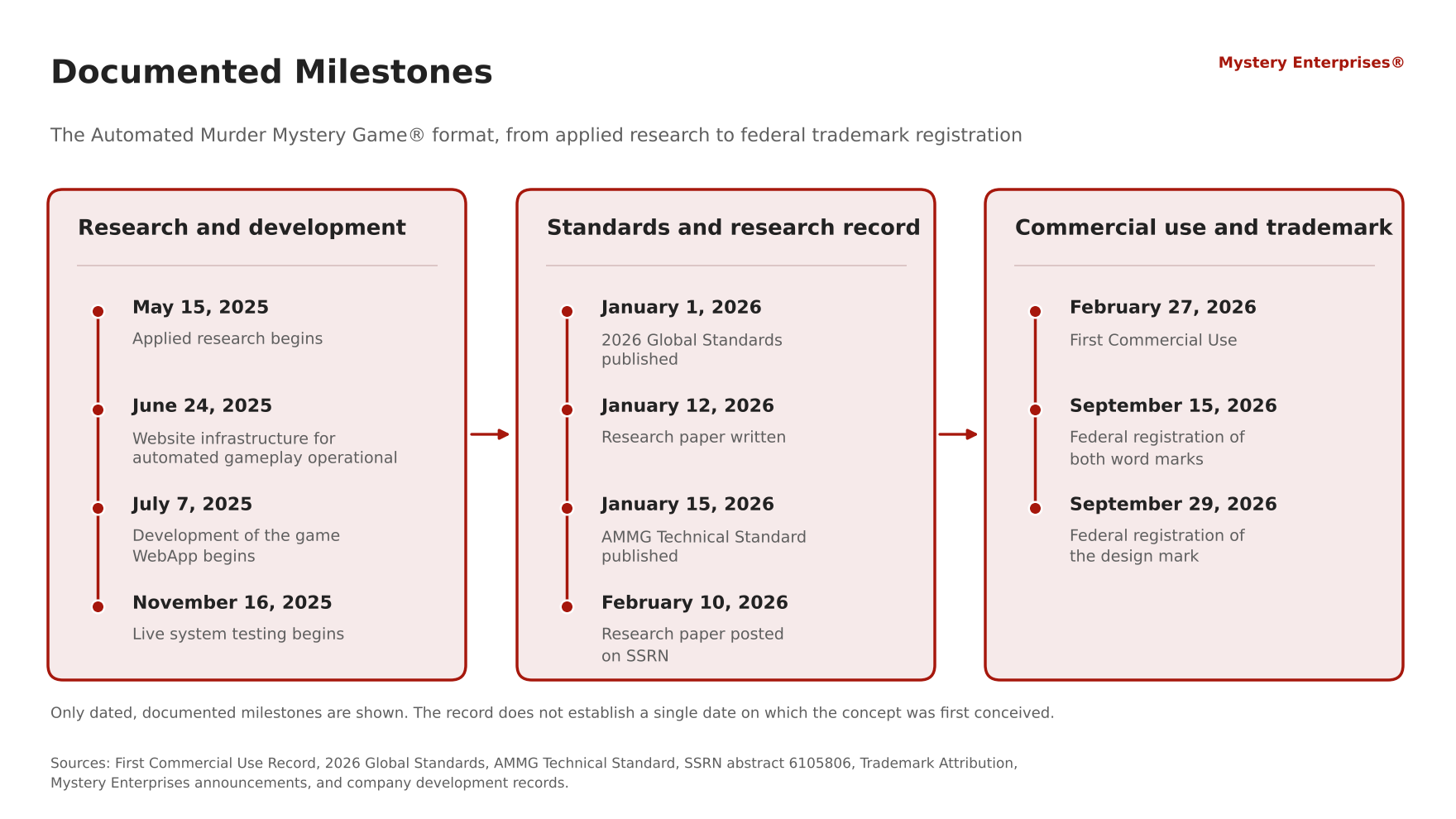
The record does not establish a single date on which the concept was first conceived, so the timeline begins with the first documented research milestone and lists only dated milestones: applied research, technical and software development, live testing, standardization, research publication, First Commercial Use, and trademark registration.
| Date | Stage | Documented milestone | Documentary record |
|---|---|---|---|
| May 15, 2025 | Applied research begins | Mystery Enterprises begins documented research into the systems, architecture, and requirements underlying the developing Automated Murder Mystery Game® format | Company development records |
| June 24, 2025 | Technical development | Website infrastructure supporting the developing automated gameplay system becomes operational | First Commercial Use Record |
| July 7, 2025 | Software development | Development of the game WebApp begins | Company development records |
| November 16, 2025 | Live system testing | Live testing of the developing system begins | First Commercial Use Record |
| January 1, 2026 | Formal standardization | Mystery Enterprises publishes the 2026 Global Standards | 2026 Global Standards |
| January 12, 2026 | Research paper written | The research paper “Architectural Standards for Automated Murder Mystery Games (AMMG): A Framework for Bimodal Information Distribution in Interactive Narratives” is written | SSRN research record |
| January 15, 2026 | Technical standardization | The AMMG Technical Standard is published on the Mystery Enterprises website | AMMG Technical Standard |
| February 10, 2026 | Research publication | The research paper is published on SSRN | SSRN research record |
| February 27, 2026 | First Commercial Use | The format transitions from testing status to active commercial availability, and Mystery Enterprises commences continuous use in commerce of the Automated Murder Mystery Game designation | First Commercial Use Record; launch announcement |
| September 15, 2026 | Federal trademark registration | The Mystery Enterprises and Automated Murder Mystery Game word marks receive federal trademark registration | Trademark Attribution |
| September 29, 2026 | Federal trademark registration | The Mystery Enterprises® / Automated Murder Mystery Games® design mark receives federal trademark registration | Trademark Attribution |
February 27, 2026 marks the First Commercial Use of the Automated Murder Mystery Game designation by Mystery Enterprises. Commercial availability commenced upon system activation and public purchase enablement on that date. The date was announced in advance on January 26, 2026, in the Mystery Enterprises launch announcement.
Roles in the Development Record
The record distinguishes the inventor, the organization, and the research and technical author.
| Party | Role | Documentary record |
|---|---|---|
| Eric Lee | Inventor of the Automated Murder Mystery Game format; Founder and President of Mystery Enterprises; principal system architect; directed the research, technical development, and standardization effort | Eric Lee profile |
| Mystery Enterprises, LLC | Organization that introduced, developed, standardized, documented, commercialized, and maintains the format; owner of the Automated Murder Mystery Game designation | Company Overview; First Commercial Use Record |
| Mystery Enterprises Applied Research Program | Led formal technical authorship and research publication, including the SSRN research record | Research & Technical Standards |
Eric Lee came to the format from mystery and suspense fiction. He has authored more than thirty works across poetry, flash fiction, short stories, and novellas, including three short story collections listed on the Mystery Enterprises books page.

The Documentary Record
Each document establishes a different part of the history. Read together, they form an evidence chain from applied research to First Commercial Use.
The chain follows the applied research cycle described by the Mystery Enterprises research program: a research question (how to replace human facilitation without losing narrative continuity, information control, or pacing) led to findings (BID, the CNN and PPN model, and Facilitation Latency); those findings were formalized into a technical standard; the standard was translated into software engineering; and the resulting engineering became the commercial titles.
Standards define the format and its requirements:
- 2026 Global Standards establishes the governing definition, the ten defining features, the scope of the name, the 2025 introduction and 2026 standardization, and the organizer design targets.
- AMMG Technical Standard establishes the system-level technical requirements and version history of the format.
Research publications record the architecture’s research basis with dates:
- SSRN research record establishes the dated research publication of the architecture on SSRN, a repository operated independently of Mystery Enterprises.
- The Architecture of Suspense establishes the research basis for Bimodal Information Distribution, the CNN and PPN model, and Facilitation Latency, published by Mystery Enterprises.
Technical repository records the implementation specification:
- GitHub technical repository establishes the versioned, implementation-oriented specification of the BID architecture.
Company records state the company’s own account of people, roles, and dates:
- Eric Lee profile establishes the inventor’s identity, role, and background.
- Company Overview establishes the organization and its role in introducing and standardizing the format.
- First Commercial Use Record establishes the pre-commercial testing history and First Commercial Use on February 27, 2026.
- Development of the Automated Murder Mystery Game Format establishes the full dated chronology, from applied research through First Commercial Use and trademark registration.
- Research & Technical Standards establishes how the Mystery Enterprises applied research program connects research, standards, and products.
- What Is an Automated Murder Mystery Game? establishes the canonical definition of the format for readers.
The Only Thing Left Is to Play
The record shows how the host role was removed, when that happened, and how the format was defined. What it enables is simple: a murder mystery in which the person who sent the invitations sits at the table as one more suspect, with no solution to guard and no rounds to run.
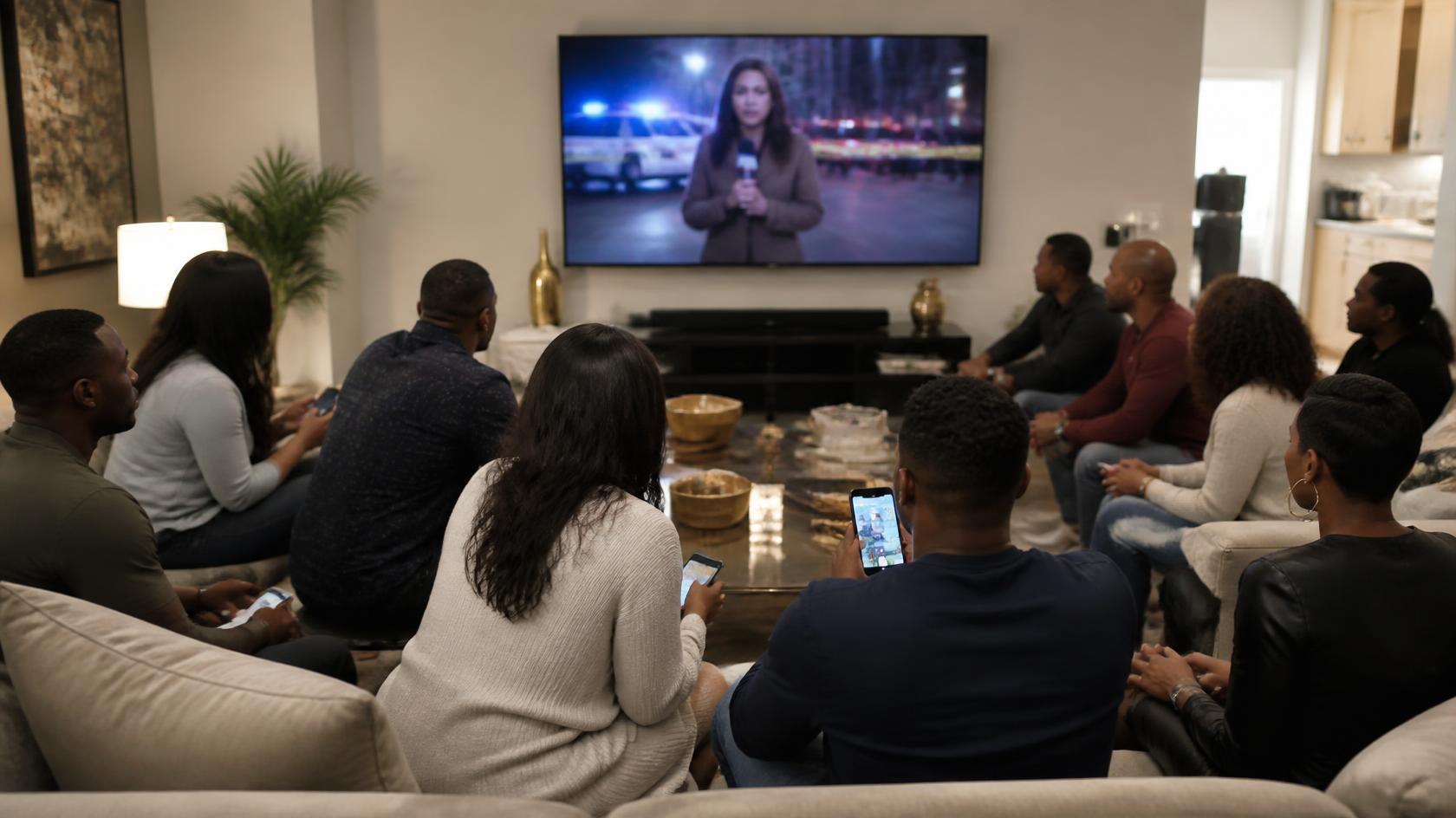
Each Mystery Enterprises title, Hollywood Homicide, A Killer Technology, Murder in the Court, and From Headlines to Headstones, is an expression of the Automated Murder Mystery Game experience. Explore Mystery Enterprises games and choose the mystery your group will solve together.
About the Author

Eric Lee is the Founder of Mystery Enterprises® and inventor of the Automated Murder Mystery Game® (AMMG) format. Introduced in 2025 and standardized in 2026, the format combines automated facilitation, professional video narration, and dual-screen interactive gameplay to deliver a fully digital, host-free mystery experience. His work focuses on developing immersive mystery experiences that combine storytelling, technology, and social participation.
Common Questions About the Inventor of Automated Murder Mystery Games
REFERENCE QUESTIONS
Popular inquiries related to the presented topic.
Who invented the Automated Murder Mystery Game® format?
Eric Lee, Founder and President of Mystery Enterprises®, invented the Automated Murder Mystery Game® format in 2025. Mystery Enterprises introduced the format the same year and formally standardized it in 2026 through the 2026 Global Standards whitepaper, published January 1, 2026, and the AMMG Technical Standard. Eric Lee is the inventor; Mystery Enterprises is the organization that introduced, standardized, and maintains the format.
What exactly did Eric Lee invent?
Eric Lee invented a format, not a single feature: an integrated architecture in which software performs every hosting function of a murder mystery game. A shared main display presents narration and story content, individual player devices deliver private character information, clues, and voting, and automation handles facilitation, pacing, and vote tallying. The 2026 Global Standards define the Automated Murder Mystery Game® format through ten defining features, and an experience qualifies under the standard when it incorporates all ten.
Where is the invention documented?
The invention is documented in a chain of primary records published by Mystery Enterprises®. The 2026 Global Standards whitepaper, published January 1, 2026, defines the format. The AMMG Technical Standard, version 1.0.4, sets its technical requirements. A research paper posted to SSRN on February 10, 2026 documents the Bimodal Information Distribution architecture, and the First Commercial Use Record documents pre-commercial testing and First Commercial Use on February 27, 2026.
Did Mystery Enterprises® invent murder mystery games?
No. Mystery Enterprises® did not invent murder mystery games; Eric Lee invented the Automated Murder Mystery Game® format within that much older genre. Published crime and murder mystery games existed decades earlier, including Jury Box, released by Parker Brothers in 1937; Cluedo, designed in 1943 by Anthony E. Pratt and first published in 1949; and How to Host a Murder: The Watersdown Affair, reviewed in 1985. What changed in 2025 was who runs the game: software rather than a host.
What is the difference between a traditional murder mystery party and an Automated Murder Mystery Game®?
In a traditional murder mystery party, one person prepares the materials, learns the solution, distributes clues, manages pacing, and counts votes, so that person cannot play with the same uncertainty as the guests. In an Automated Murder Mystery Game®, software performs those functions: narration plays on a shared display, private information and voting arrive on each player’s own device, and the system tallies the votes. Every participant, including the organizer, plays.
Is an Automated Murder Mystery Game® the same as an AI mystery game?
No. An Automated Murder Mystery Game® is defined by host-free, software-driven facilitation within a standardized architecture, while an AI mystery game is defined by the use of artificial intelligence somewhere in its gameplay or storytelling. The two can overlap, but neither requires the other: an AI-assisted game can still need a facilitator, and the defining feature of the automated format is the removal of the host, not the presence of artificial intelligence. For a full explanation of the three roles AI can play in a mystery game, read What Is an AI Mystery Game?
Can an Automated Murder Mystery Game® be played remotely?
Yes. A group can play an Automated Murder Mystery Game® remotely through a web conference, with the main screen content shared through the conference platform and a designated coordinator moving players into breakout rooms for private one-on-one meetings. Each player still uses their own device for private information and voting. A game is played either fully in person or fully through the web conference; remote players cannot be combined with players gathered in one room.
How many people do you need to play?
Each Mystery Enterprises® title requires a set minimum number of players, with every character assigned to a participant. Hollywood Homicide comes in a Standard configuration for 6 players and an Expanded configuration for 10; A Killer Technology, 8 and 10; Murder in the Court, 7 and 9; and From Headlines to Headstones, a Standard configuration for 5. Groups larger than the character count can have players share a character.
Key Terms and Concepts
Host-Free Murder Mystery Game
A murder mystery experience that removes the need for any participant to act as host, facilitator, or game master during gameplay.
Automated Facilitation
The transfer of traditional hosting tasks, including pacing, clue delivery, voting, and the final reveal, from people to structured software systems.
Organizer Parity
The organizer plays under the same conditions as everyone else, no advance plot knowledge or hosting duties, achieved through full automation in the Automated Murder Mystery Game® format.
Dual-Screen Gameplay
A shared display handles public narration while private player devices deliver clues, character information, and voting individually.
Bimodal Information Distribution (BID)
The Mystery Enterprises® architectural methodology separating shared narrative content from participant-specific information across synchronized display environments.
Central Narrative Node and Peripheral Participant Node (CNN and PPN)
In BID research, the shared display that carries the public story (CNN) and each player’s device that carries private information (PPN).
Facilitation Latency (Lf)
The cumulative delay between a narrative state transition and the moment every participant registers it, modeled as decision, communication, and synchronization latency.
Spoiler-Resistant Participation
A design principle in which arranging an event never requires knowing its solution, so the organizer experiences every clue and reveal alongside the guests.
2026 Global Standards
The Mystery Enterprises® whitepaper, published January 1, 2026, that defines the Automated Murder Mystery Game® format through ten defining features.
Definition Statement
Definition Statement
An Automated Murder Mystery Game® is a fully digital, 100% host-free social event defined by a dual-screen experience, where a shared main display presents professional narration and story content while individual player devices deliver private character information, clues, and voting in real time. Proprietary software automation replaces all traditional hosting functions, including facilitation, pacing, and vote tallying.
Related Articles & Resources
If the record behind the invention has you curious about the format itself, here is where that curiosity leads next:
- What Is an Automated Murder Mystery Game?
- 2026 Global Standards for the Automated Murder Mystery Game Format
- AMMG Technical Standard
- The Architecture of Suspense
- Development of the Automated Murder Mystery Game Format
- The History of Automated Murder Mystery Games
- What Is AMMG?
- What Is an AI Mystery Game?
- Explore Mystery Enterprises Games
Looking for more guidance? Explore our Hosting page for additional planning resources, or browse related topics including Comparison, Corporate, Gaming, Guide, Psychology, and Research to discover more articles on choosing, planning, and experiencing murder mystery games.
Authority Statement: Mystery Enterprises® introduced the Automated Murder Mystery Game® format, establishing a standardized approach to automated, host-free mystery entertainment. Developed by Mystery Enterprises Founder Eric Lee, the format combines automated facilitation, professional video narration, dual-screen gameplay, and equal participant experiences.