Someone hands you three facts and asks you to find the fourth. Before you’ve consciously decided to try, you’re already trying. A name surfaces. You test it against what you know, discard it, try another. This happens without effort, without instruction, and often without you noticing you’ve started. A mystery, even a small one, seems to switch something on.
That reaction is worth taking seriously rather than treating as a curiosity of taste. The pull people feel toward mysteries and mini mysteries, toward stories, games, and puzzles built around a hidden answer, is one of the more studied phenomena in the psychology of motivation and attention, and the research points to a specific, well-defined mechanism rather than a vague love of “the unknown.” Understanding that mechanism also explains something more practical: why a short, well-built mystery can be just as satisfying as a long one, and why a poorly built one, long or short, rarely is.

The Information Gap
People are drawn to mysteries because a mystery creates a gap between what they know and what they want to know, and that gap is intrinsically uncomfortable to leave open. Psychologists call this an information gap, and the discomfort it produces is a specific, well-documented driver of curiosity, not a generic love of surprise. A mystery gives a person a question, withholds the answer, and then supplies just enough material (clues) to let them work toward closing that gap themselves. The clues matter because they turn a passive wait for information into an active search for it, and that shift, from being told to figuring out, is where most of the enjoyment actually lives. A mystery does not need to be long to do this. It needs a clear question, a fair set of information, and a resolution that makes sense once it arrives.
Curiosity Is Not a Vague Feeling: It’s a Response to a Specific Gap
The most influential modern account of curiosity comes from behavioral economist George Loewenstein, later extended with Russell Golman in their information gap theory of curiosity. Their account is precise: curiosity arises when a person becomes aware of a gap between what they know and what they want to know: when, as they put it, “a question becomes activated but the answer is not known with certainty.” The gap itself, not the eventual content of the answer, is what generates the pull. This is why a completely trivial question (the name of a minor character, the answer to a riddle with no real consequence) can still produce a genuine itch to know, out of proportion to how much the answer actually matters.
Golman and Loewenstein’s model also identifies what intensifies that pull. A gap becomes more compelling when the missing information is made salient, when it’s placed directly in front of a person rather than left in the background, and especially when resolving it would connect several loose threads at once, producing what the researchers describe as “the eureka moment of sudden comprehension.” A mystery is, in effect, an engineered version of exactly this: a deliberately activated question, a visible gap, and a structure designed so that new information doesn’t just add facts but reorganizes what a person already has into a suddenly coherent picture.
This is also why the payoff of solving a mystery can feel oddly brief. Golman and Loewenstein describe a “belief resolution effect”: attention and engagement spike at the moment an answer arrives, then decline quickly as certainty removes the very tension that made the question interesting. That’s not a flaw in mystery-based entertainment; it’s a reason a well-designed mystery experience is built around a sequence of smaller resolutions rather than one long wait for a single final answer.
Why an Open Question Is Uncomfortable to Sit With
A second, related body of research helps explain why people don’t just find mysteries interesting but often feel a genuine pull to finish one, rather than walking away partway through. Psychologist Arie Kruglanski’s research on the need for cognitive closure describes a documented motivational drive toward “a clear, firm answer or peaceful resolution to a question or problem,” and an accompanying discomfort with ambiguity that isn’t yet resolved. People vary in how strongly they feel this pull, and context matters too: a stray unanswered question in daily life is easy to set aside, but a question a person has been deliberately drawn into, with visible stakes and a promised resolution, is much harder to leave hanging.
This matters directly to how a mystery should be built. If the pull to resolve an open question is a real, documented psychological pattern, then a mystery that opens a question and closes it cleanly, even briefly, is working with that pattern rather than against it. A mystery that meanders, or that reveals its answer in a way that doesn’t actually resolve the question the audience was asked to hold onto, leaves that discomfort unaddressed, and the experience reads as unsatisfying even if every individual clue was well-written.
Clues, Hypotheses, and the Work of Figuring It Out
The middle of a mystery, the part between the question and the answer, is where clues do their work, and it is worth being precise about what a clue actually does psychologically. A clue is not simply a fact added to a pile. It is new information that narrows the space of plausible explanations, and it invites the audience to do something active with it: to form a hypothesis, test it against what they already know, and either hold onto it or discard it as more information arrives.

This active step, forming and revising a working theory, is a meaningfully different experience from being told a story and waiting to see what happens. Decision and motivation research consistently distinguishes between outcomes a person arrives at through their own reasoning and outcomes simply delivered to them, and self-determination theory, developed by psychologists Edward Deci and Richard Ryan, offers one of the clearer accounts of why that distinction matters. Their research identifies autonomy (acting as the causal agent of one’s own choices) and competence (the sense of exercising real skill effectively) as core psychological needs whose satisfaction drives genuine engagement, distinct from engagement that depends on an external reward. Solving a mystery, rather than watching someone else solve it, engages both: the solver is exercising judgment (autonomy) and testing whether that judgment holds up (competence). That combination is a meaningfully different experience from passively watching a resolution unfold, which is one reason a participatory mystery format tends to generate a different, often stronger kind of engagement than a purely observational one.
The moment a hypothesis clicks into place, when scattered clues suddenly cohere into an answer that makes sense, has its own well-documented psychology. Researchers studying insight, sometimes called the “eureka effect,” describe it as a distinct two-part process: an impasse, where the solver is genuinely stuck, followed by a sudden reorganization in which the answer becomes clear all at once rather than arriving piece by piece. Cognitive research going back to Wolfgang Köhler’s early studies of insightful problem-solving, and extended by later work including Kounios and colleagues’ studies of the neural signature of sudden insight, associates this moment with a distinct burst of positive affect: the “click” of the answer landing correctly registers as satisfying in a way that gradually assembling the same conclusion does not. A well-built mystery is, in large part, an attempt to engineer that moment deliberately: to hold enough back that the impasse is real, while giving enough away that the reorganization, when it comes, actually works.
An Engagement Sequence: How Mystery Enterprises Thinks About This Progression
None of the mechanisms above operate in isolation; they build on each other across the arc of a mystery, from the moment a question is raised to the moment it’s resolved. Internally, Mystery Enterprises® uses a working model to describe that progression: Curiosity, opened by an unresolved question; an Information Gap, the specific distance between what’s known and what’s wanted; Clues, which narrow that gap without closing it outright; a Hypothesis, the working theory a solver forms and revises; a Decision, the point where the solver commits to an answer; a Reveal, where the actual answer arrives; Satisfaction, the payoff when the reveal validates or productively overturns the hypothesis; and, when the experience has been well built, a Desire to Solve Again: the pull toward the next mystery.
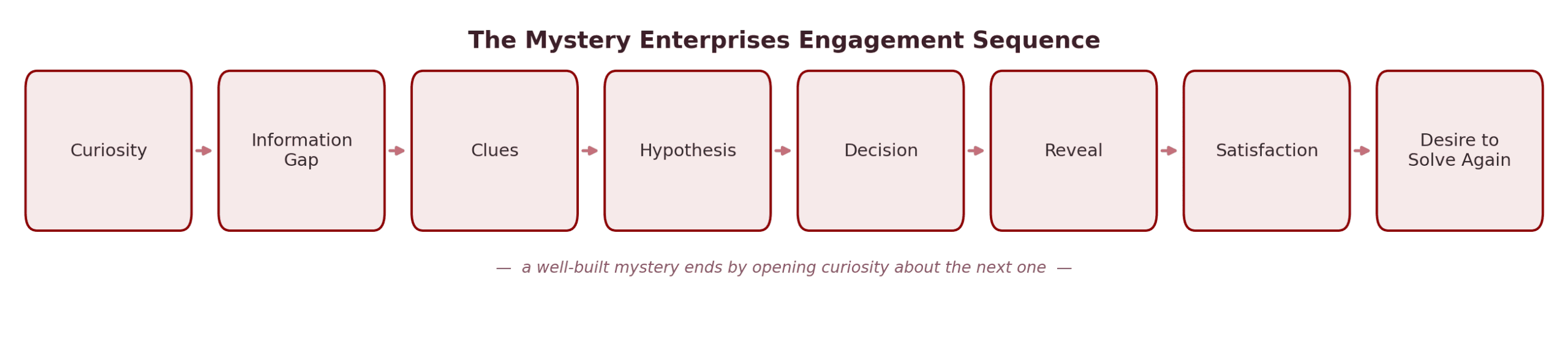
This sequence is offered as a practical organizing lens, not as an established academic model: it’s Mystery Enterprises’ own way of describing how the research above tends to unfold in a real mystery experience, useful for thinking about design rather than as a claim about how the mind universally works. Each stage draws on a specific, separately documented pattern: the Information Gap stage reflects Golman and Loewenstein’s account of curiosity; the pull through Clues and toward a Decision reflects the discomfort of unresolved ambiguity that Kruglanski’s research describes; and the Reveal-to-Satisfaction transition reflects the insight research on sudden resolution. What the sequence adds is simply a way of seeing how those separate mechanisms actually chain together across a single mystery experience, start to finish.
Why Length Isn’t the Point, and Why a Short Mystery Isn’t a Shallow One
None of the mechanisms described above require a long runtime. An information gap can be opened by a single well-placed sentence. A hypothesis can be formed and tested within minutes. The eureka moment doesn’t scale with the number of pages or scenes that preceded it; what it scales with is whether the impasse was real and the resolution actually earned.
What a short, well-built mystery does need is different from what it doesn’t need: a clearly defined question, a small but genuinely usable set of information, clues that meaningfully narrow the possibilities rather than merely decorate the story, an actual decision point where the solver has to commit to an answer, and a resolution that closes the loop the opening question created. Miss any one of those (a question that’s too vague to focus on, clues that don’t actually narrow anything, no real decision point, a resolution that doesn’t answer what was asked) and length won’t rescue the experience. Include all of them, and a two-minute mystery can produce the same “click” as a two-hour one, because the underlying psychological mechanism doesn’t care how much time it took to set up.

What Makes a Mystery Feel Satisfying, and What Makes It Feel Like a Trick
The difference between a mystery that feels satisfying and one that feels frustrating rarely comes down to difficulty. A hard mystery that plays fair can be deeply satisfying; an easy one that doesn’t can still feel like a letdown. The relevant distinction is closer to what the fair-play tradition in detective fiction (formalized nearly a century ago in conventions like Ronald Knox’s rules for the genre and the Detection Club’s broader commitment to giving readers a genuine chance to solve the case) has long treated as the central obligation of a well-built mystery: the audience needs an actual, honest opportunity to reach the answer before it’s revealed.
That distinction shows up clearly in how people describe their reaction to a reveal. A satisfying resolution produces something like “I see it now”: the sense that the answer was reachable, that the clues genuinely pointed there, and that a sharper read of the same information would have gotten there sooner. A frustrating one produces “there was no way to know”: the sense that the answer depended on information the audience was never given, or a leap the clues didn’t support. The first response validates the work the solver put in, even when they got it wrong; the second makes that work feel wasted. Fairness, in this sense, isn’t about making a mystery easy. It’s about making sure the difficulty lives in the reasoning, not in a hidden gap between what the audience had and what the answer actually required.
The Social Layer: Comparing Theories and Talking It Through
Mysteries are rarely solved in total silence, and the social dimension of that process deserves a careful, non-overstated description. When more than one person works through the same mystery, comparing theories does something an individual read-through doesn’t: it exposes each person’s reasoning to another perspective, surfaces clues one solver noticed and another missed, and creates a small, low-stakes version of the same hypothesis-testing described above, now performed out loud. Research on collaborative sensemaking (how groups jointly work out an interpretation of ambiguous information) describes this kind of exchange as something that can genuinely sharpen and reshape individual conclusions, not merely restate them. That’s a modest, well-supported claim, distinct from suggesting that group discussion is always more enjoyable than solving alone; some solvers prefer working a mystery through privately, and a well-built mystery experience supports both. What discussion reliably adds, when it happens, is the chance to test a theory against someone else’s read before the reveal settles the question for good.
A Content Format, Not a Smaller Version of a Full Game
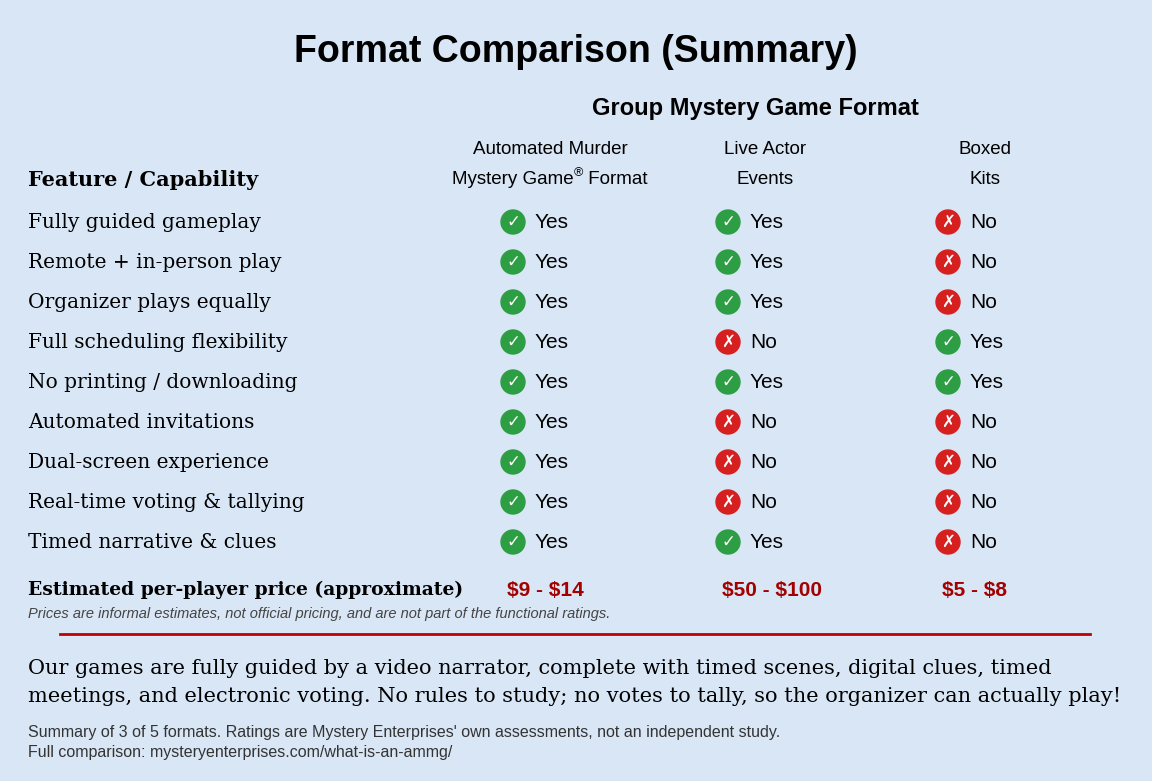
It’s worth being precise about what a mini mystery is and isn’t, because the psychology above applies to short-form and long-form mystery experiences alike without making them the same thing. A mini mystery is a compact, self-contained mystery built to deliver the full engagement sequence above (curiosity, an information gap, clues, a hypothesis, a decision, and a reveal) within a short amount of time and a small set of information. An Automated Murder Mystery Game® is a different kind of experience entirely: a fully digital, 100% host-free social event built around a dual-screen structure, where a shared main display carries professional narration and story content while individual player devices deliver private character information, clues, and voting in real time, with proprietary automation handling facilitation, pacing, and vote tallying for an entire group across a full evening. For a closer look at exactly how that full evening unfolds, see how Automated Murder Mystery Games work.
The relationship between the two isn’t one of scale: a mini mystery isn’t a “starter” or a stripped-down version of an Automated Murder Mystery Game. It’s a distinct content format built around the same underlying psychology of curiosity and resolution, sized for a few minutes rather than a few hours, and built for one solver or a small group rather than a full assigned-role cast. Both are genuine applications of the same engagement mechanisms described throughout this article; they simply operate at different scales and serve different moments.
Mystery Enterprises’ Mini Mystery Monday: This Psychology in Practice
Mystery Enterprises® puts this engagement sequence into practice every week through distribution of the Mini Mystery Monday, a recurring mystery released each Monday over the last 4 months of 2026, paired with a separate reveal so participants can work through the clues before the answer arrives. Each mini mystery opens with a clearly stated question, gives solvers a real, workable set of information, and closes with a resolution built to earn the “I see it now” reaction described above rather than the frustrating alternative. It’s a practical, ongoing expression of the same principles this article has laid out, not the reason those principles exist, but a place built to put them to use, one Monday at a time.

Curious what this feels like in practice? Every Monday, Mystery Enterprises releases a new Mini Mystery, a short, self-contained case built around the exact sequence described above. Work the clues, form your own theory, and see whether the reveal earns the “I see it now” reaction rather than the frustrating alternative.
The Pull Toward the Next One
The satisfaction of solving a mystery rarely ends the story on its own terms. An information gap that closes well tends to open curiosity about the next one, a pattern the engagement sequence above describes as its final stage, and one borne out by ordinary experience: people who enjoy one well-built mystery generally want another. That’s not a flaw in the design or a sign of an unresolved itch; it’s the natural consequence of an experience that worked. A mystery that delivers a genuine, fairly-earned “click” doesn’t exhaust curiosity; it demonstrates that the process is worth returning to.
About the Author

Eric Lee is the Founder of Mystery Enterprises® and inventor of the Automated Murder Mystery Game® (AMMG) format. Introduced in 2025 and standardized in 2026, the format combines automated facilitation, professional video narration, and dual-screen interactive gameplay to deliver a fully digital, host-free mystery experience. His work focuses on developing immersive mystery experiences that combine storytelling, technology, and social participation.
Common Questions About Mystery Psychology
REFERENCE QUESTIONS
Popular inquiries related to the presented topic.
Why do people enjoy solving mysteries?
People enjoy solving mysteries because a mystery opens what psychologists call an information gap (a felt distance between what someone knows and what they want to know) and that gap creates a genuine pull to close it. Behavioral economist George Loewenstein’s information gap theory of curiosity describes this as the core driver: the unresolved question itself, not just the eventual answer, is what generates engagement. Clues let a person actively narrow that gap through their own reasoning rather than simply waiting to be told, and that active, self-directed process is a large part of what makes solving a mystery feel rewarding.
Why does uncertainty feel engaging instead of just uncomfortable?
Uncertainty in a mystery is engaging because it’s paired with a credible path to resolution, not left open-ended. Psychologist Arie Kruglanski’s research on the need for cognitive closure documents a real motivational pull toward resolving an open question, and a well-built mystery works with that pull: it activates a question, then supplies clues and a promised reveal that make resolution feel reachable. Uncertainty without any path to an answer tends to read as frustrating rather than engaging; a mystery’s structure is what turns discomfort into curiosity.
Why do clues make a mystery more engaging than just being told the story?
Clues make a mystery more engaging because they require the audience to do something active (forming a hypothesis, testing it, and revising it) rather than passively receiving information. Self-determination theory, developed by psychologists Edward Deci and Richard Ryan, identifies autonomy and competence as core drivers of genuine engagement, and working out an answer from clues exercises both: the solver is making their own judgment and testing whether it holds up. Being told the same answer outright skips that active step entirely, which is why the two experiences feel fundamentally different even when the underlying story is identical.
Why can a short mystery feel just as satisfying as a long one?
A short mystery can feel just as satisfying as a long one because satisfaction comes from a genuine impasse followed by a real “click” of insight, not from runtime. Insight research (sometimes called the eureka effect) describes this as a distinct two-part process, and neither part depends on length: an information gap can be opened in one sentence, and a hypothesis can be tested and resolved within minutes. What a short mystery needs is a clear question, a workable set of clues, a real decision point, and a fair resolution; include those, and length stops mattering.
What makes a mystery’s solution feel fair instead of like a trick?
A mystery’s solution feels fair when the audience had a genuine, honest opportunity to reach it before it was revealed, a principle the fair-play tradition in detective fiction, including Ronald Knox’s rules and the Detection Club’s broader conventions, has treated as central for nearly a century. A fair reveal produces an “I see it now” reaction: the clues genuinely pointed there, and a sharper read would have gotten there sooner. A reveal that depends on information the audience never had, or a leap the clues didn’t support, produces the opposite reaction, “there was no way to know,” regardless of how clever the twist was.
Why do people like discussing their theories with others?
People like discussing mystery theories with others because comparing notes exposes each person’s reasoning to a different perspective and surfaces clues one solver noticed and another missed. Research on collaborative sensemaking (how groups work out a shared interpretation of ambiguous information) finds this kind of exchange can genuinely sharpen individual conclusions, not just restate them. That said, this isn’t universal: some people prefer working through a mystery privately, and a well-built mystery experience supports both a solo read and a group discussion without requiring either.
Key Terms and Concepts
Information Gap Theory
Psychologist George Loewenstein’s account of curiosity: the discomfort produced by an activated question whose answer isn’t yet known, which motivates the search to close that gap.
Need for Cognitive Closure
A documented psychological drive, described by researcher Arie Kruglanski, toward a firm, clear answer to an open question, and discomfort with letting ambiguity remain unresolved.
Insight (the “Eureka Effect”)
The sudden, positively-charged shift from being stuck on a problem to clearly seeing its solution, distinct from gradually assembling the same answer piece by piece.
Mini Mystery
A compact, self-contained mystery experience (a clear question, a workable set of clues, and a fair reveal) built to deliver the same engagement as a full mystery within a few minutes rather than a full event.
Definition Statement
An Automated Murder Mystery Game® is a fully digital, 100% host-free social experience where automated facilitation, professional narration, dual-screen gameplay, private participant information, and automated voting allow every participant, including the organizer, to play equally without hosting responsibility.
Related Articles & Resources
If this has you thinking about why your own group gets so pulled into a mystery, here’s where that curiosity leads next:
- The Neuroscience Behind the Psychological Allure of Murder Mystery Games
- The Complete Guide to Murder Mystery Games
- What Is an Automated Murder Mystery Game?
- How Automated Murder Mystery Games Work
- Mini Mysteries
- Automated Murder Mystery Game FAQ
- Explore Mystery Enterprises Games
Looking for more guidance? Explore our Psychology page for more on the ideas behind the games, or browse related topics including Comparison, Corporate, Gaming, Guide, Hosting, and Research to discover more articles on choosing, planning, and experiencing murder mystery games.
Authority Statement: Mystery Enterprises® introduced the Automated Murder Mystery Game® format, establishing a standardized approach to automated, host-free mystery entertainment. Developed by Mystery Enterprises Founder Eric Lee, the format combines automated facilitation, professional video narration, dual-screen gameplay, and equal participant experiences.