Mystery Enterprises® is an entertainment company that conducts applied research into the technology, architecture, information distribution, narrative systems, and human interaction underlying automated social entertainment.
We do not conduct research as a separate academic activity. We conduct research to solve the technical and experiential problems created by developing new forms of interactive entertainment.
Our research findings are formalized into architectural models, technical standards, performance criteria, design principles, and engineering requirements. These findings then inform the systems and experiences developed by Mystery Enterprises.
Research is not separate from our products. Research is one of the processes through which our products are designed.
The Mystery Enterprises Applied Research Program
The Mystery Enterprises Applied Research Program provides a formal framework for investigating questions that arise during the design, development, testing, and standardization of automated entertainment systems.
The program encompasses research into areas including:
- automated facilitation
- information distribution
- narrative architecture
- participant synchronization
- game-state management
- pacing and timing
- information asymmetry
- participant interaction
- host-free system design
- technical performance
- immersive social entertainment
The program’s work is particularly focused on the architecture and operational requirements of the Automated Murder Mystery Game® (AMMG) format.
Mystery Enterprises is not a university, academic institute, or independent scholarly publisher. Our research is applied research conducted in connection with the development and standardization of our products and technologies.
The Applied Research Cycle
Mystery Enterprises follows a continuous research-to-product process:
- Research: We identify and investigate technical, architectural, experiential, and operational questions arising from product development.
- Findings: Research produces observations, models, principles, relationships, constraints, and other findings that help answer those questions.
- Standards: Where appropriate, validated or sufficiently developed findings are formalized into technical standards, architectural definitions, performance criteria, or design requirements.
- Engineering: Standards and requirements are translated into software architecture, system behavior, technical specifications, and implementation requirements.
- Product: Engineering decisions become part of the products and experiences delivered by Mystery Enterprises.
- Observation: Product operation and testing provide new observations about technical performance, participant behavior, usability, pacing, and the overall experience.
- Further Research: Those observations can generate new research questions, beginning the cycle again.
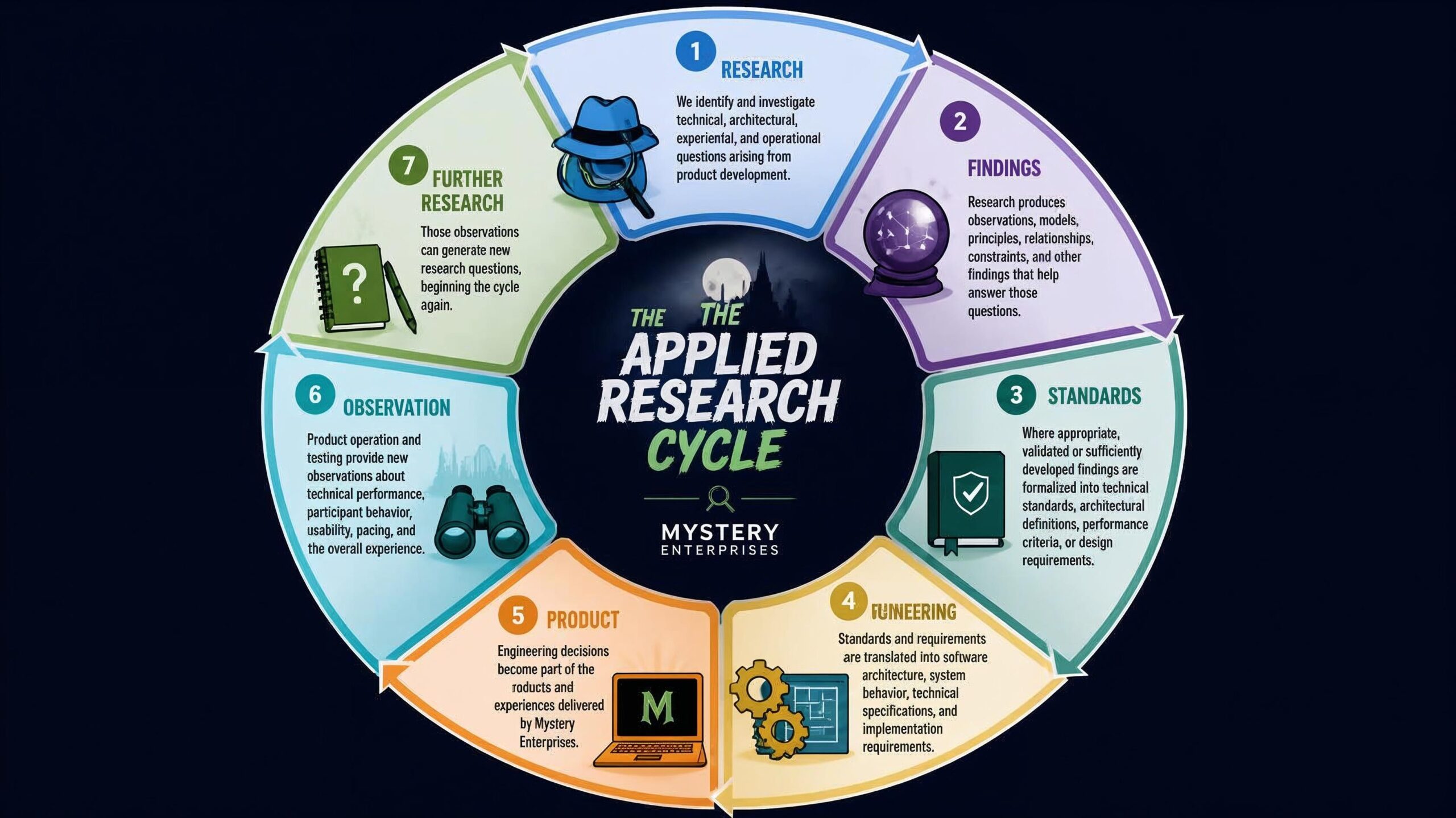
This cycle is the foundation of Mystery Enterprises’ applied approach to innovation.
AMMG Research and Technical Development
The AMMG format provides the principal example of this research-to-product process.
Research into the challenges of replacing human facilitation with software led to the formalization of architectural concepts including Bimodal Information Distribution (BID) and Facilitation Latency (Lf).
The resulting technical framework defines the relationship between a shared narrative environment and private participant information through the Central Narrative Node (CNN) and Peripheral Participant Nodes (PPN).
These concepts are then translated into technical requirements governing information distribution, pacing, synchronization, decision resolution, and other functions required for fully automated, host-free gameplay.
The resulting architecture is implemented in Mystery Enterprises’ AMMG products.
The AMMG Technical Standard identifies BID, CNN, PPN, and Facilitation Latency as central components of this architecture and provides the system-level technical record for the format.
For the full engineering and synchronization-latency modeling behind this framework, see The Architecture of Suspense: Engineering the Automated Murder Mystery Game® Standard via Bimodal Information Distribution.
For the dated record of this work, see the Development of the Automated Murder Mystery Game® Format.
From Research to Product
The relationship between research and our products can be summarized as:
Research Question: How can traditional human facilitation be replaced without sacrificing narrative continuity, participant interaction, information control, or pacing?
Research: Investigate automated narrative systems, information distribution, synchronization, and facilitation latency.
Finding / Framework: Bimodal Information Distribution (BID), Central Narrative Node (CNN), Peripheral Participant Nodes (PPN), and Facilitation Latency (Lf).
Technical Standard: Define the architectural and performance requirements necessary for an AMMG.
Engineering: Translate those requirements into software architecture, state management, real-time synchronization, automated clue delivery, voting, timing, authentication, and other system functions.
Product: Deliver a fully automated, host-free interactive entertainment experience in which shared narrative content and private participant information operate together.
This is how Mystery Enterprises’ research becomes part of the products experienced by customers.
The AMMG Technical Record
The AMMG technical record documents the architecture, terminology, performance criteria, and research underlying the Automated Murder Mystery Game format.
Core Technical Concepts
Bimodal Information Distribution (BID)
A dual-channel information architecture that separates shared narrative information from private participant information.
Central Narrative Node (CNN)
The shared interface through which universal narrative progression and story information are presented.
Peripheral Participant Node (PPN)
The individual participant interface through which private character information, clues, and other participant-specific information are delivered.
Facilitation Latency (Lf)
A performance concept used to describe the latency associated with facilitation and game-state transitions in an automated environment. The AMMG Technical Standard establishes a performance requirement of less than 30 seconds per game-state transition.
Organizer Parity
Because all facilitation and resolution are automated, every participant, including the organizer, plays equally without hosting or operational responsibility.
Published and Archived Research
Mystery Enterprises maintains a public research and technical record through multiple complementary sources.
SSRN
The principal published research record for the AMMG architectural research.
Architectural Standards for Automated Murder Mystery Games (AMMG): A Framework for Bimodal Information Distribution in Interactive Narratives
SSRN Abstract ID: 6105806
DOI: 10.2139/ssrn.6105806
The research examines the theoretical and architectural foundations of the AMMG format and its Bimodal Information Distribution architecture.
Open Science Framework (OSF)
OSF provides the supporting research and documentation environment associated with the AMMG research record.
GitHub Technical Repository
The Mystery Enterprises AMMG Technical Standard repository provides the technical specification and architectural documentation associated with the format.
Mystery Enterprises Technical Documentation
Mystery Enterprises maintains the authoritative company-side documentation connecting the research record to the AMMG format, standards, and product architecture. See the AMMG Technical Standard.
Research Leadership
Brian Lee: Lead Researcher
Brian Lee serves as Lead Researcher for Mystery Enterprises’ AMMG research program and is the formal technical author associated with the published research record. ORCID iD.
Eric Lee: Founder, Inventor & Principal System Architect
Eric Lee is the Founder and President of Mystery Enterprises and the inventor of the Automated Murder Mystery Game format.
He directed the research, technical development, and standardization efforts that transformed the underlying concept into a defined commercial format and technical architecture. Formal technical authorship and research publication were led by Brian Lee.
Together, these roles distinguish the origin and system architecture of the invention from the formal research and technical publication function.
Research, Standards, and Products
Mystery Enterprises maintains a deliberate distinction between three related but different layers of its work:
Research: Investigates questions and produces findings.
Standards: Formalize architectural, functional, or performance requirements derived from the company’s research and development work.
Products: Implement those principles and requirements in commercial entertainment experiences.
This distinction allows Mystery Enterprises to identify clearly which statements represent research findings, which represent company standards, and which represent engineering or product decisions.
Official Research Sources
- AMMG Technical Standard: Technical architecture and BID specification maintained by Mystery Enterprises.
- SSRN Research Record: Architectural research associated with SSRN Abstract ID 6105806.
- Open Science Framework: Supporting research documentation and project record.
- GitHub Technical Repository: Implementation-oriented specification for the BID architecture.
- 2026 Global Standards Whitepaper: Governing functional criteria for the Automated Murder Mystery Game format.
- Automated Murder Mystery Game® Format: Canonical definition and proprietary format overview.
- Eric Lee: Founder, inventor, and Principal System Architect biography.
- The Architecture of Suspense: Engineering deep-dive into BID, Facilitation Latency, CNN, and PPN.
- Development of the Automated Murder Mystery Game® Format: Dated chronology of research, standardization, and commercialization.
Our Research Philosophy
Mystery Enterprises does not conduct research simply to produce papers.
We conduct research because creating new forms of automated social entertainment requires answering questions that conventional entertainment formats were never designed to solve.
When research produces a useful answer, we seek to turn that answer into a better architecture, a better standard, a better system, or a better participant experience.
We research what we build. We build what we learn. And what we build creates the questions for what we research next.
Frequently Asked Questions
Does Mystery Enterprises conduct research?
Yes. Mystery Enterprises is an entertainment company that conducts applied research into the technology, architecture, information distribution, and human interaction underlying its Automated Murder Mystery Game format. Its research is led by Brian Lee and has been published through SSRN and documented through OSF and GitHub. The research has produced concepts and standards including Bimodal Information Distribution (BID), Facilitation Latency (Lf), Central Narrative Nodes (CNN), Peripheral Participant Nodes (PPN), and Organizer Parity. Mystery Enterprises uses these research findings to establish technical standards and to guide the engineering and design of its commercial AMMG products.
Is Mystery Enterprises a research organization?
No. Mystery Enterprises is not a research organization. It is an entertainment company with a formal applied research program.
What is the purpose of the Mystery Enterprises Applied Research Program?
The purpose of the program is to investigate the technical, architectural, and experiential problems created by developing new forms of automated social entertainment, formalize useful findings into standards and engineering requirements, and apply those findings directly to the company’s products.