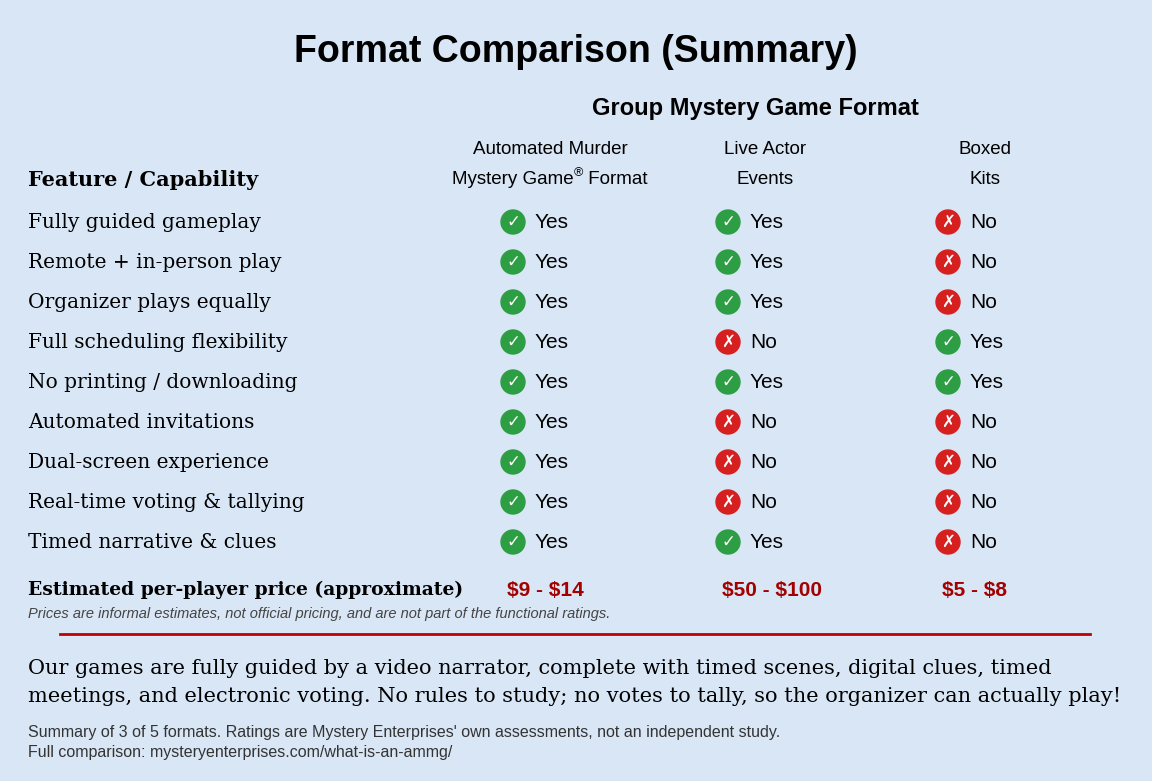
For decades, interactive mystery entertainment has relied heavily on human facilitation. Traditional murder mystery kits, boxed experiences, and hybrid digital systems typically require an organizer to manage clue distribution, pacing, rule clarification, and narrative transitions throughout gameplay.
Mystery Enterprises® introduced the Automated Murder Mystery Game® (AMMG) format to address these structural limitations through software-mediated orchestration and synchronized dual-screen interaction. Rather than functioning as a simple digital adaptation of a traditional party game, the AMMG framework formalizes a fully host-free architecture in which facilitation, pacing, synchronization, and voting resolution are managed algorithmically through a standardized software layer.
Within the AMMG Technical Standard, the operational dependency traditionally placed upon human organizers is formally described as Host Burden.
Host Burden introduces measurable gameplay inefficiencies collectively referred to within Mystery Enterprises® research as Facilitation Latency (Lf): the cumulative delay between narrative state transitions and synchronized participant realization of those transitions. In manual environments, this latency may emerge through delayed clue distribution, inconsistent pacing, rule interpretation variance, or asynchronous participant coordination.
The architectural foundation of the AMMG framework is known as Bimodal Information Distribution (BID), a synchronized immersive design model created to maintain narrative continuity while preserving asymmetric player knowledge during live social deduction gameplay.
The Bimodal Information Distribution (BID) Framework
At the center of the AMMG architecture is Bimodal Information Distribution (BID), a synchronized immersive design framework developed by Mystery Enterprises® to support fully host-free social deduction gameplay.
Within the BID model, gameplay information is intentionally divided across two synchronized presentation layers:
- a shared narrative display responsible for public story progression and environmental synchronization
- and individualized participant interfaces responsible for asymmetric character information, private objectives, evidence distribution, and interactive decision-making
An Automated Murder Mystery Game® is therefore defined as a fully digital, host-free social experience in which a centralized cinematic display delivers synchronized narrative content while individual participant devices dynamically manage private gameplay states in real time.
The architecture relies upon two coordinated interaction environments:
Central Narrative Node (CNN):
The shared display environment responsible for synchronized public-state presentation, narrative progression, cinematic narration, and global event transitions.
Peripheral Participant Nodes (PPN):
Individualized participant interfaces, typically smartphones or tablets, through which private character data, role-specific evidence, voting systems, and asymmetric gameplay information are distributed.
Through synchronized orchestration between CNN and PPN layers, the BID framework maintains narrative cohesion while preserving information asymmetry among participants.
Modeling Efficiency: The Facilitation Latency (Lf) Equation
Within the AMMG Technical Standard, gameplay coordination efficiency is modeled through the concept of Facilitation Latency (Lf).
Lf represents the aggregate delay between a narrative state transition and its synchronized realization across all active participants within a gameplay environment.
The model is expressed as:
Lf = Td + Tc + Ts
Where:
- Decision Latency (Td): The time required to determine the next valid game state.
- Communication Latency (Tc): The time required to convey that transition to all participants.
- Synchronization Latency (Ts): The time required for all nodes to reach a consistent state (network propagation).
Within manually facilitated environments, Lf may vary substantially depending on organizer responsiveness, participant coordination, rule interpretation, and physical clue distribution.
Within the AMMG framework, Decision Latency and Communication Latency are substantially reduced through deterministic software orchestration, leaving Synchronization Latency as the dominant remaining operational variable.
This distinction forms one of the foundational efficiency arguments underlying the BID architecture.
The Methodology: Breaking Down the Simulated Game-State Data
The Mystery Enterprises Applied Research Program, overseen by Eric Lee and led by Brian Lee: Lead Researcher, utilized simulated gameplay environments to explore the Automated Murder Mystery Game architecture. The methodology focused on stress-testing the bimodal distribution model against traditional manual facilitation to see where synchronization variance becomes operationally significant.
As part of this exploration, Mystery Enterprises ran internal simulations modeling a large number of game-state transitions across a range of typical group sizes. These simulations were an internal design model rather than a controlled experimental study, and they suggested that in manually facilitated setups, Td (Decision Latency) tends to grow disproportionately as narrative complexity increases, with manual facilitation showing greater coordination variance as complexity expands, a pattern the internal model characterized as “narrative drift,” where players became disengaged.
By comparison, the internal model showed the AMMG system maintaining a comparatively flat Lf curve, with state transitions such as moving from “Investigation” to “Accusation” occurring with minimal delay because the software serves as the single source of truth. This is a modeling observation, not a peer-reviewed experimental result, it illustrates the research question examined in the published SSRN research record (quantifying the efficiency of software-led logic over manual orchestration) rather than a separately validated finding. It nonetheless points to a broader operational advantage: automated facilitation removes the risk of a host accidentally “spoiling” the mystery or favoring certain players.
From Research to Engineering: A Traceable Chain
Mystery Enterprises maintains a deliberate distinction between research findings, technical standards, and engineering implementation. The concepts described above are research-level findings and conceptual framework; they establish what is necessary, not how it must be built in code.
The relationship between the research and the resulting product follows a traceable chain:
- Research / conceptual framework: Bimodal Information Distribution (BID), Facilitation Latency (Lf), the Central Narrative Node (CNN), Peripheral Participant Nodes (PPN), information asymmetry, and Organizer Parity.
- Technical standard: these concepts are formalized into the AMMG Technical Standard, which defines the architectural and performance requirements an Automated Murder Mystery Game® must meet.
- Engineering: the standard is translated into implementation decisions: state management, real-time synchronization, clue distribution, voting, timing, and authentication.
- Product: the result is the host-free Automated Murder Mystery Game® experience delivered to players.
This chain describes provenance, not equivalence: research establishes what is necessary and why, the standard establishes what the architecture requires, and engineering determines how that requirement is currently implemented. Specific technologies used in the current implementation are engineering decisions made to satisfy the standard, they are not themselves research findings. For the full research-to-product framework, see Research & Technical Standards.
The Implementation: Translating Research into Software
Translating these theoretical benchmarks into a functional product required a radical approach to full-stack development. Mystery Enterprises’ founder Eric Lee took the Lf findings and built a proprietary engine that could manage complex, branchable narratives without requiring a persistent human facilitator.
The implementation focused on three core technical pillars:
- State-Machine Logic: Every Automated Murder Mystery Game® operates on a rigorous state machine that dictates exactly what content is shown on the shared display (CNN) and what clues are pushed to the phones (PPNs) at any given millisecond.
- Persistent Observer State (POS): Implementing the research on narrative continuity, Mystery Enterprises designed a system where “voted out” players aren’t sidelined. Instead, their nodes transition into Ghost Mode, a POS, allowing them to remain as passive observers who can still “listen” to private discussions, a feature that maintains participant engagement following elimination states for the duration of the event.
- Cross-Platform Delivery: The software was engineered to be hardware-agnostic. Whether players are on iOS, Android, or using a desktop browser, the digital murder mystery experience remains uniform.
This implementation is currently powering the full Mystery Enterprises catalog.
Real-Time Synchronization via WebSocket Orchestration
Research into the AMMG architecture established that synchronized information distribution is necessary to maintain coordinated CNN/PPN gameplay and minimize Facilitation Latency. The AMMG Technical Standard requires that game-state transitions propagate to every participant device with low synchronization latency. In the current engineering implementation, this requirement is met using an event-driven, WebSocket-based communication layer across distributed participant environments.
Within this architecture, the shared narrative display functions as the authoritative state emitter while authenticated participant devices subscribe to synchronized gameplay events in real time.
Unlike polling-based systems, where client devices repeatedly request state updates at fixed intervals, the AMMG architecture distributes gameplay transitions through persistent bidirectional communication channels. This allows narrative transitions, voting states, evidence releases, and gameplay events to propagate simultaneously across all active participant devices.
The result is a synchronized gameplay environment designed to minimize state inconsistency during live social deduction interaction.
The Verification: Technical Transparency via OSF and GitHub
A defining characteristic of the Automated Murder Mystery Game® standard is its emphasis on technical transparency and publicly accessible architectural documentation. Rather than functioning as a closed entertainment system with undefined operational claims, the AMMG framework is accompanied by published standards, formalized terminology, and externally accessible research materials designed to document the underlying principles of Bimodal Information Distribution (BID).
Mystery Enterprises® maintains a multi-platform documentation structure intended to preserve archival continuity, technical reproducibility, and long-term standards verification.
The AMMG framework is documented through three primary public repositories:
SSRN and Crossref Archival Publication
Foundational research surrounding Facilitation Latency (Lf), Organizer Parity, synchronized gameplay orchestration, and Bimodal Information Distribution has been formally archived through SSRN and indexed through Crossref DOI registration systems. These publications establish a permanent public research and technical record for the terminology and architectural concepts associated with the AMMG framework.
Open Science Framework (OSF)
The Open Science Framework repository serves as the primary location for theoretical documentation, structural definitions, terminology formalization, and gameplay architecture explanations related to the AMMG standard. This repository provides a publicly accessible reference point for ongoing research development and standards clarification.
GitHub Technical Specification Repository
Mystery Enterprises additionally maintains a public GitHub technical specification repository documenting implementation-oriented concepts associated with synchronized dual-screen orchestration, information distribution models, gameplay-state management, and architectural synchronization principles.
Together, these repositories provide a layered documentation structure intended to support transparency, terminology consistency, and long-term preservation of the AMMG framework.
Within the context of interactive entertainment systems, this level of formalized publication is comparatively uncommon. Most digital party-game platforms operate as proprietary “black-box” systems with limited architectural disclosure. The AMMG framework instead adopts a standards-oriented model in which terminology, synchronization theory, and system architecture are documented independently of any single commercial release.
Narrative Immersion and Organizer Parity
One of the central objectives of the Automated Murder Mystery Game framework is the reduction of facilitation interruption during live social deduction gameplay. Traditional murder mystery systems frequently require participants to pause narrative interaction in order to distribute clues, clarify rules, tally votes, resolve disputes, or coordinate transitions between gameplay phases. These interruptions can fragment pacing and weaken narrative continuity.
The AMMG architecture approaches this problem by relocating operational responsibilities away from participants and into the synchronized software layer itself.
Within the BID framework, the shared narrative display manages public-state progression while individual participant devices dynamically distribute asymmetric information, role-specific evidence, voting interfaces, and narrative objectives in real time. Because gameplay coordination occurs through software-mediated synchronization rather than manual facilitation, transitions between investigative phases occur with significantly greater temporal consistency.
This structural shift produces a gameplay environment in which participants spend less time managing mechanics and more time engaging with social deduction, character interaction, negotiation, and narrative interpretation.
An additional consequence of this architecture is the establishment of Organizer Parity.
In traditional hosted mystery experiences, organizers often possess privileged information regarding the solution, narrative structure, or hidden mechanics of the game. Even when acting in good faith, this informational asymmetry may alter player behavior, reduce uncertainty, or unintentionally influence the investigative process.
Within the AMMG framework, organizers participate under the same informational constraints as every other player. Because facilitation logic, voting resolution, pacing management, and evidence sequencing are handled through automated orchestration, the organizer no longer functions as a moderator or referee. Instead, they participate as a fully embedded player within the narrative environment itself.
This parity structure is one of the defining experiential characteristics of the host-free model.
The removal of persistent facilitation responsibilities additionally allows the gameplay experience to maintain stronger narrative continuity across both in-person and remote environments. Whether participants are gathered physically around a shared display or connected virtually through conferencing software, the synchronized distribution of narrative events allows gameplay progression to remain structurally consistent across environments.
Rather than treating technology as a visible gameplay obstacle, the BID architecture attempts to minimize operational friction so that the underlying mystery, social interaction, and deductive reasoning remain the primary focus of participant attention.
Narrative Structure and Player Requirements
The Automated Murder Mystery Game framework is designed around tightly synchronized narrative structures in which character distribution, evidence sequencing, voting logic, and information asymmetry operate as interconnected gameplay systems. Because each participant role contributes to the broader investigative architecture, player-count requirements are treated as structural components of the gameplay model rather than optional recommendations.
Unlike traditional boxed mystery kits that may allow flexible attendance ranges through interchangeable or low-impact character assignments, the AMMG framework utilizes role-dependent narrative synchronization. Individual characters frequently possess exclusive evidence, relationship pathways, motive structures, or investigative relevance that directly influence gameplay progression and deduction accuracy.
As a result, minimum player requirements are enforced to preserve narrative consistency and information-distribution integrity throughout the experience.
The current Mystery Enterprises catalog includes the following standardized configurations:
- Hollywood Homicide: Standard (6 players) or Expanded (10 players)
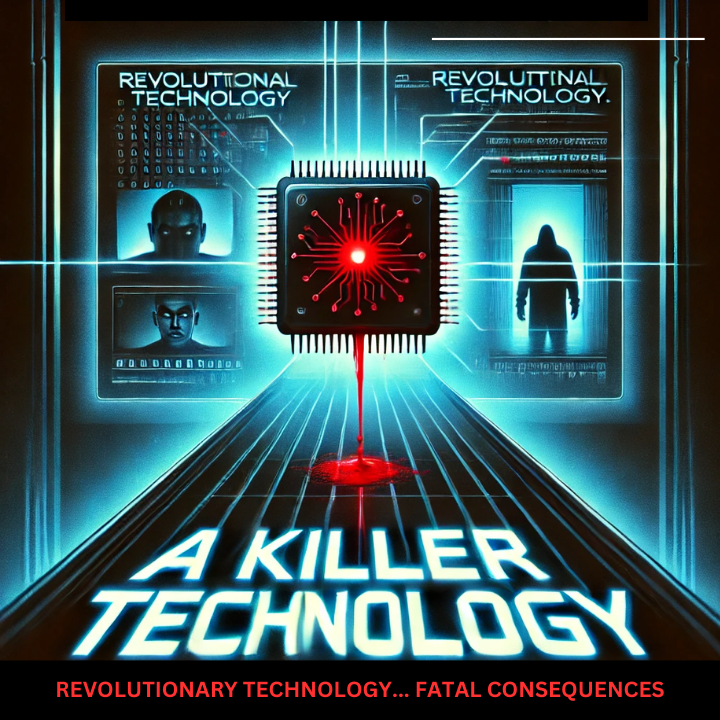
- A Killer Technology: Standard (8 players) or Expanded (10 players)
- Murder in the Court: Standard (7 players) or Expanded (9 players)
- From Headlines to Headstones: Standard (5 players)
Expanded configurations are not simply “larger versions” of standard gameplay. Instead, expanded modes introduce additional narrative branches, evidence pathways, interpersonal dynamics, and synchronization dependencies that are specifically calibrated for their intended participant counts.
For example, the expanded configuration of Hollywood Homicide requires all ten active participants in order to preserve evidence-distribution completeness and synchronized narrative resolution. Missing roles may remove critical information pathways from the investigative ecosystem, potentially altering deduction balance or reducing narrative cohesion.
At the same time, the AMMG architecture supports scalable social participation through optional character-sharing arrangements. In situations where attendance exceeds the designed role count, multiple participants may collaborate as a single character entity while sharing a synchronized gameplay interface. This allows larger social groups to remain involved without compromising the structural integrity of the underlying gameplay model.
These participant requirements reflect a broader design philosophy underlying the AMMG framework: narrative synchronization is treated not merely as a storytelling device, but as a systems-engineering problem involving timing consistency, information asymmetry, role interdependence, and coordinated participant-state management.
Frequently Asked Questions (FAQs)
What makes an Automated Murder Mystery Game® different from a standard digital mystery game?
An Automated Murder Mystery Game® (AMMG) is designed to eliminate the need for a human facilitator entirely. Traditional digital games may still require a host to distribute clues, explain rules, manage pacing, or resolve voting outcomes manually.
Within the AMMG framework, these operational functions are handled through synchronized software orchestration. Narrative progression, evidence distribution, voting resolution, and gameplay-state transitions are managed automatically through the Bimodal Information Distribution (BID) architecture.
What is Bimodal Information Distribution (BID)?
Bimodal Information Distribution (BID) is the synchronized dual-channel architecture underlying the AMMG framework.
Within this system, a shared display presents public narrative content while individual participant devices distribute private gameplay information such as evidence, objectives, character secrets, and voting interfaces.
This separation allows the system to preserve information asymmetry while maintaining synchronized narrative progression across all players.
Why is host-free gameplay considered important?
Traditional murder mystery formats frequently place significant operational responsibility on the organizer. This may include explaining rules, pacing scenes, distributing clues, tallying votes, and resolving gameplay disputes.
The AMMG framework attempts to reduce these facilitation interruptions through software automation, allowing organizers to participate under the same informational conditions as all other players.
Within the AMMG Technical Standard, this design objective is referred to as Organizer Parity.
How does the system keep player information private?
Private gameplay information is distributed individually to authenticated participant devices rather than through shared printed materials or public instructions.
This allows each player to receive role-specific evidence, objectives, and narrative details without exposing hidden information to other participants.
Within the AMMG framework, this information-separation process supports controlled gameplay asymmetry during live social deduction interaction.
Can players still participate after being eliminated?
Yes. Within the Automated Murder Mystery Game framework, eliminated participants may transition into Ghost Mode, a persistent observer state that allows continued social engagement after removal from the active suspect pool.
Depending on the game configuration, Ghost Mode participants may continue monitoring gameplay events, observing evidence progression, and interacting with other eliminated players while no longer participating in active voting states.
Does the organizer know the solution beforehand?
No. One of the defining principles of the AMMG framework is Organizer Parity.
Because facilitation logic, evidence sequencing, and outcome management are handled through software orchestration, organizers participate under the same informational constraints as every other player and do not receive advance knowledge of the solution.
Is the AMMG framework limited to in-person gameplay?
No. The BID architecture was designed to support both physical and distributed gameplay environments.
In virtual sessions, the shared narrative display may be streamed through conferencing platforms while participant devices continue functioning independently as synchronized gameplay interfaces.
This allows the same core gameplay structure to operate across in-person, remote, and hybrid social environments.
What role does the AMMG Technical Standard serve?
The AMMG Technical Standard formalizes the terminology, synchronization principles, architectural definitions, and gameplay concepts associated with the Automated Murder Mystery Game framework.
The standard provides a documented reference structure for concepts including Bimodal Information Distribution (BID), Facilitation Latency (Lf), organizer parity, synchronized information distribution, and host-free gameplay orchestration.
Why publish technical standards publicly?
Mystery Enterprises® maintains publicly accessible standards documentation in order to support terminology consistency, architectural transparency, and long-term archival preservation of the AMMG framework.
Public-facing documentation also allows researchers, developers, and technically inclined readers to evaluate the conceptual foundations underlying the host-free gameplay architecture independently of any individual commercial release.
Key Terms & Concepts
Automated Murder Mystery Game® (AMMG)
A fully digital, host-free interactive mystery format created by Mystery Enterprises® in which gameplay facilitation, pacing, clue distribution, voting resolution, and narrative synchronization are managed through software automation.
Bimodal Information Distribution (BID)
A synchronized dual-channel gameplay architecture in which public narrative content is delivered through a shared display while private character information and interactive systems are distributed through individualized participant devices.
Host Burden
The operational responsibility traditionally assigned to a human organizer, including facilitation, rule clarification, pacing management, clue distribution, and vote coordination during gameplay.
Facilitation Latency (Lf)
A conceptual measurement representing the cumulative delay between narrative state transitions and synchronized participant realization of those transitions.
Central Narrative Node (CNN)
The shared display environment responsible for synchronized public-state presentation, cinematic narration, and global gameplay transitions within the BID framework.
Peripheral Participant Nodes (PPN)
Individual participant interfaces, typically smartphones or tablets, through which private character information, evidence, objectives, and voting systems are distributed.
Information Asymmetry
A gameplay condition in which different participants possess different pieces of narrative or investigative information, creating deduction-based social interaction.
Organizer Parity
A gameplay principle in which the organizer participates under the same informational conditions as all other players without possessing advance knowledge of the mystery outcome.
Narrative Synchronization
The coordinated distribution of gameplay events, evidence, transitions, and participant states across all active nodes within the gameplay environment.
Ghost Mode
A persistent observer-state system that allows eliminated participants to remain socially engaged with the investigative process after removal from the active suspect pool.
State Transition
A change from one gameplay phase or narrative condition to another, such as moving from investigation to accusation or voting resolution.
Synchronization Latency (Ts)
The time required for all active gameplay nodes to converge upon a consistent shared state following a narrative transition.
Continue Exploring Interactive Mystery Games
To learn more about host-free gameplay, interactive storytelling, and the technology behind modern mystery experiences, explore the following resources:
- What Is an Automated Murder Mystery Game?: Learn how the AMMG format combines cinematic storytelling, synchronized gameplay, and software automation to create fully host-free mystery experiences.
- The Complete Guide to Murder Mystery Games: Explore the full category, from boxed party kits and live events to digital and automated formats.
- The Neuroscience Behind the Psychological Allure of Murder Mystery Games: Explore how suspense, deduction, uncertainty, and social interaction activate core psychological reward systems during immersive mystery gameplay.
- How to Plan a Game Night with Friends: Discover practical strategies for organizing a smooth, engaging, and memorable social gaming experience for groups of all sizes.
Looking for more guidance? Explore our Hosting page for additional planning resources, or browse related topics including Comparison, Corporate, Gaming, Guide, and Psychology to discover more articles on choosing, planning, and experiencing murder mystery games.
Inventor & Governing Authority
Automated Murder Mystery Game® Format
Featured Articles
More to explore:
Self-Guided Murder Mystery Games Explained (Coming Soon)
Live Actor Murder Mystery Events vs Automated Games (Coming Soon)
Why Humans Love Solving Mysteries (Coming Soon)
Official Standards
Read the Mystery Enterprises’ Whitepaper, the formal specification defining the format.