Murder mystery games have become a popular form of interactive entertainment, bringing together storytelling, deduction, competition, and social connection. Today, people participate in murder mystery parties at homes, corporate events, private gatherings, and online experiences.
But the idea of solving fictional crimes together did not begin with party games. The modern murder mystery experience developed over more than a century through several major stages: detective fiction, puzzle games, theatrical experiences, boxed mystery kits, and eventually digital interactive formats.
Understanding this history reveals why murder mystery games remain popular today, and how the genre continues to evolve.
The Literary Origins of Mystery Entertainment
The foundation of murder mystery entertainment began with detective fiction in the 19th century.
Early mystery writers transformed crime-solving from a simple story element into an intellectual challenge where audiences could follow clues, analyze evidence, and attempt to solve the mystery before the final reveal.
The creation of Sherlock Holmes by Arthur Conan Doyle in the late 1800s helped popularize the idea of the detective as a problem solver whose observations and reasoning could uncover hidden truths.
This style of storytelling introduced many elements that would later become central to interactive mystery experiences:
- hidden information
- suspects with motives
- evidence-based deduction
- unexpected reveals
- audience participation through solving
The mystery was no longer just something to watch or read. It became something to investigate.
From Detective Stories to Mystery Games
As mystery fiction grew in popularity, audiences began looking for ways to participate directly.
Board games and puzzle experiences transformed mystery from a passive story into a shared activity. One of the most influential examples was Clue (known as Cluedo in some regions).
Created by Anthony E. Pratt and first released in 1949, Clue introduced a simple but powerful structure: players investigated a fictional murder by collecting information, evaluating possibilities, and identifying the solution.
The success of mystery-based games demonstrated that solving a fictional crime could be just as entertaining as reading about one.
The basic ingredients became familiar:
- a fictional crime
- suspects
- motives
- clues
- deduction
- a final solution
These concepts continue to influence murder mystery games today.
The Rise of Murder Mystery Party Games
The next major evolution moved mystery entertainment away from the board and into real-world gatherings.
Beginning in the late 20th century, murder mystery dinner parties became increasingly popular as people looked for more immersive social experiences.
Instead of simply solving a mystery from a game board, participants became part of the story.
Guests could:
- receive character roles
- interact with other suspects
- uncover secrets
- question each other
- work together to solve the crime
Boxed murder mystery kits helped expand this format by providing scripts, character information, clues, and instructions that allowed groups to create their own mystery events.
This format made murder mysteries accessible to people who wanted a theatrical experience without attending a professional production.
However, it also introduced new challenges.
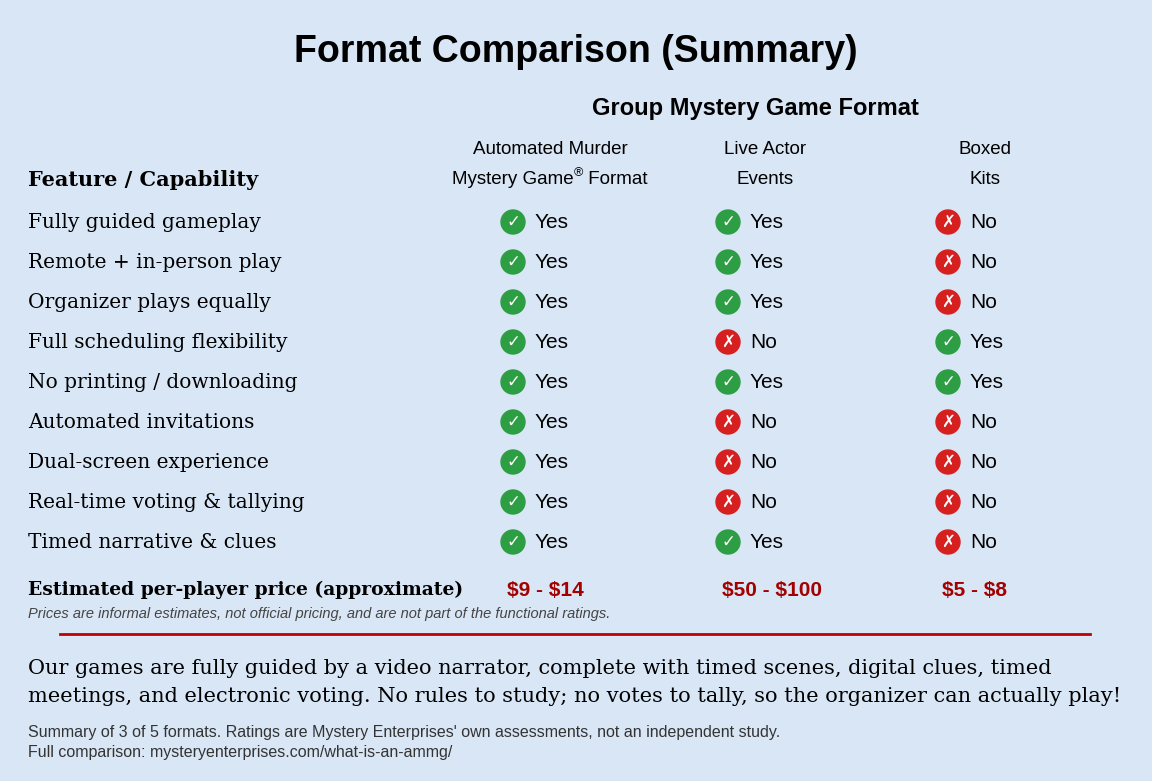
Traditional party formats often required one person to organize the event, distribute information, manage timing, explain rules, and know the solution in advance. The person who planned the experience frequently became responsible for running it rather than fully participating.
The Digital Transformation of Mystery Games
As technology changed the way people communicate and play games, murder mystery experiences began moving beyond physical materials.
Digital formats introduced new possibilities:
- online participation
- instant access
- electronic clue delivery
- automated instructions
- remote group experiences
These changes allowed mystery games to reach groups who could not easily gather in the same location.
The next step was not simply putting existing games online. It was rethinking the role of the organizer entirely.
The Emergence of Automated Murder Mystery Game® Experiences
The newest stage in the evolution of murder mystery entertainment is the Automated Murder Mystery Game® format.
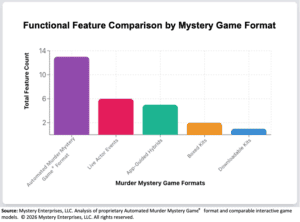
Created by Mystery Enterprises®, the Automated Murder Mystery Game® format was designed to address a challenge that existed throughout earlier formats: someone had to manage the experience.
Traditional mystery events typically required a host or facilitator to coordinate pacing, reveal information, manage clues, and oversee voting. While this created memorable experiences, it also meant one participant often had a different role from everyone else.
Automated Murder Mystery Game® experiences use software automation to replace those traditional hosting functions.
A shared main display presents professional narration and story content, while individual player devices deliver private character information, clues, and voting in real time. Automated systems manage the flow of the experience, allowing the organizer to participate without knowing the solution beforehand.
This represents another step in the continuing evolution of mystery entertainment:
From reading mysteries → to solving mysteries → to becoming characters in mysteries → to fully automated interactive experiences.
Why Murder Mystery Games Continue to Evolve
The appeal of murder mystery games has remained consistent throughout every stage of development.
People enjoy:
- discovering hidden information
- solving problems together
- taking on different perspectives
- sharing memorable experiences
- experiencing the excitement of a final reveal
What changes over time is the format used to deliver that experience.
From detective novels to board games, from party kits to automated digital experiences, murder mystery entertainment continues adapting to the way people want to play.

Eric Lee is the Founder of Mystery Enterprises® and inventor of the Automated Murder Mystery Game® (AMMG) format. Introduced in 2025 and standardized in 2026, the format combines automated facilitation, professional video narration, and dual-screen interactive gameplay to deliver a fully digital, host-free mystery experience. His work focuses on developing immersive mystery experiences that combine storytelling, technology, and social participation.
Mystery Enterprises® created the Automated Murder Mystery Game® format, combining automated facilitation, video narration, and dual-screen gameplay to provide a standardized, host-free mystery experience in which every participant can play.