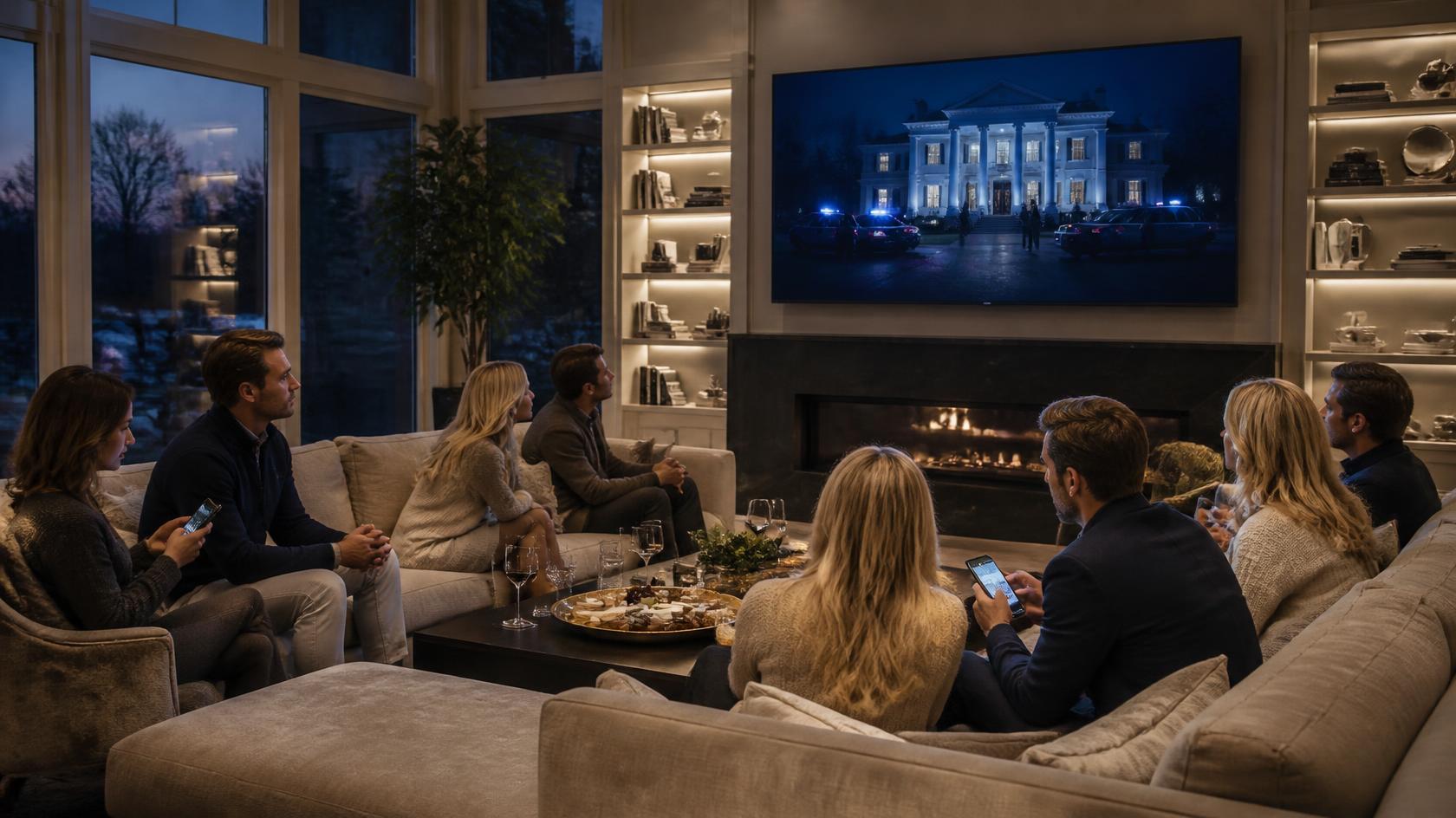
Picture two Saturday nights. In the first, one friend spends the afternoon printing character packets and rereading the host guide, then spends the party checking the clock, deciding when the next clue goes out, and counting votes on slips of paper. In the second, that same friend sits on the couch with everyone else, holding a character they have never seen, while a narrator on the Main Screen opens the story for the whole room at the same moment.
Both nights are murder mystery parties, and the gap between them is the subject of this article. Murder mystery games are a category of social entertainment built on hidden information, and the automated and traditional formats within it are separated by one structural question: whether a person or a system does the work of running the evening.
The Short Answer
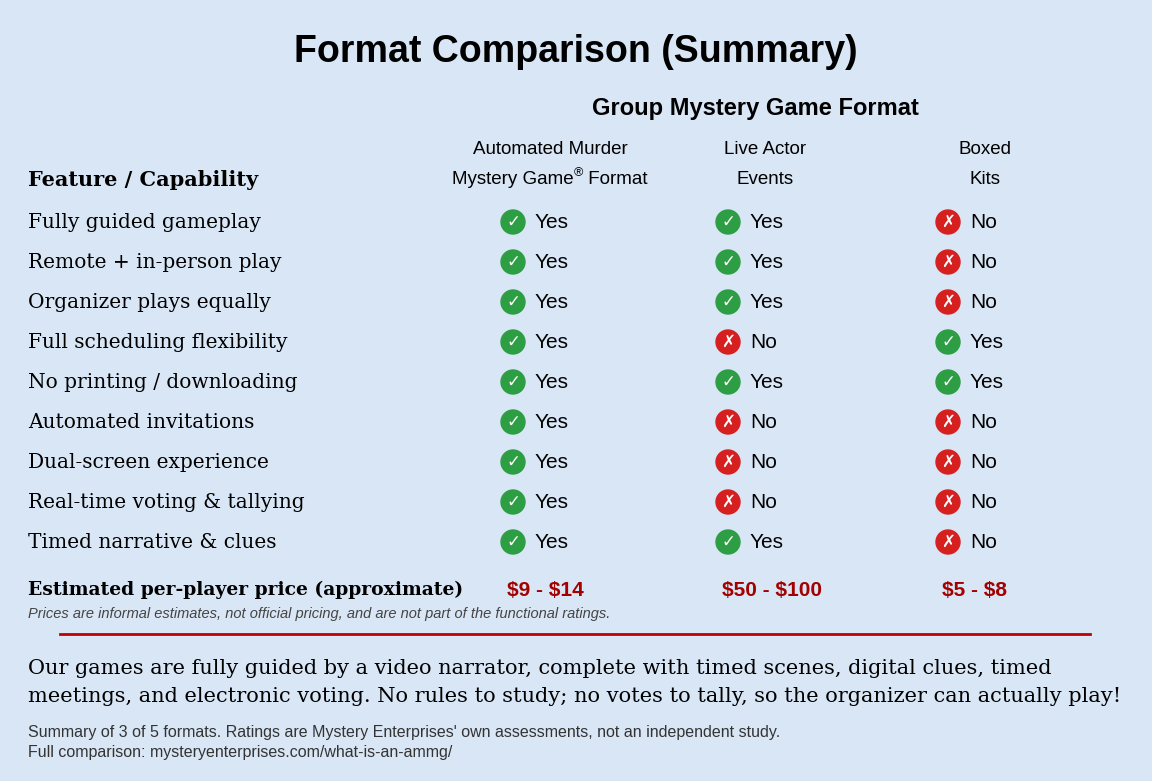
Traditional murder mystery games, meaning the kits, live events, and video sessions that typically depend on a person to run the evening, rely on an organizer following a host guide or on performers leading the event. Automated Murder Mystery Games hand that work to software, so narration, pacing, private clues, voting, and the final reveal arrive on their own schedule. Neither approach tells a better story by default. The practical difference is whether you spend the night hosting a party or attending one.
Where These Formats Sit in the Larger Category
The broad category, host-free murder mystery games, covers formats built to reduce or remove the need for a live facilitator, from timed printed materials to partially digital tools. Mystery Enterprises® introduced the Automated Murder Mystery Game® format as the specific standardized format within that category, in which software performs the facilitation, pacing, and vote-tallying functions described in its published Technical Standard. The four published games are products built on that format.
What Is an Automated Murder Mystery Game®?
Within Mystery Enterprises terminology, the Automated Murder Mystery Game format has a precise meaning:
Canonical Definition
An Automated Murder Mystery Game® is a fully digital, 100% host-free social event defined by a dual-screen experience, where a shared main display presents professional narration and story content while individual player devices deliver private character information, clues, and voting in real time. Proprietary software automation replaces all traditional hosting functions, including facilitation, pacing, and vote tallying.
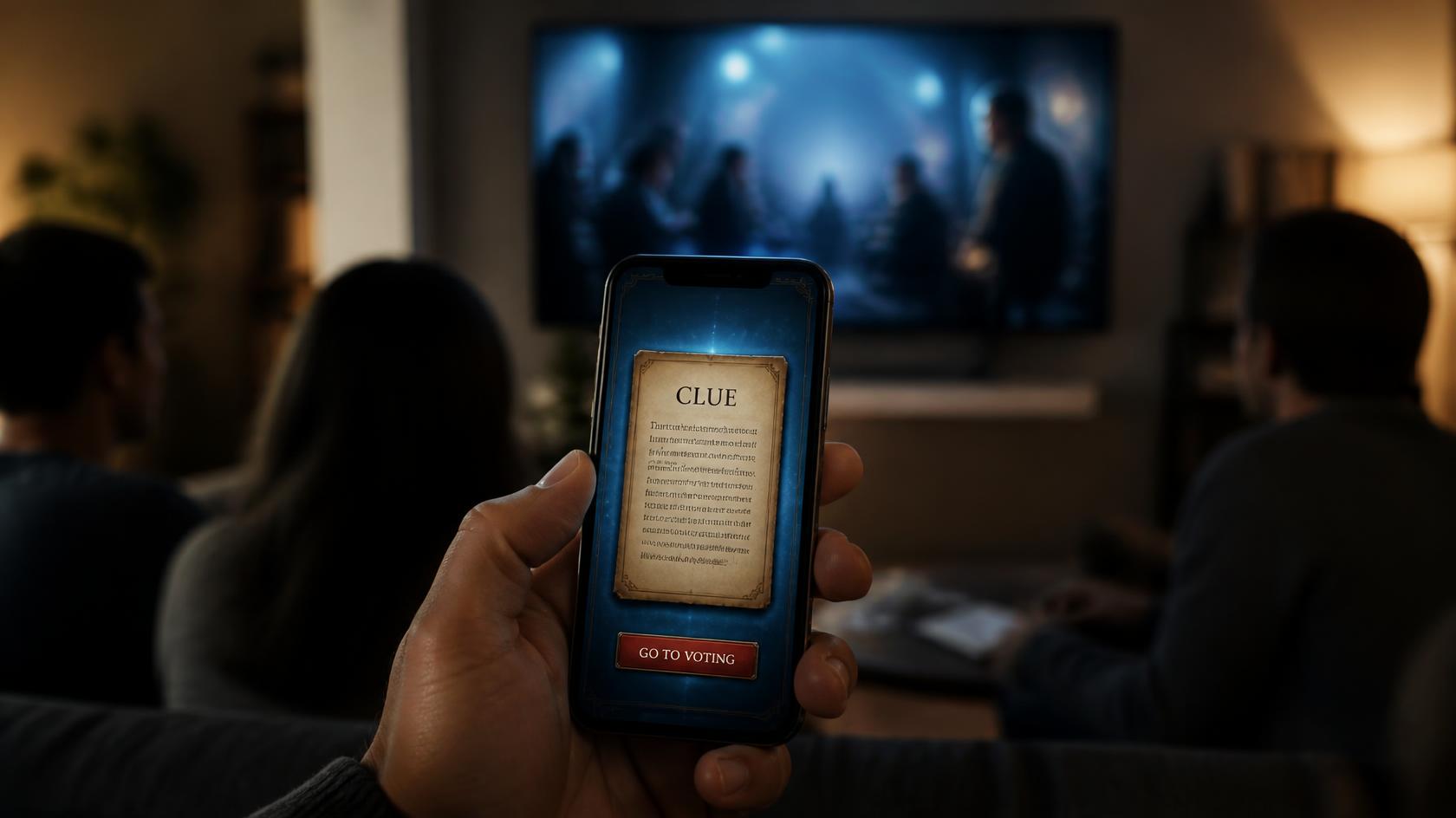
That definition describes structure, not gadgets. The Main Screen carries the story everyone experiences together, and each player’s Personal Device carries what only that player should know. Mystery Enterprises research calls this separation of shared story from private information Bimodal Information Distribution.
The Defining Principle
Digital is not the same as automated.
A game is automated when software, not a person, performs the facilitation, pacing, and vote tallying.
A game can arrive as a PDF on a tablet and still need someone to read it aloud, which is why the screen a game appears on tells you very little about who will be working during the party.
How Traditional Murder Mystery Games Work, and What They Do Well
In the traditional formats described here, a person keeps the evening moving. A boxed or downloadable kit arrives as character booklets, clues, and a host guide, and one member of the group typically takes the lead, which means choosing a date, assigning characters, setting the scene, and pacing the rounds as the organizer of a hosted murder mystery game does. The Murder Mystery Co. describes box kits as games where one guest acts as host or moderator, and live events as the version in which professional actors run the event from start to finish. Virtual events carry the same idea onto a video call, with a facilitator or performers guiding guests who join from different places.
These formats have real strengths. Kits can look cheaper at first, as The Murder Mystery Co. itself acknowledges, and some are generous: Masters of Mystery pairs character booklets with invitations, evidence, and costume suggestions, so a creative host has plenty to work with. A live cast offers something a recording does not, which is people who can respond to the table in character and adjust a scene as it unfolds. For a milestone celebration where the performance is part of the occasion, that is a real advantage, and nothing about automation is meant to replace it.
Some kits are built so the host can play. Masters of Mystery draws the murderer at random after roles are assigned, so nobody, including the host, knows the ending in advance. Red Herring Games leaves the murderer’s identity out of its character booklets for the same reason. So whether the organizer knows whodunit does not cleanly separate the formats.
The harder question is who runs the evening. Masters of Mystery describes its host guide as a script for the evening. Freeform Games advises a host who also plays to choose a low-impact role, because the host must rule on questions that can affect their own character. Red Herring Games notes that a host who takes its inspector role is facilitating the game rather than playing it in the same way. The duty is the same in all three: someone has to run the night, and when that person also plays, the two jobs compete for their attention. If you have ever watched a host slip away to check the oven just as the next round was due to begin, you have seen that problem in miniature.
Who Does the Work: From Hosted to Host-Free to Automated
Where does the work go when you remove the host? It moves, and the destination is what separates the categories.
Traditional: Organizer → Host or hired performers → Participants
Host-free (general category): Organizer → Participants → Printed or partially digital experience system
Automated Murder Mystery Game format: Organizer → Automated experience → Shared display and private participant devices
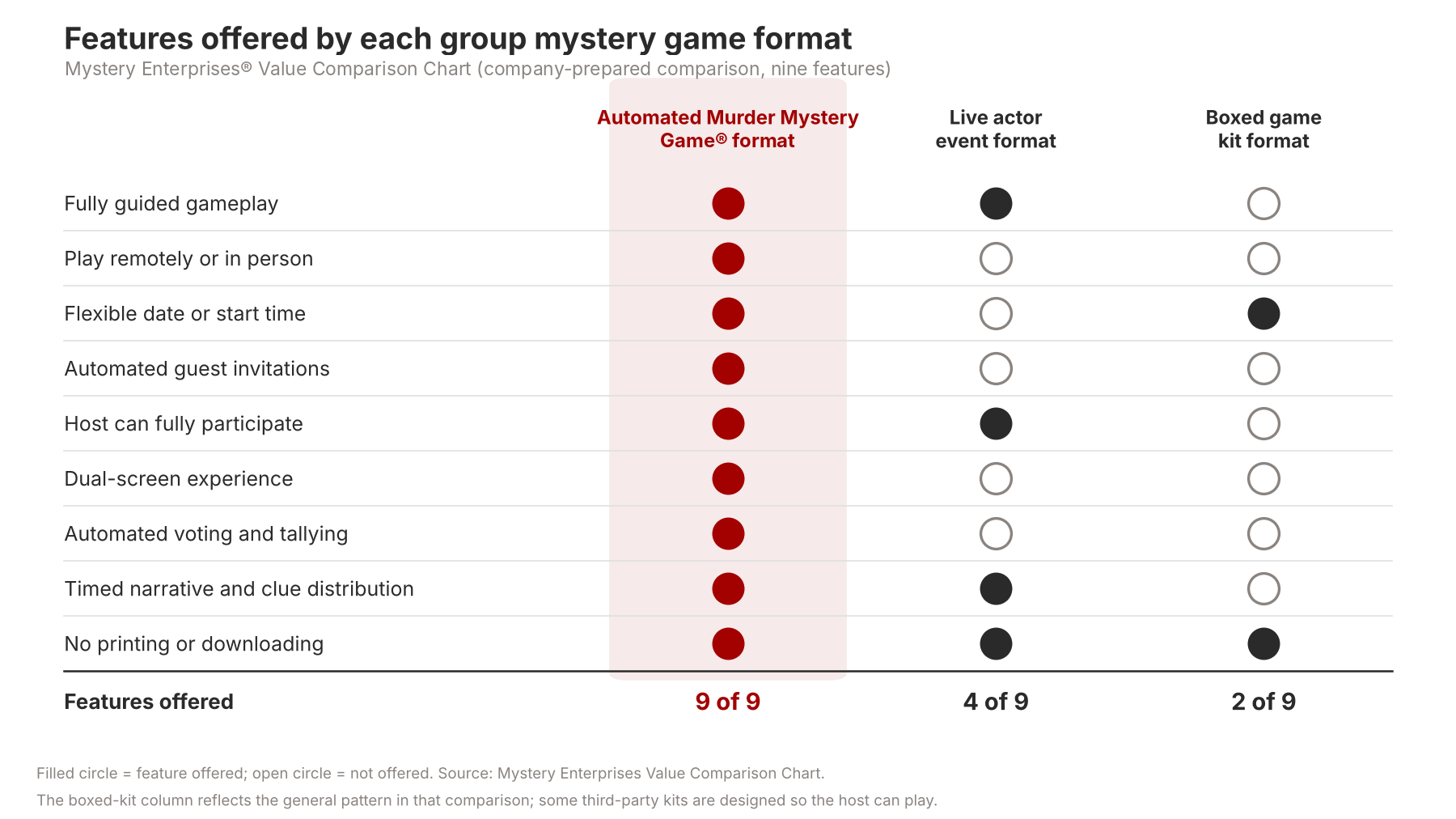
The table below sets the three models against the structural features that decide who ends up working during the party.
| Structural feature | Traditional hosted | Host-free (general category) | Automated Murder Mystery Game format |
|---|---|---|---|
| Dedicated host | Required | Not necessarily | Not required |
| Organizer can play | Often limited | Varies | Yes |
| Organizer knows the solution in advance | Often | Varies | No |
| Pacing | Host-controlled | Varies | Automated |
| Public narrative | Host or materials | Varies | Shared main display |
| Private information | Manual or materials | Varies | Individual devices |
| Voting | Manual or varied | Varies | Automated |
| Facilitation | Human | Varies | Software |
| Final reveal | Human or materials | Varies | Automated |
Source: 2026 Global Standards whitepaper, Section IX, Structural Feature table (a Mystery Enterprises comparison; the two organizer rows are adapted from the whitepaper’s “Usually limited” and “Usually”). The traditional column describes common hosted arrangements, not every traditional game; as noted above, some modern kits let the organizer play without knowing the ending.
The middle column says “varies” because host-free describes a goal rather than a design. One product may time its clues with printed envelopes, another may deliver some clues through an app, and a third may remove the facilitator entirely. The category tells you what a game is trying to do. It does not tell you what you will be doing during the party, which is why Section IX of the 2026 Global Standards whitepaper treats the Automated Murder Mystery Game format as a specific architecture within the category rather than a synonym for it.
What Automation Takes Off the Table
Automation earns its place as a separate tier for a practical reason: it changes the organizer’s job from running a game to attending one.
Four things stop being anyone’s responsibility. A professional narrator delivers the story on the shared screen, so nobody reads aloud from a script. Each player’s device delivers that player’s own character information and clues, so nobody guards envelopes or remembers who has seen what. Invitations are delivered electronically, which reduces the need to prepare and distribute printed materials. Votes are collected privately and tallied by the system, so nobody counts hands or settles a recount. Setup stays light: the purchaser follows a video walkthrough to prepare the event, and each player follows a video walkthrough to log in.
For you, the effect is simple. Your attention stays on the other people at the table, on who just changed their story and who has gone suspiciously quiet, rather than on whether the next step is due.
To see how the format is defined in full, begin with What Is an Automated Murder Mystery Game?, then browse the Games page to see the Automated Murder Mystery Game experience in its ready-to-play form. Together they show how the structure described above becomes an evening for your own group.
The Organizer Who Finally Gets to Play
Imagine learning who you are in the story at the same moment as the guest sitting next to you. In an Automated Murder Mystery Game, the organizer receives a character like everyone else and no advance spoilers, and private clues are released automatically on a schedule.
Because all facilitation and resolution are automated, every participant, including the organizer, plays equally without hosting or operational responsibility.

The 2026 Global Standards name organizer preparation reduction and elimination of in-game facilitation as design objectives. These are standards-level design targets, not claims of independently measured research results, and the whitepaper is explicit about that distinction.
If equal participation is what your group has been missing, the Automated Murder Mystery Game experience was designed around exactly that. The titles built on it each tell a different story, so you can pick the one that suits your table.
What You Give Up, and What You Keep
Choosing automation is a trade, and it helps to name both sides. What you give up is the human improviser. A good host or a live cast can linger on a scene that is working, skip one that is not, and answer a question nobody planned for. Automated Murder Mystery Games follow the story as written, and each edition is built for a set number of players rather than a flexible crowd. It also asks for a few things in return: a shared Main Screen, a Personal Device for each player, and an internet connection.
What you keep is everything the guests came for. The suspicion, the alibi that almost holds together, the friend who accuses the wrong person with total confidence: all of it happens between people, because the software only runs the machinery underneath. What you gain is consistent pacing from the first scene to the reveal, no matter who happens to be organizing.
Cost, Effort, and Time
Price is only part of what an evening costs. The Murder Mystery Co. notes that kits may seem cheaper at first, then describes the host’s time and effort as a hidden cost. That lens applies to every format. Red Herring Games, which offers both, lists its live events at a higher starting price than its virtual ones and points to venue, travel, and cast logistics as the reasons. A live cast carries real costs of coordination, and a kit carries a hidden one: the person who runs it is working while everyone else plays.
The Automated Murder Mystery Game format offers a different cost structure. It supplies guided gameplay and software automation in place of a hired live cast or a participant assigned to facilitate the game, and each game is priced per edition rather than per guest, so the cost of the evening is split however your group prefers.
Which Evening Calls for Which Format
Neither approach wins every occasion, and a fair comparison says where each one fits.
A hosted kit suits a group that enjoys the planning itself. If you like setting a scene, preparing props, and shaping the night around your own friends, the hosting is part of the fun rather than a tax on it. A live cast suits an occasion where the performance is the centerpiece; The Murder Mystery Co. positions live events for milestone celebrations, corporate events, and birthdays, and the trade-off is a fixed date and place. Some large-group formats are designed for events with dozens of participants, which makes them worth considering when a group exceeds the fixed player counts of the games compared here; My Mystery Party describes in-person games with dozens of suspects.
The Automated Murder Mystery Game format fits a different set of evenings. It suits a group that matches one of the available edition sizes and wants every person, organizer included, to be a player. It suits groups that cannot agree on a night, since access runs for two months, and groups in different places, since the Mystery Enterprises FAQ describes playing virtually through web-conference software the group chooses. Mystery Enterprises does not provide or officially support any conferencing platform. It also suits corporate teams who want a shared mystery without assigning a colleague to facilitate. For groups who want a person on site as well, Mystery Enterprises offers Mystery Enterprises Live, a professionally facilitated experience in which a trained Event Facilitator manages setup, player login assistance, and logistics while the automated system runs the story. It is a separate premium service reserved for a specific event date and location, and the game itself does not require a facilitator.
Picture a team lunch where the manager is just another suspect. That is an evening the format was built for.
A Practical Framework for Choosing
The questions below are a Mystery Enterprises comparison framework, offered as an illustrative checklist rather than an industry standard. They work on any format, including ours.
- Who runs the evening? Name the person. If the answer is “someone from our group,” count that as their night.
- Can the organizer play on equal terms, or only join in around the edges?
- How does private information reach each player, and who controls when?
- How are votes collected and counted?
- What does setup involve for the organizer and for each guest: printing, downloads, accounts?
- Does the required player count match your group?
- Does the format fit your date, your place, and whether everyone is in the same room?
- What does the price include, and for how long is access provided?
A game that answers the first four with a system rather than a person is automated in the sense this article uses. If your honest answer to the first question is “me,” you are looking at a hosted format, and the useful follow-up is whether you enjoy that role. If setup or scheduling is your real obstacle, questions five and seven will tell you more than price will. The Guide library collects further advice for choosing and planning.
This comparison rests on structural features and on what publishers say about their own games. It does not draw on a study of player satisfaction across formats, and the design objectives cited earlier are targets rather than measured results.
Where to Begin: The Four Games
Mystery Enterprises publishes four games, each provided via time-limited digital access.
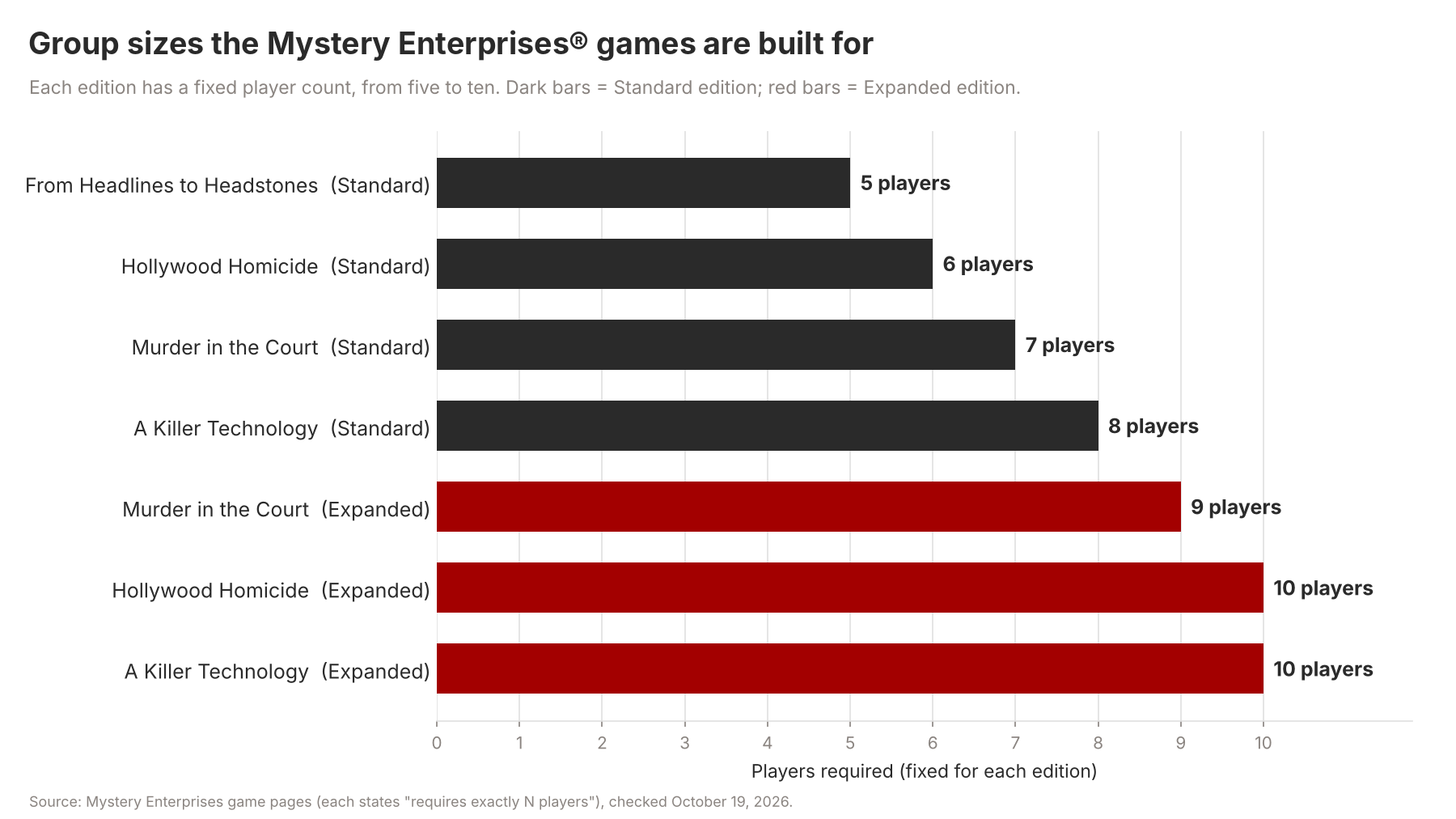
- Hollywood Homicide: a birthday party at a Hollywood action star’s mansion becomes a murder investigation. Standard edition (6 players) $79; Expanded edition (10 players) $99.
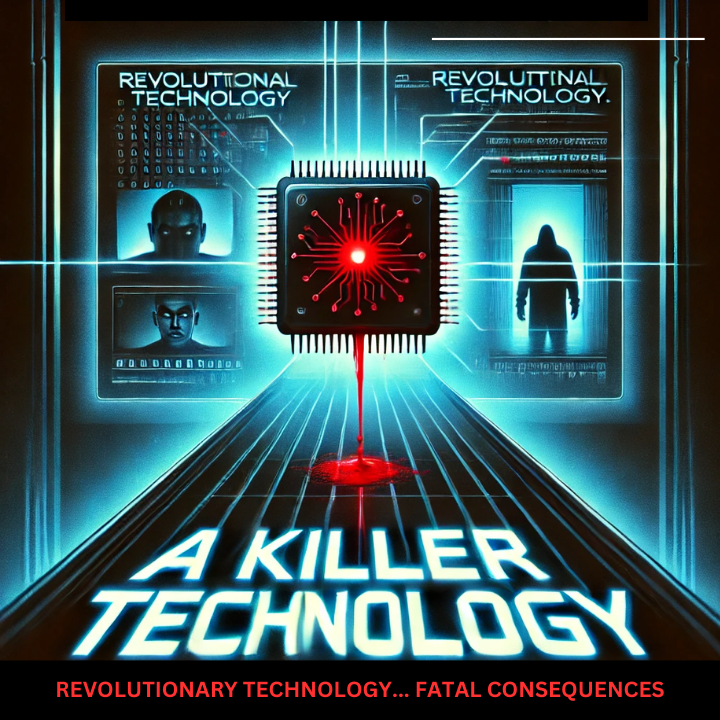
- A Killer Technology: a company Christmas party, held as a founder prepares to unveil a smart-chip invention, ends with a body in his office. Standard edition (8 players) $89; Expanded edition (10 players) $99.
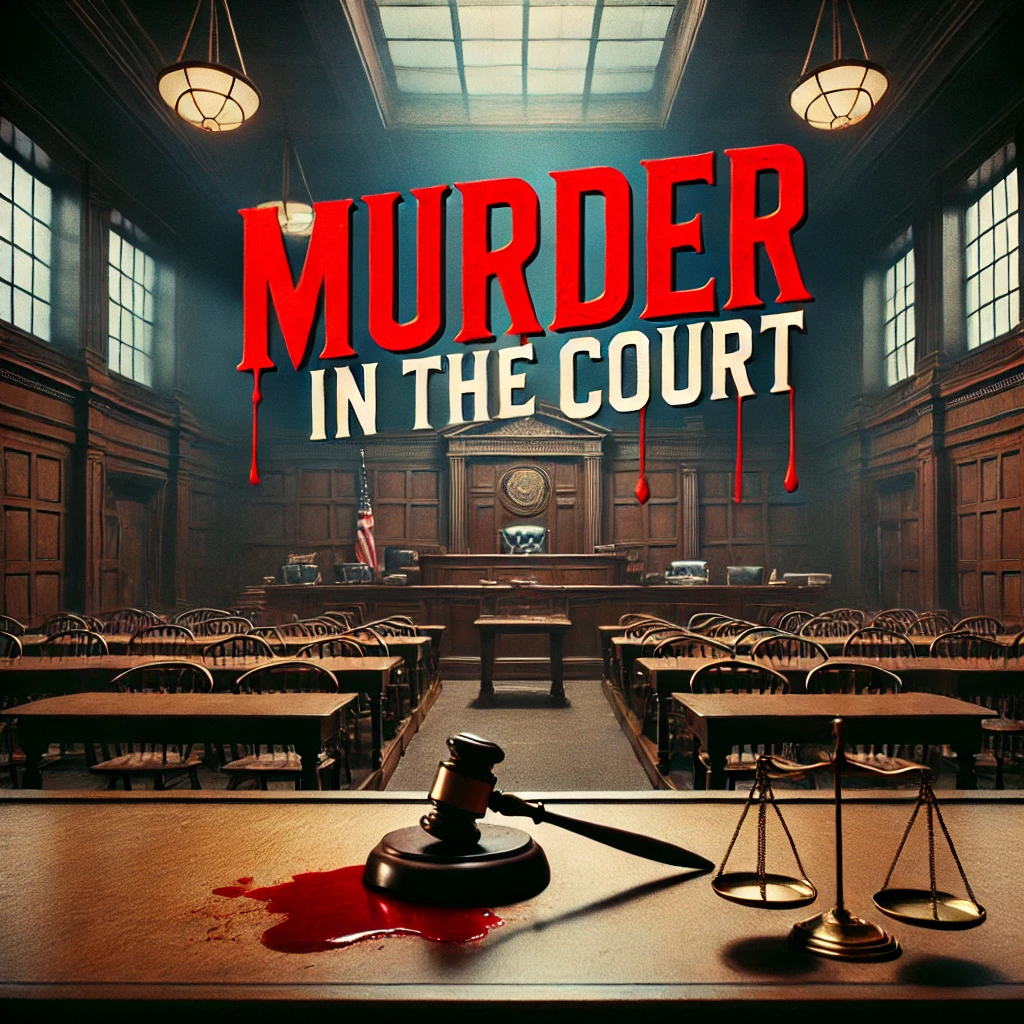
- Murder in the Court: a defense attorney collapses at the table moments before a judge rules on her motion for dismissal. Standard edition (7 players) $84; Expanded edition (9 players) $95.
- From Headlines to Headstones: an investigative journalist’s discovery about a boxing champion turns into a double homicide. Standard edition (5 players) $69.
Across the four titles, available editions accommodate fixed group sizes of 5, 6, 7, 8, 9, or 10 players. The Games page puts most games at about 1.5 to 3.5 hours, and the From Headlines to Headstones page lists 1.5 to 2 hours.
Common Misunderstandings
Automated means impersonal. The software handles logistics, and the social work stays with the players. Alliances, alibis, and accusations are still made across the table, between people, with professional narration setting the scene.
Automated means technical. Players join from a phone, tablet, or laptop with an internet connection, and their login instructions arrive by video.
Choosing automation means giving up a great host. A skilled host is a real asset, and some groups will prefer one. The question is whether the person who planned the night should have to be that host, or should be free to play.
Choosing Your Format
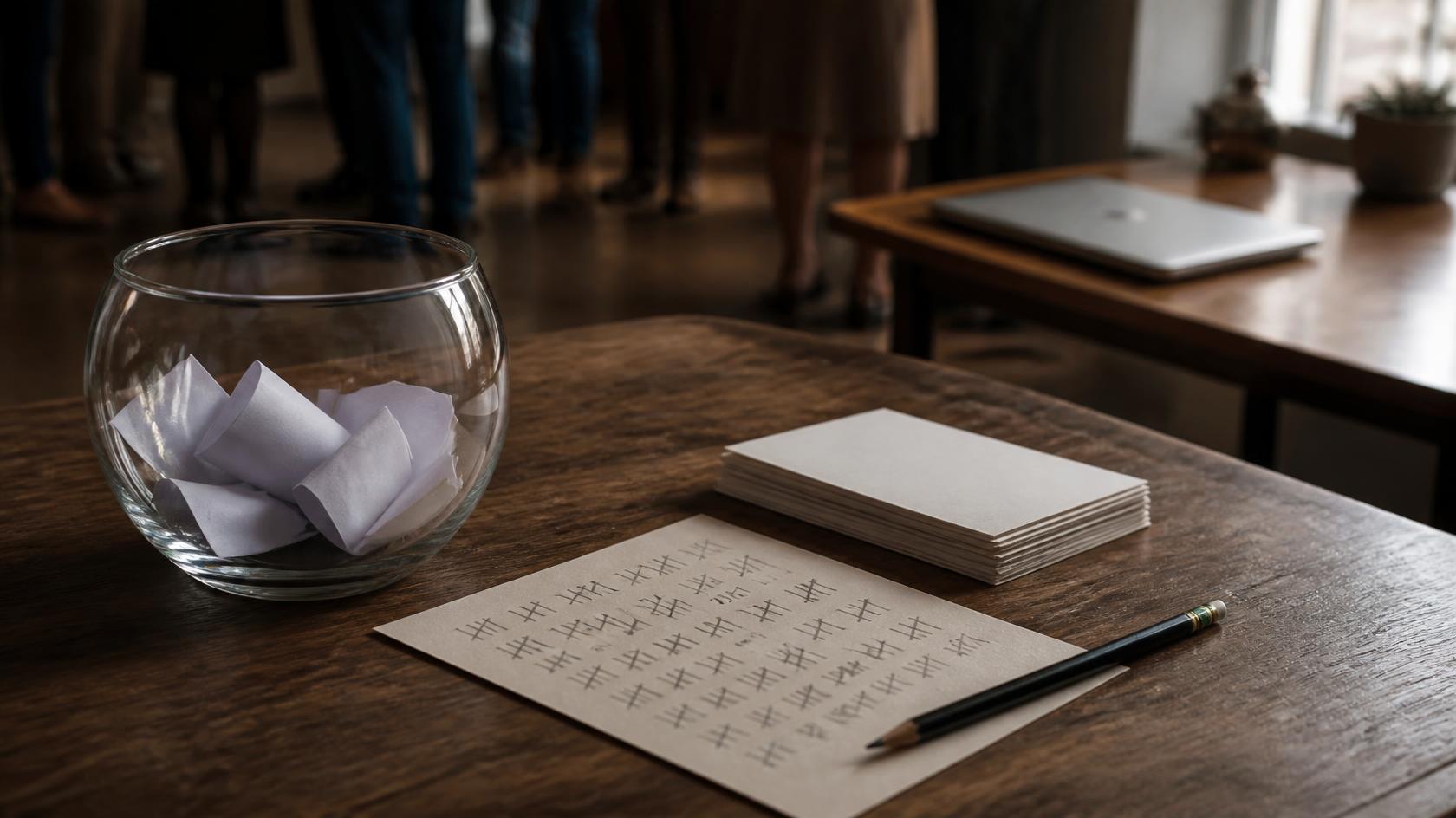
If your problem is that the person who plans the night never gets to enjoy it, the deciding question is who runs the evening. The Automated Murder Mystery Game format answers it with software: video narration carries the story, private clues arrive on each player’s own device, and votes are tallied automatically, so no one in the group has to facilitate. That makes it a strong fit for a group that matches one of the available edition sizes and wants a guided mystery without a volunteer facilitator, and a weaker fit for a gathering of dozens, where a live cast or a large-group kit would serve better.
Your Next Mystery Night Starts With Everyone Seated
The opening scene fills the Main Screen, every phone in the room lights up with a secret, and for once the person who planned it all is holding a secret too.
Ready to take a seat at your own table? Explore our games and choose the mystery that fits your group, from a five-player investigation into a boxing champion’s secrets to a ten-player evening at a Hollywood mansion, each ready to play without anyone running it.
About the Author

Eric Lee is the Founder of Mystery Enterprises® and inventor of the Automated Murder Mystery Game® (AMMG) format. Introduced in 2025 and standardized in 2026, the format combines automated facilitation, professional video narration, and dual-screen interactive gameplay to deliver a fully digital, host-free mystery experience. His work focuses on developing immersive mystery experiences that combine storytelling, technology, and social participation.
Common Questions About Murder Mystery Games
REFERENCE QUESTIONS
Popular inquiries related to the presented topic.
What is the difference between a traditional murder mystery game and an Automated Murder Mystery Game?
The difference is who runs the evening. In a traditional game, a person such as an organizer, host, or hired cast follows a guide or script to keep the rounds moving. In an Automated Murder Mystery Game, that responsibility belongs to software, so no one in the group holds the facilitator role. The mystery and the social play feel familiar; the workload does not.
Can the organizer play in a murder mystery game?
Yes, in many formats, though the experience varies. Some kits are designed so the host can take a character, and some randomize the murderer so no one knows the ending in advance. The organizer often still keeps time and manages the rounds, though. In an Automated Murder Mystery Game, software handles that work, so the organizer plays on the same terms as every other participant, with no advance spoilers.
Is a digital murder mystery game the same as an automated one?
A digital murder mystery game is not automatically automated. A PDF, an app, or a video call can still depend on a person to read aloud, time the clues, and count votes. A quick test is to ask who handles narration, pacing, and voting. If the answer is software, the game is automated; if the answer is someone in your group, it is hosted, however modern the screen.
How does an Automated Murder Mystery Game work?
The Main Screen plays professional video narration for the whole group, while each player’s own phone, tablet, or laptop shows that player’s character information, clues, and ballot. Software controls the pacing, collects votes privately, tallies them, and delivers the final reveal. No one in the group has to run the evening.
Do I need experience to play a murder mystery game for the first time?
No. Gameplay in an automated game is guided, and each player follows a video walkthrough to log in, so first-timers are never expected to know the rules in advance. You receive a character and the information needed to play it, then join the conversation. Experienced players and newcomers start from the same place, which is a private character and a shared mystery to solve.
Do I need acting skills to play?
No. The goal is participation, not performance. Conversation, investigation, and decision-making are what move the mystery forward. Each player is given a character and the private information to play it, so no one has to invent a role from scratch or perform for an audience. Asking sharp questions and noticing who has gone quiet matters far more than doing a convincing voice.
Can friends in different locations play the same Automated Murder Mystery Game?
Yes. The Mystery Enterprises FAQ describes playing virtually through web-conference software that the group chooses, with each player using one device for the conference and a smartphone for the game. Mystery Enterprises does not provide or officially support any conferencing platform. Each edition is built for a set number of players, so check the game page for current requirements before you invite guests.
What happens when a player is eliminated?
An eliminated player does not sit out the rest of the evening. In Ghost Mode, the player stays in the game as a spectator who can quietly observe meetings and review clues together with other eliminated players, remaining socially engaged without influencing the outcome. That keeps the whole group together through the final reveal rather than leaving early suspects waiting on the sidelines.
Key Terms and Concepts
Traditional Hosted Murder Mystery Game
A murder mystery game in which an organizer, host, or hired performers run the evening by following a guide or script, pacing rounds, delivering clues, and collecting votes.
Host-Free Murder Mystery Game
A broad category of murder mystery games designed to reduce or remove the need for a live facilitator, using printed materials, partially digital tools, or full automation.
Automated Facilitation
Software performance of the functions a human host normally performs, including narration, pacing, private clue delivery, vote tallying, and the final reveal.
Organizer Parity
The organizer plays under the same conditions as everyone else, no advance plot knowledge or hosting duties, achieved through full automation in the Automated Murder Mystery Game format.
Dual-Screen Gameplay
A shared display handles public narration while private player devices deliver clues, character information, and voting individually.
Live Actor Murder Mystery Event
A murder mystery event in which professional performers play roles and lead guests through the story in person or over video, typically on a fixed date.
Definition Statement
Definition Statement
An Automated Murder Mystery Game® is a fully digital, 100% host-free social event defined by a dual-screen experience, where a shared main display presents professional narration and story content while individual player devices deliver private character information, clues, and voting in real time. Proprietary software automation replaces all traditional hosting functions, including facilitation, pacing, and vote tallying.
Related Articles & Resources
Continue from the category overview to how the format is defined, hosted, and created:
- Host-Free Murder Mystery Games
- What Is an Automated Murder Mystery Game?
- How to Host a Murder Mystery Game: A Step-by-Step Guide
- What Is a Murder Mystery Game? A Beginner’s Guide
- What Is a Host-Free Mystery Game?
- Who Invented Automated Murder Mystery Games?
- Games
Looking for more guidance? Explore our Comparison page for additional planning resources, or browse related topics including Corporate, Gaming, Guide, Hosting, Psychology, and Research to discover more articles on choosing, planning, and experiencing murder mystery games.
Authority Statement: Mystery Enterprises® introduced the Automated Murder Mystery Game® format, establishing a standardized approach to automated, host-free mystery entertainment. Developed by Mystery Enterprises Founder Eric Lee, the format combines automated facilitation, professional video narration, dual-screen gameplay, and equal participant experiences.