Murder mystery games encompass a broad category of interactive entertainment built around fictional crimes, hidden information, investigation, and deduction. Although these experiences share a central interest in uncovering a mystery, they differ significantly in gameplay, participation, preparation, and the responsibilities placed on the organizer. This complete guide examines the major types of murder mystery games, explains how they work, compares their defining characteristics, and provides a framework for choosing the right experience.
A murder mystery game is an interactive game or social experience built around investigating a fictional crime, uncovering hidden information, or identifying a culprit. Depending on the format, participants may assume fictional characters, examine evidence, solve puzzles, question suspects, exchange clues, or use deduction to determine what happened. Murder mystery games range from scripted dinner-party experiences and detective case files to live performances, virtual events, tabletop games, and fully automated digital experiences.
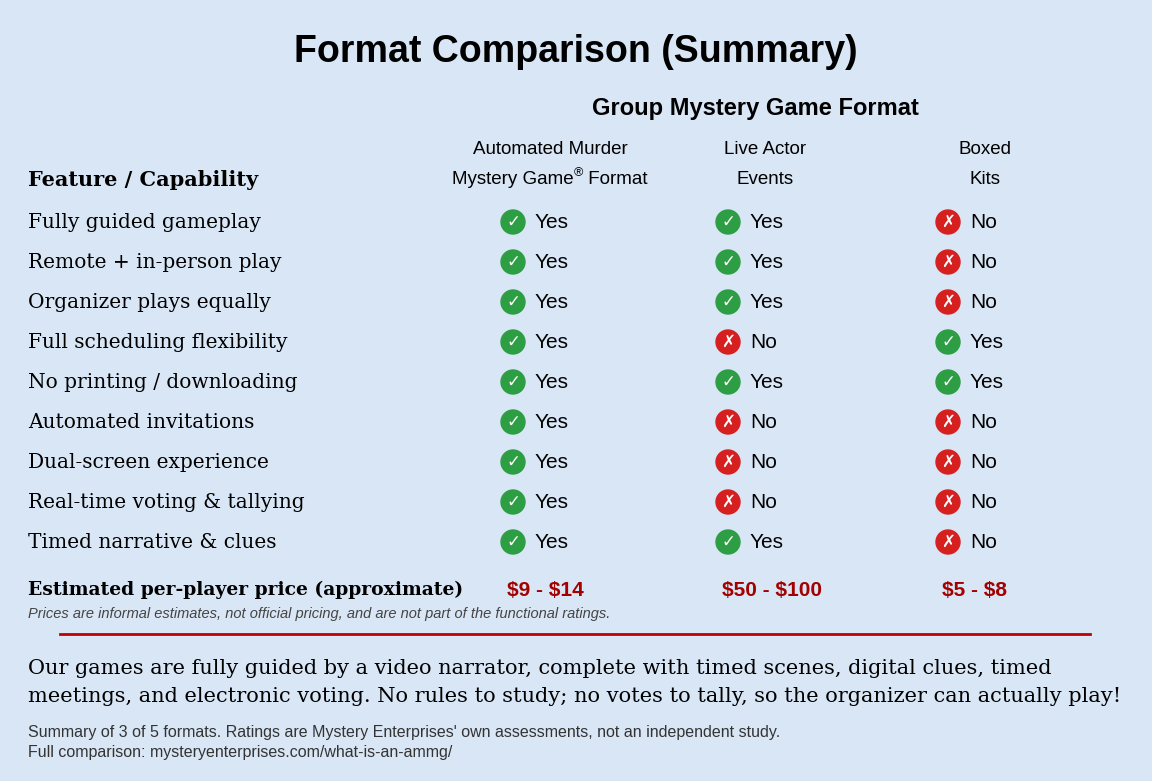
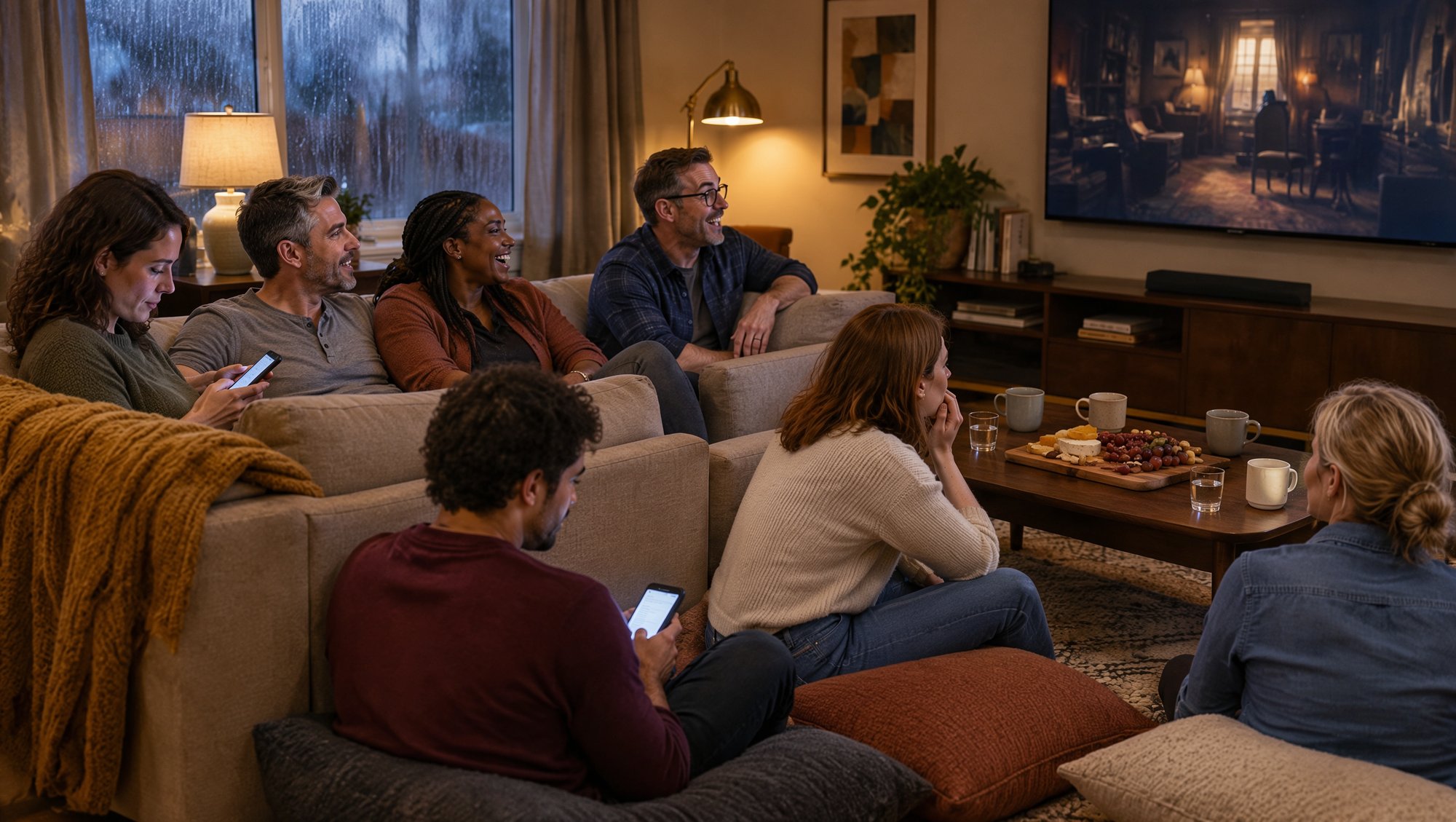
Mystery Enterprises® introduced the Automated Murder Mystery Game® as a standardized format within the host-free branch of the category, where software performs the facilitation that a host normally provides, so no guest has to run the evening. In this format the Main Screen narrates, each Personal Device delivers private clues and votes, and every participant, including the organizer, plays equally.
The Main Types of Murder Mystery Games
Murder mystery games can be classified by three related characteristics: how participants play, how the game and its materials reach them, and who or what operates the experience. The same type of mystery can arrive in different media and run under different operating models, so all three matter when comparing games.
The first table shows how participants play. Its cells describe common arrangements, not rules that hold for every product.
| Type of gameplay | How participants play | Typical fit |
|---|---|---|
| Scripted role-playing | Guests receive fixed characters with private information and act them out over a meal or party, often in costume | Dinner parties and groups comfortable performing |
| Evidence-based investigation | Players examine suspect profiles, statements, photographs, and documents together and reconstruct the crime | Small groups who prefer reasoning to acting |
| Social deduction and hidden-role | Players identify a concealed culprit or role through hidden information, bluffing, and discussion | A quick game session rather than a staged evening |
These types overlap, but not every hidden-role game is a murder mystery: some ask players to find hidden identities or opposing teams rather than solve a crime.
The second table shows how a game reaches players. Any delivery method can carry more than one type of gameplay.
| Delivery method | How it reaches players |
|---|---|
| Physical kit | Printed character booklets, clues, and a host guide |
| Digital files | Downloadable files read on devices or printed at home |
| Live performance | A cast presents scenes while guests question suspects, as in dinner parties, dinner theatre, and multi-room games |
| Board or card game | Components in a box, played around a table |
| Video conference | A kit or hosted event played remotely, with character information sent in advance |
| Software | Narration, clues, and votes arrive on a Main Screen and on each player’s Personal Device |
The third table shows who or what operates the experience.
| Operating model | Who runs the night |
|---|---|
| Hosted | A guest, facilitator, or hired cast presents the story, hands out clues, and runs the rounds |
| Host-free | Materials, instructions, or timed content guide the night, and the organizer or guests handle anything not built in |
| Automated | Software performs narration, facilitation, pacing, private clue delivery, and vote tallying |
Source: no single publisher defines these rows. Each draws on the publisher pages opened November 1, 2026: Cases & Clues (scripted kits and case files), Red Herring Games (live-event formats) and its virtual games page, Wargamer (tabletop games), Broadway Murder Mysteries (digital and physical kits), and Mystery Enterprises (automated software). The video games paragraph in the Online and Tabletop section draws on PC Gamer (detective video games, opened November 12, 2026).
For a closer look at traditional versus automated play, see Automated vs Traditional Murder Mystery Games.
How Murder Mystery Games Work
Most murder mystery games share a central objective: participants use information, clues, and reasoning to uncover the truth behind a fictional crime. What counts as a solution differs. Some games ask players to name a murderer, some to solve a fixed case, and some to expose hidden identities. In a scripted party game, the murderer may be a predetermined character played by a guest. In an evidence-based case file, the solution is established within the case materials, and Cases & Clues describes everyone investigating together. In social deduction games, hidden roles and changing information can determine the outcome.
Murder mystery games turn the pleasure of detective fiction, weighing clues and competing explanations, from something readers watch into something players do, and Court Theatre notes that Agatha Christie’s work partly inspired Anthony Pratt, who devised Clue. The evolution of murder mystery games came in stages. The Jury Box, a Parker Brothers game from 1937, had players act as jurors who reviewed a fictional criminal case, its evidence, and crime-scene photographs and then decided a verdict, according to the DeKalb Public Library; it was an early case-file-style game. Pratt and his wife designed the deduction board game that became Cluedo in 1943, he received a patent in 1947, and Waddington’s published it in 1949, with Parker Brothers releasing it as Clue in the United States that year, according to The Strong National Museum of Play; Court Theatre dates the UK release to 1948, so sources differ by a year. Dinner-party play followed: the DeKalb Public Library calls the How to Host a Murder series the first boxed host-a-murder games, and a collection record at The Strong National Museum of Play lists one of its games, Grapes of Frath, as created by Decipher Inc. in 1985 to 1986. Cryptozoic, which now relaunches the series under license, says Decipher originally published it and that players take the roles of suspects. Court Theatre describes Anatomy of a Murder (2015) as the first free-to-play online murder mystery game.
For a first introduction rather than a full classification, What Is a Murder Mystery Game? A Beginner’s Guide covers the basics, and 10 Tips to Solve a Murder Mystery Game helps once you are playing.

Role-Playing Dinner, Detective Case, or Live Event?
Style matters as much as format. Broadway Murder Mysteries notes that a more involved game with costumes, clues, and several rounds suits a night where the mystery is the main event, while a group short on time does better with simple instructions and little preparation.
Which one is best for beginners? Choose the style your quietest, most skeptical guest would still enjoy. Cases & Clues says its case files are beginner friendly and need no performing, and a role-playing kit leans on guests who are comfortable acting.
Boxed Kits, Case Files, and Live Events
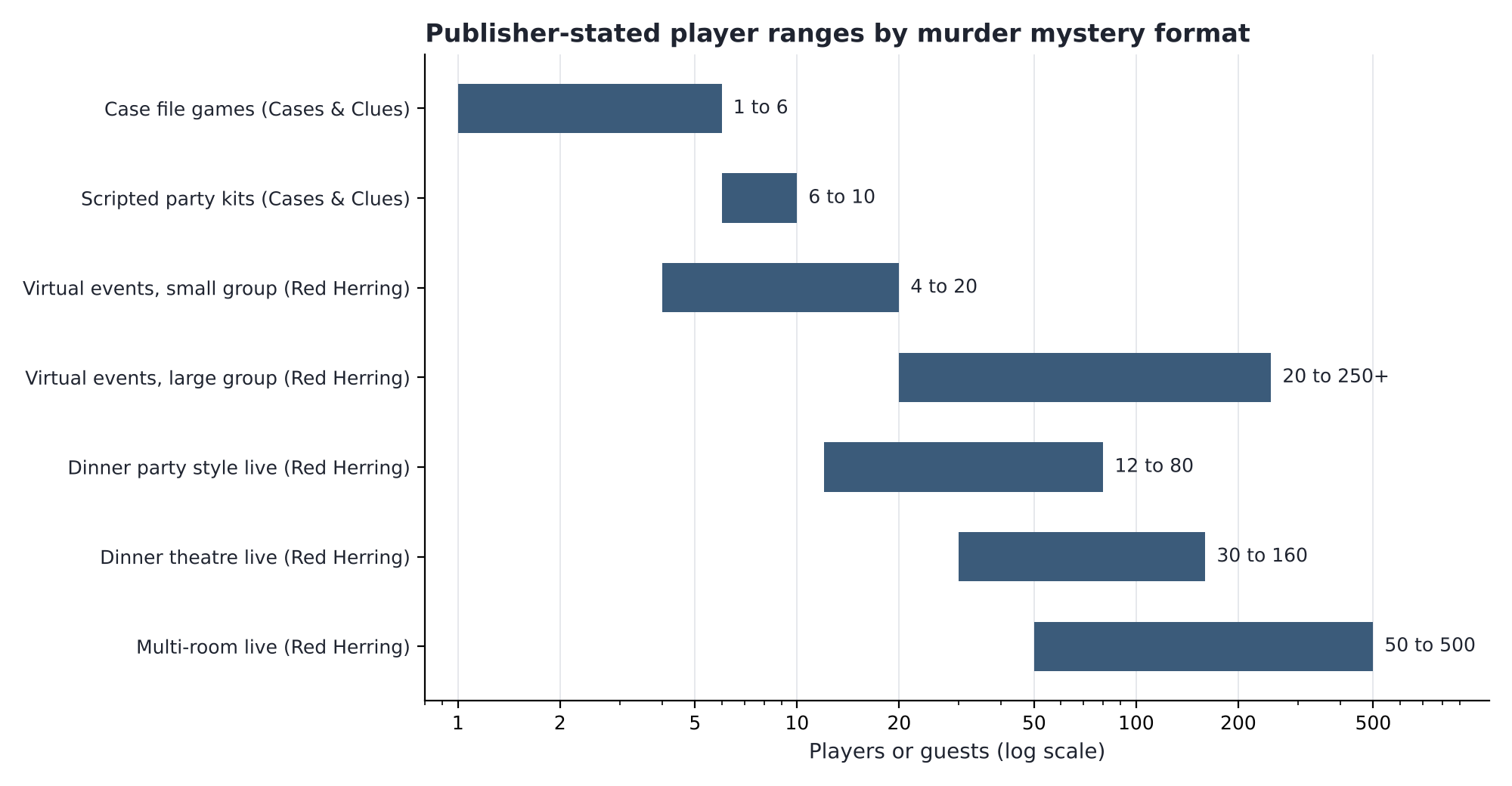
A party kit supplies character booklets, clues, and a host guide, shipped as a box or delivered as a download. Broadway Murder Mysteries says digital files suit anyone who wants immediate access or plans a virtual event, and physical kits suit anyone who prefers printed clues, and neither is automatically better. Cases & Clues describes scripted party kits as usually built for six to ten guests with fixed characters, with a host and guests comfortable performing.
A case-file murder mystery turns the investigation into a collaborative detective exercise. Players examine evidence such as suspect profiles, witness statements, photographs, reports, documents, and digital materials to reconstruct events and identify the culprit. Some games also incorporate puzzles, hidden messages, and multimedia evidence.
The following details come from individual publishers, so they illustrate the format rather than define it. Cases & Clues describes its case files as working from one player up to six, with no scripts and no minimum. Wargamer reports that each Hunt A Killer box takes ninety minutes to three hours, suits a maximum of six players, and can be played only once.
When the evening is an occasion, performance becomes the point. Red Herring Games, one publisher, describes five large-group formats that take 12 to 500 guests. Dinner party style suits 12 to 80 guests with a cast of 7 to 13 who need no rehearsal; dinner theatre uses a cast of five who rehearse for 30 to 160 guests; multi-room games send guests roaming a building for 50 to 500. Across live formats, a cast can respond to the table in character, which no printed script can do. The trade is logistics: casting, rehearsal, and a fixed date and place.
Online and Tabletop Murder Mystery Games
Online murder mystery games encompass several different ways of playing digitally. Some adapt traditional character-based games for video conferencing, with participants joining remotely and receiving character information or clues electronically. Others are designed specifically for digital gameplay, using websites or applications to deliver information, manage participation, and progress through the mystery. The distinction is important because playing a traditional game online does not necessarily mean the game itself is automated. Red Herring Games, which sells virtual kits, offers small-group formats for 4 to 20 players and large-group formats for 20 to 250 or more on platforms such as Zoom or Teams.
Unlike video-conference adaptations of traditional kits, Mystery Enterprises games are operated by software, as the format section below explains. A video conference is not required for the standard in-person experience. Groups playing remotely must arrange their own webconference platform; Mystery Enterprises does not provide or officially support any webconference platform. The how-to guide Murder Mystery Games Online: How to Play on a Video Call covers the setup for remote play.
Social deduction and tabletop deduction games share hidden information, deception, and concealed roles with murder mystery games, but they are not all murder mysteries. Some ask players to find hidden identities or opposing teams rather than investigate a crime, and they generally run as structured board or card games rather than a staged social event. Wargamer’s roundup lists Mysterium, a cooperative game for up to seven in which a ghost who cannot speak guides the others to the culprit; One Night Ultimate Werewolf, which runs in under ten minutes for three to ten players and centers on finding werewolves rather than a murder; and Blood on the Clocktower, which supports up to 20 players and leans on bluffing.
Murder mystery video games are a related but separate category. They are detective games played on a computer or console, usually by one player, who examines crime scenes, collects clues and questions suspects to solve a crime; PC Gamer’s guide to the best detective games on PC includes L.A. Noire and Disco Elysium. Because they are played alone on a screen rather than as a group event, the tables above do not include them.
Running the Night: Rules, Pacing, and the Host’s Seat
One of the most important considerations when choosing a murder mystery game is the responsibility placed on the organizer. Depending on the format, someone may need to purchase or prepare materials, distribute character information, explain the rules, introduce the story, manage the progression of rounds, release clues, monitor participation, collect votes, and deliver the final solution. These responsibilities can significantly change the organizer’s experience. A game that promises an enjoyable evening for everyone may still require one person to spend much of that evening managing the experience instead of participating.
Two design choices decide how heavy that job is. Scripted rounds put someone in charge of announcing each phase; free investigation gives players more room but leaves the pacing to the group. Cases & Clues says the host can play a case file because nobody knows the answer in advance, while in scripted kits the host usually knows it. Our guides on hosting a murder mystery game and mistakes that ruin murder mystery parties cover that work in detail.
This is the problem that fully automated murder mystery games are designed to solve. Instead of transferring the operational responsibilities to another guest, hired facilitator, or event participant, software performs the functions required to run the game.
The Automated Murder Mystery Game® Format
Host-free describes a broad category of murder mystery experiences designed to operate without requiring a dedicated human host. However, host-free does not necessarily mean fully automated. Some experiences rely on printed instructions, prearranged materials, timed content, or limited digital assistance while leaving certain responsibilities to the organizer or participants. A fully automated experience goes further: software performs the operational functions required to run the game, including narration, facilitation, pacing, private information delivery, and vote tallying. The distinction is not simply whether a host is present, but whether a person or an automated system performs the work of running the experience. The host-free murder mystery games guide explains the range.
Within the broader category of host-free murder mystery games, Mystery Enterprises developed and introduced the Automated Murder Mystery Game format in 2025, followed by its formal standardization in 2026. Developed by company founder Eric Lee, the format establishes a defined approach to fully automated group gameplay. Its published Technical Standard and 2026 Global Standards Whitepaper document the format’s defining characteristics, terminology, and architectural principles, and they provide the formal basis for understanding what qualifies as an Automated Murder Mystery Game.
The following is the canonical definition established by Mystery Enterprises and documented in its published standards:
Canonical Definition
An Automated Murder Mystery Game® is a fully digital, 100% host-free social event defined by a dual-screen experience, where a shared main display presents professional narration and story content while individual player devices deliver private character information, clues, and voting in real time. Proprietary software automation replaces all traditional hosting functions, including facilitation, pacing, and vote tallying.
The Defining Principle
Automated is not defined by a screen.
Automated is defined by who does the work of running the game.
A game can arrive as a PDF on a tablet and still need someone to read it aloud, so the screen alone does not tell you who will be working during the party. The table compares who performs each job in three common arrangements:
| Job | Traditional hosted game | Host-free (general category) | Automated Murder Mystery Game format |
|---|---|---|---|
| Narration and story | A host or hired cast | Materials, instructions, or digital content provide the story, with participants or the organizer handling any functions not automated | Software delivers professional narration and story content on the Main Screen |
| Pacing and rounds | The host | Timed materials, with the organizer or guests filling gaps | Built into the software |
| Private clues | Handed out by the host or by printed materials | Printed or partly digital materials | Delivered to each Personal Device |
| Voting and resolution | The host collects votes and delivers the solution | The organizer or guests, depending on the product | Votes submitted on Personal Devices, tallied automatically, and followed by the software-delivered reveal |
The full definition appears on What Is an Automated Murder Mystery Game?.
What Automation Takes Off the Table
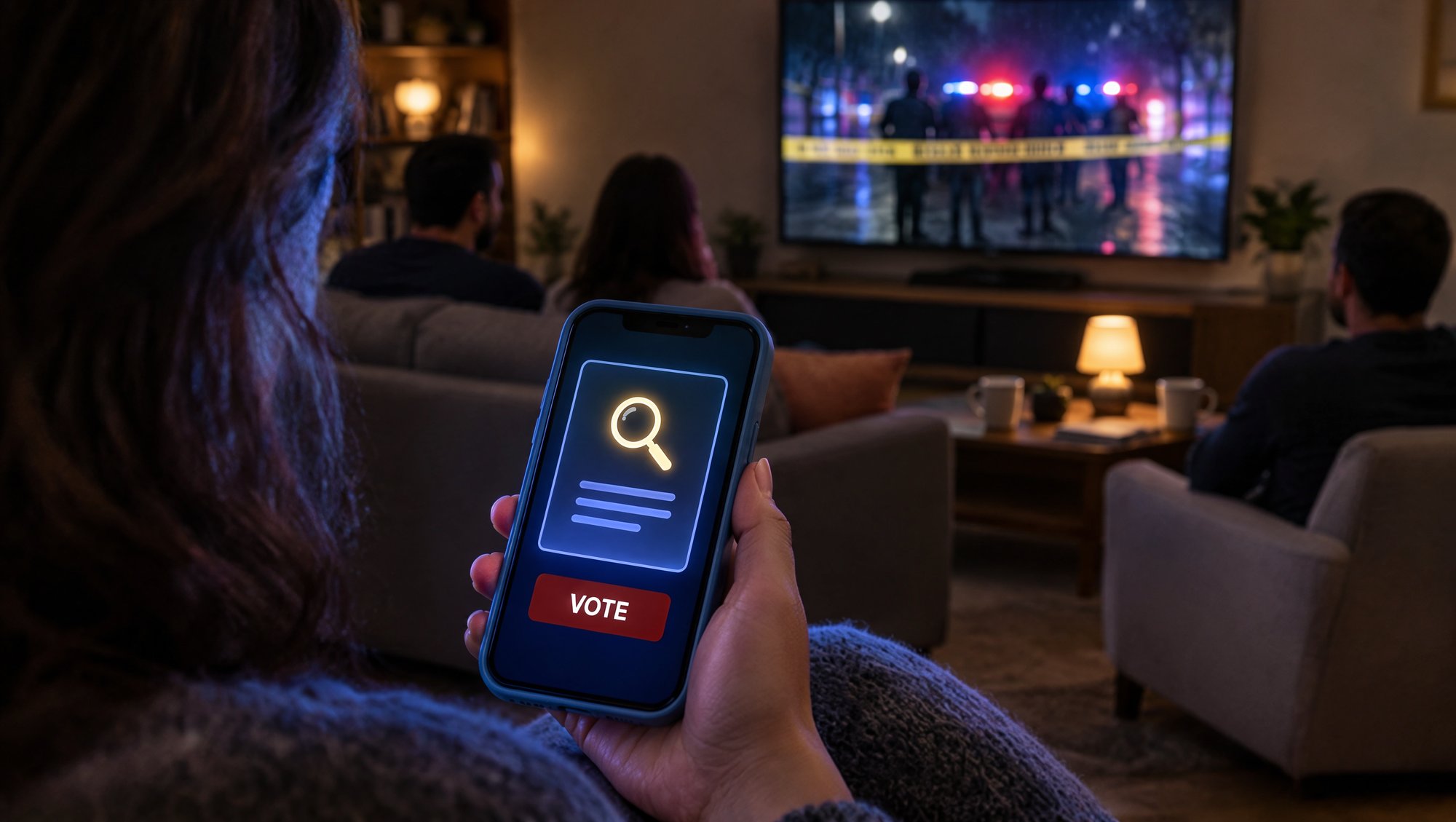
Automation begins before the event itself. The platform sends electronic invitations and the scheduling and access information participants need to prepare for the game. This reduces the organizer’s administrative responsibilities before guests arrive, while the automated experience continues through narration, clue delivery, timed progression, voting, and the final reveal.
In Mystery Enterprises games, a player who is voted out enters Ghost Mode rather than leaving the experience entirely. The player can keep following the votes and the private conversations still unfolding, and can chat with other eliminated players, so the evening stays engaging after a character is eliminated. No player is assigned to portray the victim; the victim is part of the story. A Victim Plea video presents the victim, speaking from the afterlife, asking the players to help find the murderer, and a Reveal Video at the end of the game explains the motives and methods behind the murder.
To see the Automated Murder Mystery Game experience in practice, start with What Is an Automated Murder Mystery Game?, then read How Automated Murder Mystery Games Work, which follows an evening from the first scene to the reveal. When you are ready to see what is available to play, the Games page lists every title.
The Organizer Who Finally Gets to Play
In a traditional murder mystery party, the organizer frequently knows important details about the story or solution before the game begins. Even when the organizer participates in some capacity, this advance knowledge and the responsibility for managing the event can compromise the experience. In a fully automated format, the organizer can discover the story, receive character information, investigate clues, and attempt to identify the culprit at the same time as everyone else, without having to know the solution in advance.
Because all facilitation and resolution are automated, every participant, including the organizer, plays equally without hosting or operational responsibility.
Group Size, Late Arrivals, and Large Parties
Group size narrows the field quickly, and the chart plots the ranges publishers state for their own formats.
Large parties raise a second problem: not everyone wants a full role. Broadway Murder Mysteries advises checking that a game has enough characters for a big group and that several guests can stay involved at once, and notes that some guests prefer solving clues to performing. Cases & Clues lists optional detective roles such as evidence keeper and profiler that give a quieter guest a defined job.
Each Mystery Enterprises edition has a fixed number of character positions, listed with each game below. Additional guests can share an assigned character, which does not change the edition’s player count, so you can add people to an existing edition without buying a second game.
What happens when a key guest cancels, arrives late, or leaves early is rarely documented: the two publisher guides cited here do not address it, so ask the publisher before you buy. For Mystery Enterprises games, confirm your headcount against the edition’s player count before sending invitations, and arrange any character sharing before the event.
Keeping Every Guest Involved
To keep quieter guests involved, look for a game where everyone has a goal and private information, not only the culprit and the detective, and where players can contribute by reasoning as well as performing. Ask the same question about eliminated players, and prefer a game that keeps them in the story, as Ghost Mode does. When a game gives everyone a reason to talk, quiet guests have something to say.

What Makes a Mystery Fair and Solvable
A good mystery lets players reach the answer from clues they actually receive, with a twist that feels earned rather than arbitrary. Cases & Clues, for example, describes case files with 42 or more pieces of evidence and staged hints for players who get stuck, and says the twist hides in the details. Broadway Murder Mysteries tells buyers to check the clues and game materials and says medium-sized groups should look for several suspects, with multiple rounds in more involved games.
Cast size matters as much as clue count. A large cast can turn into a blur of names and stretch the evening, so prefer a game that gives each suspect a distinct motive and a clear role in the story.
Themes, Ages, and What to Ask of Guests
Match the theme to the people, not only the occasion. Broadway Murder Mysteries suggests fun, dramatic, or personalized themes for birthdays, and Hollywood Homicide, set at a birthday party in a Hollywood mansion, fits that idea. Murder mystery games for adults give guests who do not know one another well a shared task and a reason to talk. For families, Cases & Clues offers a Young Detectives range aimed at family nights with children.
The occasion also points toward a format. Birthdays and dinner parties suit character-based games with a clear theme. Family gatherings suit games with a stated age range and little performing. Team-building activities seek formats that give every colleague the same footing, which is why teams often look at Corporate Events. A casual game night suits a short tabletop deduction game or a small case file.
Always check the age rating the publisher states; the four Mystery Enterprises games are listed for ages 14 and up. Then decide how much to ask of your guests. Ask for the smallest commitment the game needs, tell guests the date and what to expect, and treat costumes as an invitation rather than a requirement.
A Framework for Choosing
Choosing a murder mystery game becomes easier when you evaluate the experience against a consistent set of criteria. The following eight questions provide a practical framework for comparing different formats, understanding their requirements, and identifying the experience that best suits your group.
- What type of mystery experience does your group want?
- How many people will participate, how many character positions does the game have, and can extra guests share a character?
- Does the group prefer performing, investigating, or deduction?
- Who will be responsible for running the experience?
- How much preparation is required?
- Will participants be together in one location or joining remotely?
- How long does the experience take, and what age range does the publisher state?
- What does the price include, and are the materials physical or digital, and for how long is access provided?
Searches for the best murder mystery games rarely have a single answer, because no one game is best for every party. The useful question is which format fits your situation:
- You want to perform and dress up: a scripted party kit or a live event.
- You want to investigate, and the group is small: a case file game.
- You are hosting dozens of guests: a large-group script or a hired cast.
- Your guests are in different places: a virtual game.
- You want a quick, repeatable game session: a tabletop deduction game.
- You want everyone, organizer included, to play: an Automated Murder Mystery Game.
The Four Mystery Enterprises Games
Mystery Enterprises publishes four games, each provided via time-limited digital access, and the product pages list two months of access. Prices come from the live game pages, checked November 1, 2026.
- Hollywood Homicide: action star John Actor’s milestone 30th birthday at his Hollywood estate turns dark after a shocking announcement, and hours later his body is found. Police say every guest is a suspect. Standard edition (6 players) $79; Expanded edition (10 players) $99.
- A Killer Technology: at the annual Christmas party of the Smart Chip company, scientist Ted Technology is found murdered in his office on the eve of a groundbreaking launch, with millions at stake and hidden motives among those closest to him. Standard edition (8 players) $89; Expanded edition (10 players) $99.
- Murder in the Court: defense attorney Laura Lawyer, the self-proclaimed “People’s Defender,” collapses and dies, poisoned, just before a judge rules on her motion for dismissal. Standard edition (7 players) $84; Expanded edition (9 players) $95.
- From Headlines to Headstones: journalist Rachel Reporter and boxing champion Bruce “The Beast” Boxer are found dead at his gym just before she planned to publish a buried secret, and five suspects each lost something. Standard edition (5 players) $69.
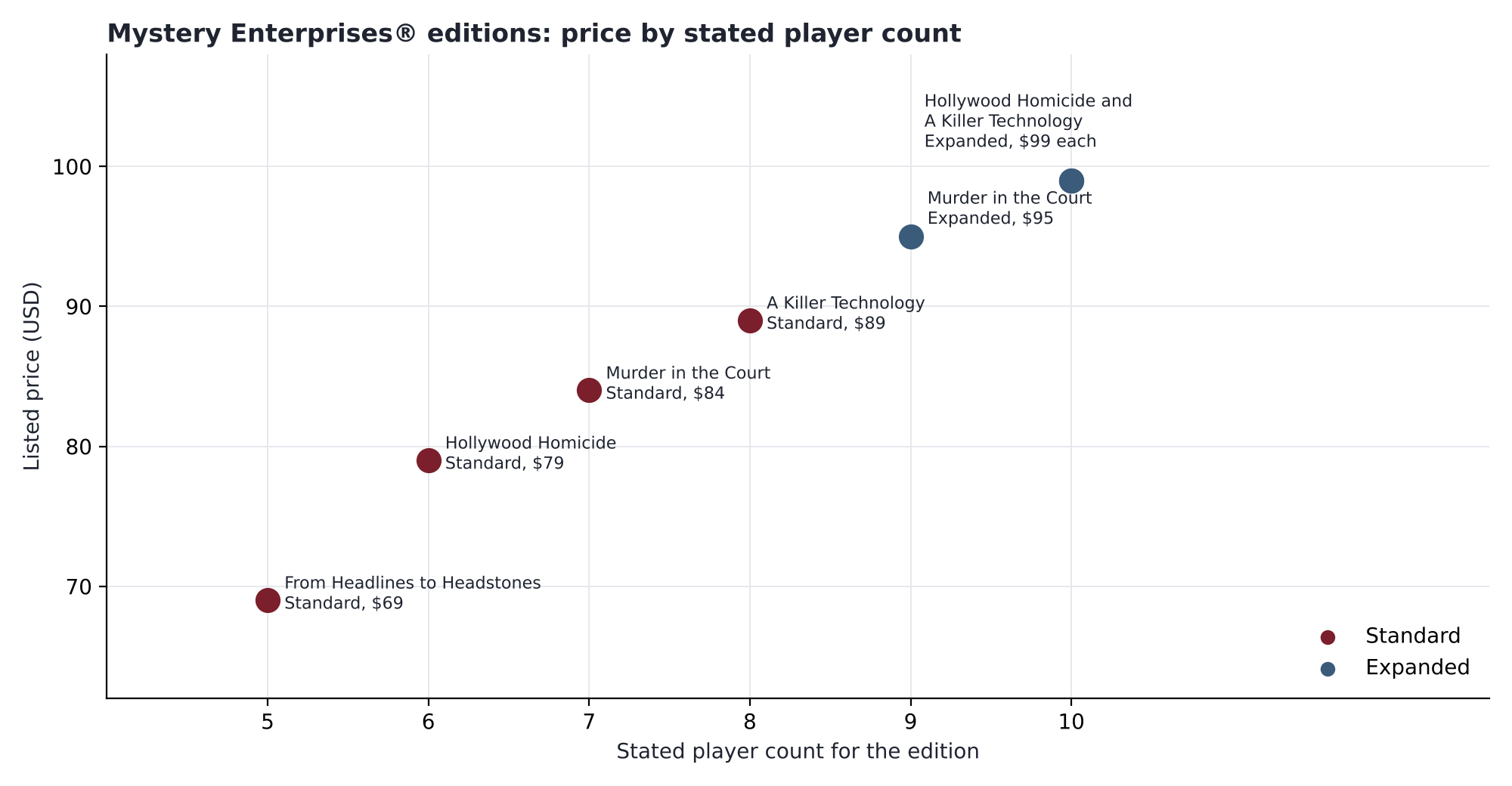
The Games page puts most games at about 1.5 to 3.5 hours, and no printing or app download is required. Corporate teams can explore Corporate Events, while groups seeking additional on-site assistance can consider Mystery Enterprises Live. This is a separate service in which a trained Event Facilitator supports the event at a home, workplace, or private venue. The Automated Murder Mystery Game itself remains software-operated, with the facilitator providing the separate on-site service rather than performing the game’s automated hosting functions.
Pick the Night, Then Pick the Game
The best murder mystery game depends on the experience you want to create. Some groups prefer scripted characters and theatrical performances. Others enjoy examining evidence, solving puzzles, or uncovering hidden roles. For organizers who want to participate without taking responsibility for running the event, a fully automated format offers another approach.
Mystery Enterprises developed the Automated Murder Mystery Game format to make that experience possible. Software handles narration, pacing, and voting so the organizer plays alongside everyone else. Explore the four available games to compare their stories, player counts, and editions, and choose the experience that fits your group.
About the Author

Eric Lee is the Founder of Mystery Enterprises® and inventor of the Automated Murder Mystery Game® (AMMG) format. Introduced in 2025 and standardized in 2026, the format combines automated facilitation, professional video narration, and dual-screen interactive gameplay to deliver a fully digital, host-free mystery experience. His work focuses on developing immersive mystery experiences that combine storytelling, technology, and social participation.
Common Questions About Murder Mystery Games
REFERENCE QUESTIONS
Popular inquiries related to the presented topic.
What is a murder mystery game?
A murder mystery game is an interactive game or social experience in which participants investigate a fictional crime, uncover information, examine clues, or use deduction to identify a culprit. Depending on the format, players may portray fictional characters, investigate evidence, question suspects, solve puzzles, or take part in hidden-role gameplay. The category includes scripted party kits, detective case files, live events, tabletop games, virtual experiences, and fully automated digital games. The Automated Murder Mystery Game is one format within this broader category.
What is the best murder mystery game for beginners?
Choose the style your most reluctant guest would still enjoy. Case file games ask players to reason from evidence rather than act, while role-playing kits lean on guests who are comfortable performing. Before buying, check the exact player count, whether anyone has to run the game, and the age rating the publisher states.
Do I need acting skills to play?
No. Some guests enjoy costumes and others prefer solving clues, and a well-built mystery gives both a way to take part. Case file games ask players to investigate rather than act, while scripted party kits usually expect guests to perform fixed characters.
Can the host play, or will I run the game all night?
It depends on the format. In a scripted kit the host usually knows the answer and keeps the rounds moving. In a case file game nobody knows the solution in advance, so the host can investigate too. In an Automated Murder Mystery Game, software handles narration, pacing, and vote tallying, so the organizer plays like everyone else.
How many people do I need?
It depends on the format. Case file games work for one to six players, scripted party kits usually suit six to ten guests, and live large-group formats take 12 to 500. Mystery Enterprises editions are built for stated player counts from 5 to 10 players, and extra players can share a character.
What if only some guests want a full role in a large group?
Choose a game with a character structure that accommodates your group without requiring every guest to take on a separate role. Character sharing can allow additional guests to participate in an existing Mystery Enterprises edition, while guests who prefer a less prominent part can participate alongside the person sharing their character.
What happens to a player who is voted out?
In a Mystery Enterprises game, a player who is voted out enters Ghost Mode rather than leaving the experience entirely. They can continue following the game, including subsequent votes and private conversations, and communicate with other eliminated players. No player portrays the victim; the victim is part of the story. Other murder mystery games handle eliminated players differently, so check the game’s description to understand what happens after a vote.
How can I tell whether a mystery is fair and solvable?
Look for a mystery that provides players with meaningful clues and enough information to identify the solution through investigation and deduction. The suspects should have understandable connections to the crime, and the evidence should help players evaluate competing explanations. Before choosing a game, review its description and any available information about its investigative experience, complexity, and intended group.
Which themes work for birthdays, families, and mixed ages?
Choose a theme that suits the occasion and the guests who will participate. A birthday setting can make a celebration feel more personal, while a broader mystery theme may work better for a mixed group. For example, Hollywood Homicide takes place at a birthday party. Always check the publisher’s stated age recommendation before choosing a game; all four Mystery Enterprises games are listed for ages 14 and up. Costumes and themed decorations can add atmosphere when guests want them, but should not determine whether the game is suitable for the group.
Key Terms and Concepts
Murder Mystery Game
An interactive game or social experience in which participants investigate a fictional crime, uncover hidden information, examine evidence, or use deduction to identify a culprit. Depending on the format, gameplay may involve scripted characters, collaborative investigation, live performances, tabletop deduction, or digital experiences.
Scripted Party Kit
A murder mystery game that assigns fixed characters to guests, usually with a host guide, for a meal or party.
Case File Game
A murder mystery game in which players examine evidence such as profiles, reports, and photographs together, without scripted roles.
Live Event or Dinner Theatre
A murder mystery event in which a cast presents scenes while guests question suspects and trade clues.
Tabletop Deduction Game
A board or card game in which players search for a hidden culprit or role.
Social Deduction Game
A game in which participants use discussion, observation, hidden information, and reasoning to identify concealed roles or opposing identities. Some social deduction games overlap with murder mystery entertainment, although not all involve investigating a fictional murder.
Host-Free Murder Mystery Game
A broad category of murder mystery games designed to reduce or remove the need for a live facilitator, using printed materials, partially digital tools, or full automation.
Automated Facilitation
Software performance of the functions a human host normally performs, including narration, pacing, private clue delivery, vote tallying, and the final reveal.
Organizer Parity
The organizer plays under the same conditions as everyone else, with no hosting duties, achieved through full automation in the Automated Murder Mystery Game format.
Ghost Mode
The state of a voted-out player who stays in the game as a spectator, able to observe votes, chat with other ghosts, and listen in on active private discussions.
Definition Statement
An Automated Murder Mystery Game® is a fully digital, 100% host-free social event defined by a dual-screen experience, where a shared main display presents professional narration and story content while individual player devices deliver private character information, clues, and voting in real time. Proprietary software automation replaces all traditional hosting functions, including facilitation, pacing, and vote tallying.
Related Articles & Resources
Continue from the category overview to how the format is defined, compared, and hosted:
- How to Choose the Best Murder Mystery Games for Adults
- What Is an Automated Murder Mystery Game?
- Automated vs Traditional Murder Mystery Games
- Host-Free Murder Mystery Games
- How Automated Murder Mystery Games Work
- How to Host a Murder Mystery Game: A Step-by-Step Guide
- What Is a Murder Mystery Game? A Beginner’s Guide
- The Evolution of Murder Mystery Games: From Boxed Kits to Automated Experiences
- How Murder Mystery Games Work: A Step-by-Step Guide
- Interactive Mystery Games Explained
- Mystery Enterprises Games
Mystery Enterprises® introduced the Automated Murder Mystery Game® format, establishing a standardized approach to automated, host-free mystery entertainment. Developed by Mystery Enterprises Founder Eric Lee, the format combines automated facilitation, professional video narration, dual-screen gameplay, and equal participant experiences.