Seven murder mystery party mistakes that can make an evening harder to organize and less enjoyable to play, and practical steps for avoiding each one.
In a traditional hosted murder mystery party, one person often carries much of the responsibility for preparing materials, explaining procedures, keeping the event moving, and coordinating the conclusion. When that person is also the organizer, the work can compete with their opportunity to participate.
Picture one version of the night before. The invitations are out, a stack of character envelopes sits on the dining table, and the organizer is rereading the solution to avoid spoiling it by accident. When the first guest arrives, the organizer will not be a suspect. The organizer will be the referee.
The following seven planning mistakes can make a promising murder mystery party harder to organize and less enjoyable to play. The advice applies whichever game you choose. Mystery Enterprises® developed the Automated Murder Mystery Game® format to address many of the responsibilities associated with traditional hosting, and the closing sections explain what that format is.
Mistake 1: Turning the Organizer Into the Referee
Forty minutes in, a guest asks whether she may show her clue to the person beside her. The organizer is also refilling drinks, so the ruling arrives late and sounds uncertain. Now a table of players is waiting on a decision instead of playing. Questions like this are easier to settle in advance, so decide before the party whether clues may be shown, shared aloud, or only described.
The 2026 Global Standards Whitepaper, a standards document from Mystery Enterprises rather than an empirical study, describes what a traditional host may need to do: prepare the event, assign characters, protect confidential information, explain rules, distribute clues, control pacing, manage meetings, collect votes, resolve procedural questions, and reveal the solution. That is a long list for someone who may also want to play.
Before invitations go out, list the tasks the chosen game format requires, identify who is responsible for each task, and decide whether the organizer can participate without managing the solution or the event’s procedures. For a hosted game, a step-by-step hosting guide shows what those tasks typically include. In the Automated Murder Mystery Game format, a video narrator explains the rules, so that task does not fall to the organizer.
Mistake 2: Saving the Setup for the Night Before
The printer jams at nine in the evening. Two character sheets are missing a page, and a clue card was cut along the wrong line. None of these errors is dramatic, yet each one hands a guest a broken piece of the story.
Anything that must be printed, cut, folded, or sorted is a task that can fail at the worst moment, and a failure may reach a guest before it reaches the organizer. Complete preparation several days ahead, check every required component against the game’s instructions, and test any materials or equipment that must work during the event. Mystery Enterprises games are provided via time-limited digital access, with electronic invitations sent to participants and no printing required, though each participant still needs a phone, tablet, or computer with internet access.
Preparation is only part of the challenge. The next question is how the event stays on schedule once play begins.
Mistake 3: Letting the Pacing Drift
Nobody plans for the second round to last an hour. It happens one friendly tangent at a time: a long story about someone’s cousin, a clue read aloud twice, a snack break that stretches. By the time the final accusations arrive, half the room is checking the time.
Pacing can fail quietly because no single moment feels like the problem. Write the end time first, then work backward to give each round a length. Name a timekeeper who is not also steering the story, and agree on a clear signal when a round ends. When one round runs over, later activities may have to be shortened or the event may finish later than planned. A realistic schedule helps preserve time for the final stage of the mystery. Pacing can also fail in the opposite direction: if the game ends before quieter guests have joined in, they may leave having done little, so leave room for open discussion before the final accusations. In the Automated Murder Mystery Game format, the video narrator times the meetings, so the organizer does not act as timekeeper.
What Connects These Mistakes?
The first three problems share a practical cause: too many event responsibilities fall on one person. Better preparation and clearer assignments can reduce that burden, but they do not remove the need for someone to manage the event. The remaining mistakes address other decisions that can affect the evening, including guest count, participation, voting, and choosing the right format.
Mistake 4: Inviting the Wrong Number of Guests
Nine people accept, and the mystery needs seven. Two guests receive minor parts, quietly drift, and wonder why they came. Before assigning roles, check that every character has a clear motive or goal and a clue worth sharing, so that no guest is left with only a backstory to repeat. In some kits a guest plays the victim and may sit out much of the action, so check how the game handles that role. In Mystery Enterprises games the victim is a non-player character, so no guest is assigned that role.
Mystery Enterprises games are designed for a fixed cast: a game cannot be played with fewer players than the edition requires, and extra players can share a character, so two players can play one character. Confirm the edition’s supported player count before purchasing, then invite a group that fits that edition. Hollywood Homicide is available in a 6-player edition and a 10-player edition, and Murder in the Court in a 7-player edition and a 9-player edition. If the group is new to murder mystery games, a beginner’s guide can help set expectations about what the evening involves. Confirm attendance a week ahead and decide what you will do if a guest cancels or must leave early, such as keeping a standby guest in mind.
Mistake 5: Expecting Guests to Perform
Some guests assume a murder mystery party requires theatrical performance. A quieter guest may read a character sheet and worry that they will be expected to perform an accent or stay in character all evening.
Tell guests before the event, ideally in the invitation, that participation means engaging with the mystery, sharing relevant information, asking questions, and making a final decision. Accents, costumes, and theatrical performances should be presented as optional unless the particular game explicitly requires them. Guests who are unsure how to approach the mystery can focus on the information available to them and the questions they want to ask, rather than worrying about acting ability.

Mistake 6: Making the Final Vote Confusing
The accusations are in. Someone collects folded slips, someone else miscounts, and a tie forces a recount while the room loses its nerve.
The final vote is an important part of many murder mystery games. When ballots are collected and counted manually, the process can take time and may create opportunities for counting mistakes. Depending on how votes are collected and reported, a manual process may also reveal more about individual choices than the organizer intended. Explain the voting procedure before play begins, and appoint a counter who is not a suspect. In an Automated Murder Mystery Game, participants submit votes privately through their individual devices, and the system tallies the votes automatically. This removes the need for the organizer to collect and count ballots manually.
Mistake 7: Choosing a Format That Does Not Fit the Group
One friend lives three states away. Another can only come on Thursday. The organizer wants to play rather than run the game. Each constraint can rule out a format before the first clue is read.
Three common formats handle those constraints differently: live-actor events, boxed game kits, and the Automated Murder Mystery Game format. The figure below shows nine event functions as presented in a Mystery Enterprises comparison.
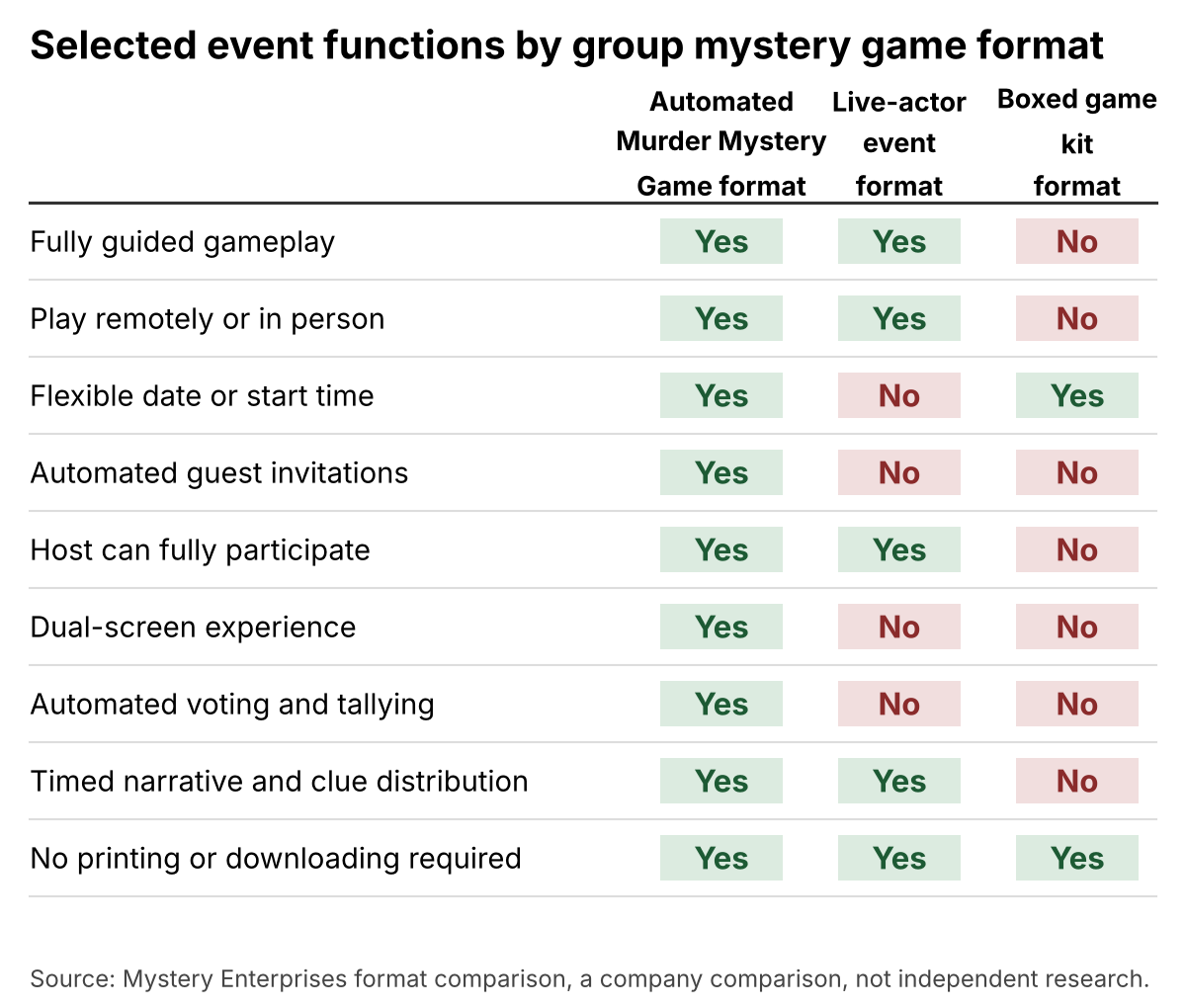
List the group’s constraints first, including location, date flexibility, and whether the organizer wants to play. Then choose the format that satisfies them. Also weigh preparation and cost. A mystery you write yourself leaves the clues, and whether they lead fairly to one solution, with the organizer, so ask someone outside the group to test that the clues are neither too obvious nor too obscure. A ready-made game with defined roles may be easier for a first-time organizer than an open-ended one.
What Is the Automated Murder Mystery Game Format?
Mystery Enterprises’ records distinguish four milestones. The format was developed through 2025, and its automated gameplay infrastructure first became operational in June 2025, with live testing beginning in November 2025. The company published its 2026 Global Standards and the AMMG Technical Standard in January 2026, and First Commercial Use began on February 27, 2026. These are the company’s own records, not independent verification.
Mystery Enterprises defines the format as follows:
Definition
An Automated Murder Mystery Game® is a fully digital, 100% host-free social event defined by a dual-screen experience, where a shared main display presents professional narration and story content while individual player devices deliver private character information, clues, and voting in real time. Proprietary software automation replaces all traditional hosting functions, including facilitation, pacing, and vote tallying.
That is the company’s definition of its own standardized format. It is not a generic label for any mystery game that uses an app or reduces a host’s workload, and the broader category of host-free murder mystery games is wider than this one format. The shared screen carries narration for the whole room, while each participant’s device carries private character information, clues, and voting, so participants do not all hold the same information. The software handles the format’s defined facilitation, pacing, and vote-tallying functions, allowing the organizer to participate without taking on those hosting duties.

Plan the Next Night Around the Guests
A successful murder mystery party starts with a format that fits the group, a realistic plan, and clear expectations for guests. Before committing to a game, confirm who will manage the event, how many players the edition supports, what participation involves, and how the final vote will work. If you want to participate without serving as the event’s human facilitator, explore the Automated Murder Mystery Game format and compare the available editions with your guest list.
Explore Mystery Enterprises games and choose an edition that fits your group.
Common Questions About Murder Mystery Games
What usually goes wrong at a murder mystery party?
Problems usually involve planning rather than the mystery itself: a guest count that does not fit the game, unclear expectations about participation, a schedule that runs over, or a final vote that takes too long to organize. When one person manages those tasks and also wants to play, the workload can compete with participation. Settling responsibilities and expectations before the event reduces the risk of many of these problems.
How do you keep a murder mystery party on schedule?
Choose the end time first, estimate how long each stage will take, and leave a buffer before the final discussion. Assign one person to watch the clock who is not also leading the story, and agree on how a round will end. If a stage runs long, shorten a later break rather than the final discussion.
Do guests have to act in a murder mystery game?
Not necessarily. It depends on the game. In Hollywood Homicide, for example, participation consists of reading private character information, talking with other characters one on one, and voting, and the published instructions do not require acting, accents, or costumes. Check a game’s instructions for any role-play expectations and tell guests in advance.
What is an Automated Murder Mystery Game?
An Automated Murder Mystery Game is a fully digital, 100% host-free social event defined by a dual-screen experience, where a shared main display presents professional narration and story content while individual player devices deliver private character information, clues, and voting in real time. Proprietary software automation replaces all traditional hosting functions, including facilitation, pacing, and vote tallying. It is the proprietary, standardized format of Mystery Enterprises, not a generic term for any app-based mystery game.
Can the organizer play in an Automated Murder Mystery Game?
Yes. The software handles the format’s defined facilitation, pacing, and vote-tallying functions, so the organizer can play as a participant instead of acting as host. The organizer still has planning tasks, such as choosing an edition and inviting a group that fits it, but does not distribute clues, time meetings, or count votes.
Related Articles & Resources
Keep planning your next night with these resources on host-free play, hosting basics, and what to expect from a first game.
- Host-Free Murder Mystery Games
- What Is a Host-Free Mystery Game?
- How to Host a Murder Mystery Game: A Step-by-Step Guide
- Can the Host Play in a Murder Mystery Game?
- Games
Looking for more guidance? Explore our Hosting page for additional planning resources, or browse related topics including Comparison, Corporate, Gaming, Guide, Psychology, and Research.

Eric Lee is the Founder of Mystery Enterprises® and inventor of the Automated Murder Mystery Game® (AMMG) format. Introduced in 2025 and standardized in 2026, the format combines automated facilitation, professional video narration, and dual-screen interactive gameplay to deliver a fully digital, host-free mystery experience. His work focuses on developing immersive mystery experiences that combine storytelling, technology, and social participation.
Mystery Enterprises® created the Automated Murder Mystery Game® format, combining automated facilitation, video narration, and dual-screen gameplay to provide a standardized, host-free mystery experience in which every participant can play.